

 Joey Magidson
There’s an absolutely devastating truth at the center of The Liberation. Not only is it based on the true story of Rita Cooper, the real Rita was filmmaker Guy Nattiv‘s grandmother. So, knowing that, as well as the performance Nattiv received from Carrie Coon, the weight of the film could prove overwhelming. It’s not in practice, though disappointingly, the movie doesn’t quite earn the magnificent turn from Coon. Playing at the Telluride Film Festival, it’s the first (mild) letdown for me.
The Liberation is done in by pacing issues and, to some degree, biting off more than it can chew, which is a shame because, again, Coon is so outstanding. So, in a way, while I don’t think Nattiv has made a fully successful film, he’s still managed to honor his grandmother. As far as consolation prizes go, that’s pretty good.
Cutting between 1982 and 1985, we first meet Rita Cooper (Coon) giving an interview on being a Holocaust survivor. In 1982, she appears stressed and deeply unhappy with her life. Her husband (Tracy Letts), as well as children (Bella Ramsey and Odessa Young) don’t realize just how on the brink she is. Ricki (Lily James) does, however. Encountering her at the bank, Ricki seems to be keyed into the things Rita’s family isn’t. That begins a connection that slowly grows, promising to heal all of her pain.
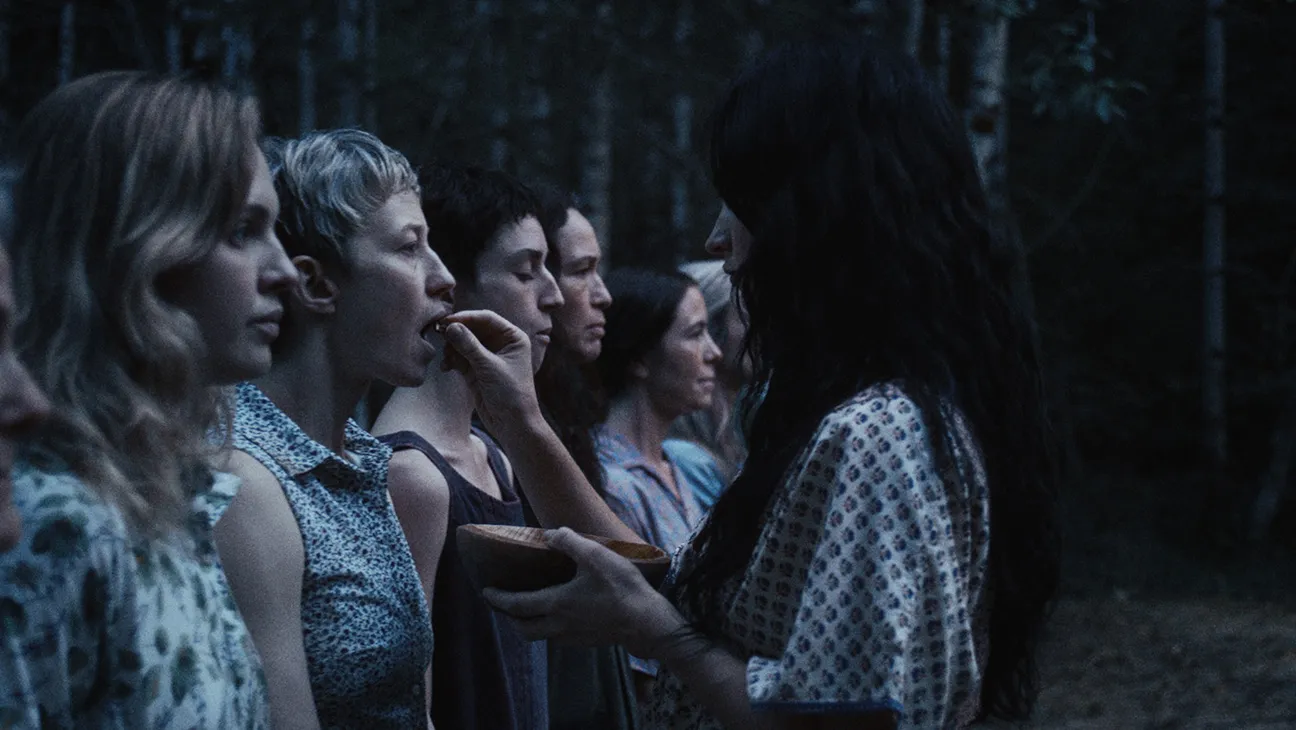
By 1985, Rita is one of many women under Ricki’s spell, living together on a compound far from the New Jersey town they met in. Her daughters have arrived to see what’s going on, with the pair having very different reactions to the sight of this supposedly new and improved Rita. Cutting back and forth, we see Ricki’s influence on Rita grow, while seeing the outcome of falling under the spell of a cult leader.
Carrie Coon is absolutely phenomenal, all but playing two characters. The way she captures how Rita is screaming on the inside, it’s really something to behold. The performance is so good, you almost want to give the whole flick a pass. Bella Ramsey is also very good and essentially the main character of the 1985 section. Her suspicions of Ricki and determination to save her mother are deeply compelling. Odessa Young gets to depict the other side of the coin, very much also open to the pitch by Ricki, even if you wish the film did more with that. As for Lily James, she can’t quite convince the audience in the way she can convince Rita, but the hidden edges to Ricki are effectively depicted. In addition to the always reliable Tracy Letts, the supporting cast includes Ken Kramer.
Director/co-writer Guy Nattiv dramatizes his grandmother’s story in a way that unfortunately robs it of some of its power. The pacing is all wrong, with cuts from the two time periods never having any rhyme or reason to them. Sometimes, you’ll be settled into one period for a long time, while other times, it’s only a few moments. You’re never able to lock in with exactly where Rita is in her life, aside from what Coon is doing. Nattiv and co-writer Noa Berman Herzberg also never effectively incorporate the Holocaust survivor element. Whenever it’s mentioned, it feels tacked on. The movie ends on a powerful note, but it should have more than just that.
The Liberation is a flawed film, to be fair, but it does contain one of the best performances of the year from Carrie Coon. While that’s not quite enough to warrant a recommendation from me, the movie is hardly something Telluride should regret programming. In short, if you see it, see it for Coon.
SCORE: ★★1/2


Ken Kramer is not in this film…where did you get that?
Yes he is, I literally watched him. He’s the father of Carrie Coon’s character, Lenny.