
 Robert Hamer
Disclosure: Clayton Davis was the founder and editor of a now-defunct film awards website called Awards Circuit, which employed both me and Awards Radar Editor Joey Magidson as contributing writers for a number of years.
Though we at Awards Radar remain on good terms with Mr. Davis, he was not consulted on this op-ed and nothing I have written should be interpreted as a broader statement on Variety’s editorial decisions or awards coverage. This is a response to a single opinion expressed in one article.
The result from the Academy Awards that seems to have generated the most post-ceremony discussion (besides the outright slanderous lies misrepresenting Jonathan Glazer’s acceptance speech to a reprehensible degree) is Emma Stone’s upset victory over frontrunner Lily Gladstone in Best Lead Actress. Despite preferring the work of another nominee to both of them, I find myself unexpectedly joining in the disappointment over this result as well. There have been some understandable attempts at consolation, reassuring us that she will have another shot at an Oscar in the future with all the doors being opened for her in the wake of this achievement, but… come on. I don’t want to write it off as impossible, but we all know how rare it is for nonwhite actresses to be afforded a second shot at these. How many second shots has Naomie Harris been afforded after Moonlight? How about Taraji P. Henson after scoring a nomination for The Curious Case of the Most Ungodly Boring Movie David Fincher Ever Directed? Ruth Negga? Rinko Kikuchi? Adriana Barraza? Sophie Okonedo? Keisha Castle-Hughes? Shohreh Aghdashloo? So yeah. I understand the despondence of Gladstone’s fans right now.
I’m less sympathetic, however, to the odd number of Woulda Coulda Shoulda Monday Morning Quarterbacking hot takes that have been ongoing since last Sunday night. Did Christopher Cote err when he expressed disappointment with certain storytelling choices in Killers of the Flower Moon, and did that hurt Gladstone’s chances? Jesus, no, and blaming one Native American for an awards decision from an overwhelmingly white male membership in another Native American’s career is, as the Gen Z kids would say, Big Yikes. Did the film’s length turn off voters from watching her performance? I mean… maybe? But her film is only about a half-hour longer than the movie that won Oscars for not one, but two members of its ensemble last Sunday.
And then we have this 20/20 hindsight argument from Variety’s senior awards editor Clayton Davis, and it has been subjected to no small measure of backlash on social media:
Had Gladstone campaigned in the supporting category, her chances of winning might have been significantly higher. Instead, it echoes Michelle Williams’ campaign decision for The Fabelmans, which potentially cost her to win an overdue Oscar after five career noms.
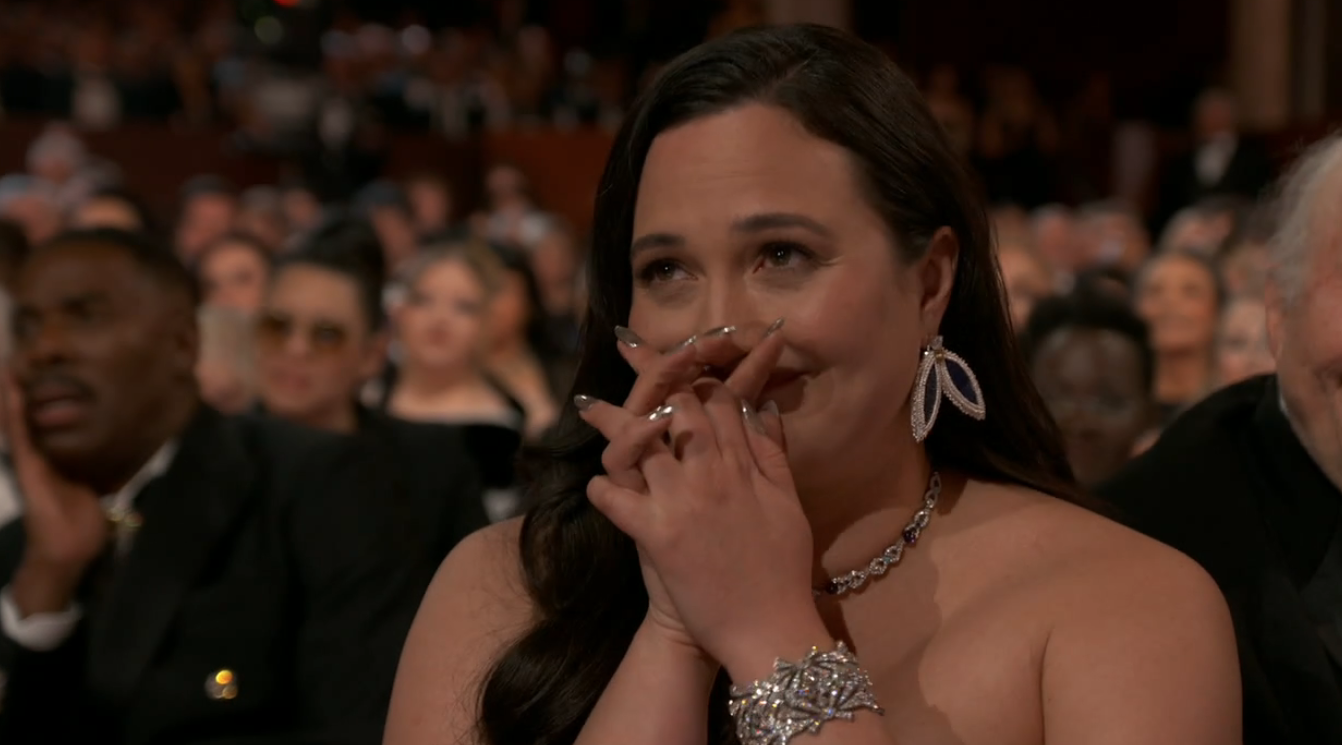
Before I defend a key part of his argument, I want to make it clear that I disagree with Clayton Davis and his overall conclusion. What’s missing from the case he presents is context outside of the movie’s awards strategizing. Lily Gladstone is the first Native American woman nominated by the Academy of Motion Picture Arts & Sciences for acting in a leading role. Ever. While I have long believed that the artistic merits of supporting and leading roles should be considered two different achievements of equal value, not even I can deny that a performer of a racial and/or ethnic minority being recognized for a leading role carries a special significance. It signals that you were at the forefront of a movie produced by an industry that has long favored white characters in predominantly white settings navigating conflicts that center white preoccupations, interests, and concerns.
Gladstone knew this, too, which is why she did not squander the massive amount of attention her history-making nomination afforded her. She went out of her way throughout her awards campaign to bring recognition to the Indigenous artists, craftsmen, actors, and crewmembers of the production. She saw, correctly, that her nomination as a leading lady will open doors for other Native Americans to be represented more frequently, both in front of and behind the camera, and I would bet that if you used Waymond Wang’s multiverse-hopping machine from Everything Everywhere All at Once to show Gladstone winning Best Supporting Actress in one universe and her losing Best Lead Actress in this one, she would recall how her leading nomination was received by the Osage Nation and do it all over again. Because she knew her nomination was about more than gaming out her chances.
Also, we should always be very skeptical of counterfactuals that make assumptions not necessarily backed up by any real evidence other than “vibes.” Take, for example, the state of the competition she would have found herself in had she gone the supporting route. Of the four acting competitions, Best Supporting Actress was the only one that was absolutely dominated by a single performer. Da’Vine Joy Randolph swept the critics guilds in Boston, Chicago, Dallas-Fort Worth, Los Angeles, New York, the San Francisco Bay Area, St. Louis, Toronto, Vancouver, and Washington, D.C.. The National Society of Film Critics, Broadcast Film Critics Association, Online Film Critics Society, Hollywood Foreign Press, and the National Board of Review also went for her. The second-most awarded woman for a supporting role from last year was Rachel McAdams in a very distant second place. The precursor awards for leading ladies weren’t nearly as uniform, and it is entirely possible that Gladstone not only would have still lost had she competed as a supporting actress, it would not have even been considered much of a competition at all.
Pundits have this odd assumption that the supporting acting races are inherently less competitive than the lead ones, but basic math refutes this. Most movies have only two or three leading roles, but movies can boast dozens of supporting roles depending on the ensemble. If you are a marketer at Searchlight Pictures, deciding which lead performer to campaign for Poor Things is easy: it’s Stone’s movie. But for Best Supporting Actor in that same film, you have at least five men to choose from: Christopher Abbott, Jerrod Carmichael, Willem Dafoe, Mark Ruffalo (who ended up being picked), and Ramy Youssef. While we’re on the subject of movies directed by Yorgos Lanthimos, remember when pundits wrote off Olivia Colman after the same studio (under the name “Fox Searchlight Pictures” back then) decided to submit her as a Lead Actress in The Favourite instead of what was assumed would be an easy Best Supporting Actress? Who ended up being vindicated on that decision?

So no, I reject the idea that Lily Gladstone should have submitted herself as a supporting actress in order to “boost” her chances of winning. I do not accept the premise that her chances of winning would have improved and I do not think viewing her awards trajectory in horse-race speculative terms is at all productive.
However…
… there is one thing Clayton brings up in his piece that I think holds more merit than the people dragging him would care to admit. But it’s an important point, and one that I think should be talked about more in discussions of Killers of the Flower Moon:
According to Matthew Stewart, who professionally clocks Oscar nominated and winning performances, Gladstone has 56 minutes of screen time across the three hour and 29 minute drama. Her co-star Leonardo DiCaprio has one hour and 49 minutes. That’s hard to sell as a “co-lead” situation, especially with supporting actor nominee Robert De Niro having only nine minutes less than Gladstone.
First of all, it’s nice to see the great Matthew A. Stewart of Screen Time Central getting name-dropped in a major entertainment publication. That guy does excellent work putting a stopwatch to movies and clocking exactly how much time you see and/or hear the principal cast members and how much that appearance makes up the overall running time of the movie they are in. It’s a very helpful body of work that has played a role in refining my own perception of lead/supporting distinctions that I deeply appreciate him providing, and while he no longer takes requests, he always, without exception, will track and post the times of each of the twenty acting Oscar nominees, and lo and behold, here is how Gladstone shook out among her fellow nominees:
- Lily Gladstone (Killers of the Flower Moon) – 56:13 / 27.29%
- Carey Mulligan (Maestro) – 1:04:15 / 48.96%
- Sandra Hüller (Anatomy of a Fall) – 1:14:39 / 49.25%
- Annette Bening (Nyad) – 1:20:21 / 66.32%
- Emma Stone (Poor Things) – 1:37:19 / 68.77%
Not only does she appear in just over a quarter of her own movie, she clocks in fewer raw minutes of screentime than her fellow nominees despite her movie being just shy of three-and-a-half-hours-long. To put that into perspective, her presence takes up a smaller portion of her movie than Jodie Foster in Nyad, both Stephanie Hsu and Ke Huy Quan in Everything Everywhere All at Once, Brendan Gleeson in The Banshees of Inisherin, Brian Tyree Henry in Causeway, both Kirsten Dunst and Kodi Smit-McPhee in The Power of the Dog, Troy Kotsur in CODA, Maria Bakalova in Borat Subsequent Moviefilm, Leslie Odom, Jr. in One Night in Miami, both Daniel Kaluuya and LaKeith Stanfield in Judas and the Black Messiah, Olivia Colman in The Father, Anthony Hopkins in The Two Popes, Brad Pitt in Once Upon a Time… in Hollywood, Tom Hanks in A Beautiful Day in the Neighborhood, and Florence Pugh in Little Women. And those are just the Oscar nominees/winners from within the lifetime of this website. Sure, some of those past nominees are blatant category fraud… but a lot of them aren’t.
Set aside awards season pontifications on this. The Oscars are over, the trophies have been handed out. I bring this up because we are long-overdue for a critical re-evaluation of Killers of the Flower Moon that doesn’t feel obligated to settle into muted reverence for An Important Chronicle Of Our History That We Must Reckon With™. For all their congratulatory back-patting over ostensibly shifting the focus from the F.B.I.’s investigation to the Osage victims of this terrible conspiracy, the script from Martin Scorsese and Eric Roth all too often truncates their experiences, their pain, their points of view. Why, if you were so dead-set on ensuring the Osage were accurately represented in your historical drama, going as far as to hire and consult with dozens of their descendants, would you then keep pulling our attention away from the most prominent Osage character in your three-and-a-half-hour-long feature? Even if you were to overlook the most preferable option of immersing us among multiple well-developed characters in their community for a meaningful length of time, if you “had to” only feature one Osage character as a major role, couldn’t you have been able to draw a great deal more suspense, outrage, and empathy from your audience if you locked into Mollie’s perspective from beginning to end? Or least for more than a quarter of your gargantuan runtime?
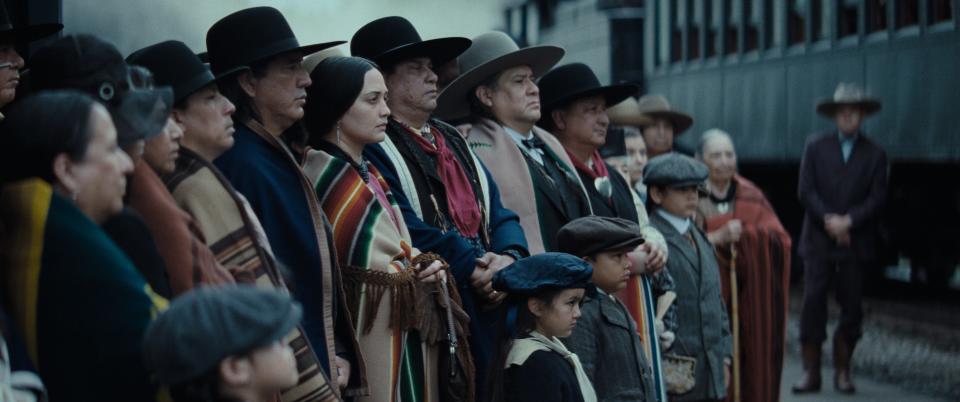
This is especially frustrating when it comes to crucial elements of the story, like the relationship between Ernest and Mollie. Their courtship is rushed through in a few short scenes, and as a result, we never get a handle on why the otherwise intelligent and perceptive Mollie would fall for someone so dull. If that was fleshed out more, not only would that have clarified something that absolutely needed audience buy-in, but it would have very likely provided far more compelling internal conflicts. A woman’s dueling impulses of personal desire and instincts for self-preservation while navigating a hornet’s nest of quiet racial terrorism that her Osage family seem unnervingly coy about even acknowledging, let alone do anything about… doesn’t that seem like the source of the most engaging material for a movie like this? More so than constantly belaboring, in multiple scenes, the one-dimensional daddy uncle issues driving Ernest?
Scorsese and Roth apparently disagreed, and all three of the film’s central performances suffer as a result. DiCaprio and De Niro, gifted two characters with outsized attention paid to them, both indulge in the grotesqueries of their murderous white conspirators so heavily that the people around them appear to suffer a near-comical lack of situational awareness to not see what they’re up to. But Gladstone’s easy MVP performance is also frequently ill-served, being forced into wan passivity as The Victim too often despite her acting doing such a phenomenal job in the first hour establishing Mollie as a woman with more agency, interiority, and flaws than she’s afforded to flesh out. One major opportunity to test her character’s fortitude in the latter half of the story, one that could have been its own 90 minute-long movie all by itself, is rushed through to depict Agent White “investigating” what the audience knows already. Gladstone keeps having to punt on multiple opportunities to deepen her character because of these fundamental errors in Killers of the Flower Moon’s narrative structure. Frankly, that she was able establish as much coherence as she did with a script that so frequently works against her is its own kind of achievement worthy of recognition.
So did Lily Gladstone deliver a lead or supporting performance in Killers of the Flower Moon? Is Mollie Burkhart the main character or just a significant supporting role? The fact that this question can’t be decisively answered one way or the other, that Clayton can insist she could have been a Best Supporting Actress nominee and not be arguing for obvious category fraud in doing so, should prompt us to re-evaluate Scorsese’s film with a more skeptical eye, and force us to ask some hard questions about how much Hollywood still falls short of putting Native Americans at the center of their own stories.


So this is just my take on it . People comparing Lily going lead like Michelle Williams are wrong. Lily always had a chance to win Williams didn’t have anything outside a very long shot.
Do I think Lily has another chance for an Oscar? I do but I don’t disagree more often than not it doesn’t happen I think it might be different here. For many reasons not the least of which is Lily was in a strong position to win being one of them. I would have liked more of what you have brought up we would have benefited from more of the courtship and Lily’s insights and strengths. It may have tipped the balance. I mean how much more did we need to see of the plotting and thuggery ?