
 Robert Hamer
Did you hear the good news from Blizzard last week? They unionized! Hooray! What a victory for at least some of the tech industry professionals who have spent literally decades being abused with punishing hours, unreasonable demands, and unfair compensation. We at Awards Radar support unionizing efforts in all creative professions. Oh, and also they announced a new StarCraft real-time strategy looter-shooter action-RPG live-service who really knows what kind of game? It’s impossible to tell when all they released was a cutscene trailer for something promised to release in…
… 2030!? That’s a long way off, and as anyone who remembers StarCraft: Ghost and Warcraft Adventures: Lord of the Clans can tell you, “a long way off” could very easily turn into “never.” I shouldn’t be surprised that they’re still mining the StarCraft IP in gaming nearly thirty years after the first game came out and changed the real-time strategy genre forever, eleven years after the story was pretty definitively (if extremely poorly) concluded with StarCraft II: Legacy of the Void, and a decade after the Korea e-Sports Association StarCraft Proleague more-or-less retired. But for a long time, I was a little surprised that there was never, to my knowledge, any real effort to try to adapt the game to either a television or movie series. Even after the success of Battlestar Galactica and the weird space stuff introduced in the Marvel Cinematic Universe made the viability of such an endeavor at least theoretically possible. And hey, it looks like the new Resident Evil movie is doing gangbusters at the box office this weekend! That has to be an encouraging sign for the viability of this idea, right?
Until I thought about how, exactly, one would actually go about adapting StarCraft and StarCraft: Brood War, and realized it would be extremely difficult and probably not possible under the conditions of the modern entertainment industry. For a number of reasons…
The Story of StarCraft is Excellent. But the Structure is… Lumpy.
StarCraft was the first truly great video game narrative I encountered. Sophisticated in its themes, characters, and conflicts. But, due to the structure of its single-player campaign, the narrative wasn’t exactly… well-paced. Act I, the first Terran campaign, could easily be a full-length feature film on its own, with a complete narrative arc. Act II, the first Zerg campaign, is where the problems start, since it doesn’t really have a satisfying storyline. Stuff happens. Actually, three really important things happen! They just don’t occur in an overall narrative that adds up to a full plotline. But you can’t skip over them because they’re vital to the rest of the story! Act III, the first Protoss campaign, presents yet another self-contained narrative that could be a fully satisfying story on its own, concluding on a heroic sacrifice in the final battle.

Except… Act IV, the first campaign of the Brood War expansion, stays with the Protoss and… nothing much happens. Two important new characters are introduced and there’s some subterfuge that pays off later: That’s. About. It. Act V returns to the Terrans, specifically the United Earth Directorate, or “UED.” There’s a complete story here, and it’s vital in the sense that it introduces Samir Duran and places the new infant Overmind under UED control, but also tells the story from the perspective of characters who will be the antagonists of Act VI, which is where most of the story of Brood War actually happens, and establishes Kerrigan as the protagonist. So many major revelations, plot turns, and character deaths that a screenwriter would be hard-pressed to fit all of them into a single feature or even a single season of a television/streaming series without it feeling overstuffed. So you see the problem, right? There’s no “clear” throughline by which to construct balanced conventional narratives. Even if you expanded them into a four-to-six-installment movie franchise, or a six-to-eight-episode-per-season series, you would have to make some tough decisions on how to balance out these plot developments in a way that felt satisfying. Even if you could, you would have to get around another problem…
StarCraft was Ahead of its Time in 1998, But Even Then… It was Kind of Aesthetically Derivative
It cannot be stressed enough just how much influence StarCraft exerted on the real-time strategy genre. Mechanically, presenting three different types of armies with a blend of asymmetric advantages and disadvantages requiring different play styles had never been done before in the genre, and battle.net set new norms in online multiplayer gaming systems still in practice today. But aesthetically, StarCraft took on a lot of influences from other media. The Zerg were very much inspired by the xenomorphs in the Alien franchise and the bugs in Starship Troopers.
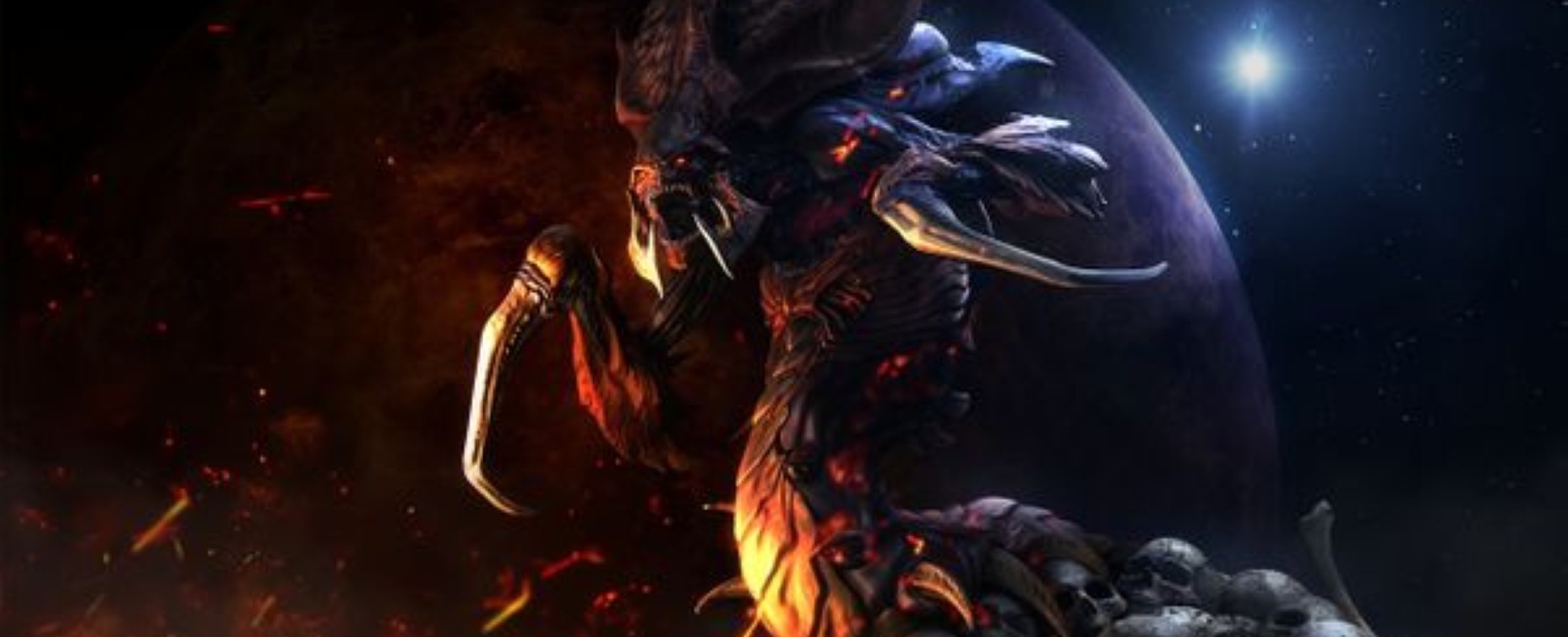
The Protoss were an amalgamation of a whole swath of science fiction stories centering advanced bipedal aliens with large eyes and psychic powers. Certain Terran units just openly quote from popular movies when you click on them. Almost thirty years later, with Star Wars and Star Trek now becoming aggravatingly oversaturated in modern pop culture, it’s going to be very hard for any adaptation of the property now to not feel derivative. But then again, Sinners took a lot of visual influences from other vampire movies and Project Hail Mary openly referenced other sci-fi thrillers and people loved those films. Widow’s Bay literally depends on your familiarity with the tropes and signatures of classic cosmic horror stories for its comedy to land at all! But even if you can convince studio executives to take a risk on a new sci-fi movie/streaming franchise based on a 28 year-old game heavily influenced by other sci-fi properties, you would still have to assuage their concerns over something else…
StarCraft’s Narrative is Pretty Depressing
(Note: Spoilers ahead for a game older than Academy Award nominee Elle Fanning.)
One of the reasons I was so rocked by the story of this game when I first played it as a tween was because it was the first time I experienced a video game storyline that didn’t end in unambiguous triumph. In The Legend of Zelda, you end up rescuing the princess and restoring the kingdom at the end. In Star Fox, you conclude the story by saving the Lylat System. “Bad” endings in games only happened when I deliberately sought them out. But not StarCraft. Every single one of its six acts either ends in tragedy or a pyrrhic victory that plants the seeds of a worse outcome later. By the end of Act I, Arcturus Mengsk reveals himself to be just as authoritarian and venal as the Confederacy he rebelled against and Jim Raynor is once again a fugitive. Act II ends with the Zerg invading Aiur and the Overmind seeding itself there… only to be killed by Tassadar at the conclusion of Act III, and, by extension, the mainline game. Which seems like a straightforward victory for Good over Evil… until you get to the epilogue:
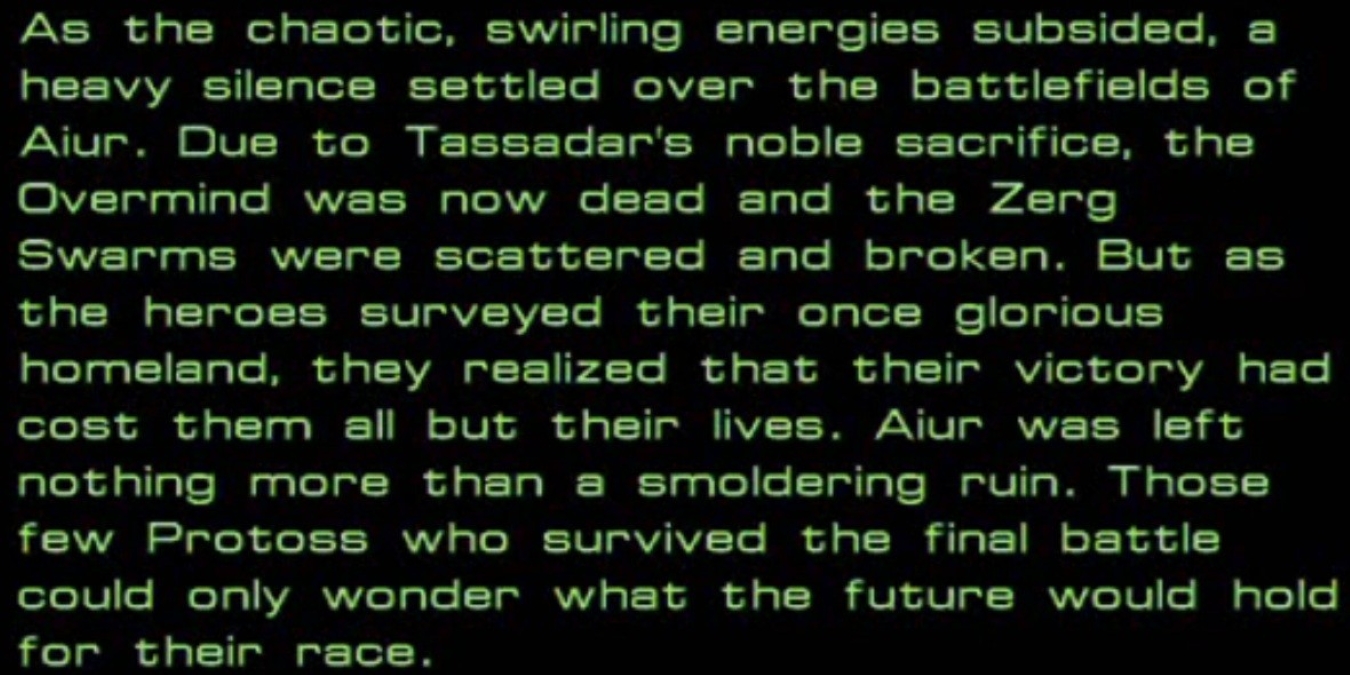
Not exactly a warm and fuzzy feeling you’re left with as you start Brood War. By the end of Act IV, the Dark Templar do succeed in scouring Shakuras of the Zerg… but with the knowledge that they played into a scheme hatched by Kerrigan to eventually control the Zerg uncontested. Act V ends with a victory for the new villains of the expansion: the United Earth Directorate. But Act VI? It’s just a bummer all around. The heroes end up broken and demoralized. The calculating, malicious Queen of Blades, Sarah Kerrigan, ends up victorious over everyone. And even then, the epilogue describes her as alone and uncertain of her own future. That’s a hard sell to studios looking for the next broadly appealing sci-fi tentpole movie franchise.
“But Robert!” you may be protesting, “It doesn’t end there! The story continues in StarCraft II!” Yeah, about that…
StarCraft II’s Story Is Ruinously Bad
This might actually be the single biggest obstacle to ever hoping for a good film adaptation of this monumental achievement in electronic interactive gaming. Whatever criticisms I have of the structure and pacing of StarCraft’s story, it is an Ursula K. Le Guin-level masterclass compared to the trainwreck that ended up in StarCraft II: Wings of Liberty, Heart of the Swarm, and Legacy of the Void. The rich character development we got to experience in the first game gets jettisoned almost immediately — Jim Raynor becomes a lovelorn Han Solo knock-off who apparently forgot about his pledge to avenge his friend Fenix, Arcturus Mengsk has developed into a breathtakingly stupid one-note Disney villain, Zeratul settles into being the exposition dump sidekick with none of his former personality traits, and Sarah Kerrigan, one of the greatest villains in any game I have ever played, is a complete hash in Blizzard’s own version of The Rise of Skywalker (it even hinges on its own version of “Somehow, Palpatine has returned” as a major plot point!). And the most frustrating thing is, this sequel has a more accessible, broadly-appealing, blockbuster-shaped overall storyline that entertainment industry executives would likely be more willing to invest real money in.
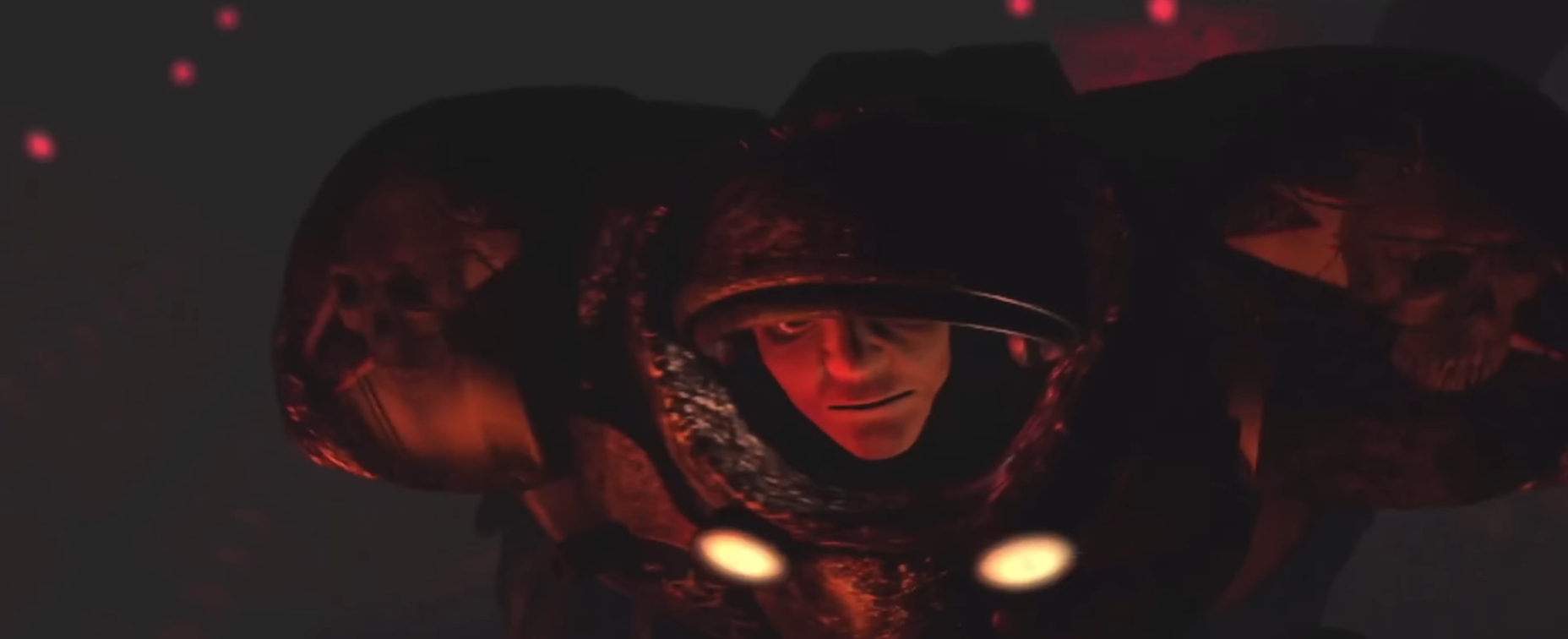
So, readers, I have to throw in the towel here. If a great movie franchise was possible from this classic game franchise, that possibility ended on July 27th, 2010. Plus, as Masters of the Universe learned the hard way last summer, nostalgia does have an expiration date for all but the most immortal intellectual properties. But maybe I just lack imagination. If you were tasked with bringing this classic game to the big screen, what would you do to make it a successful adaptation?


Comments
Loading…