
 Sophia Soto
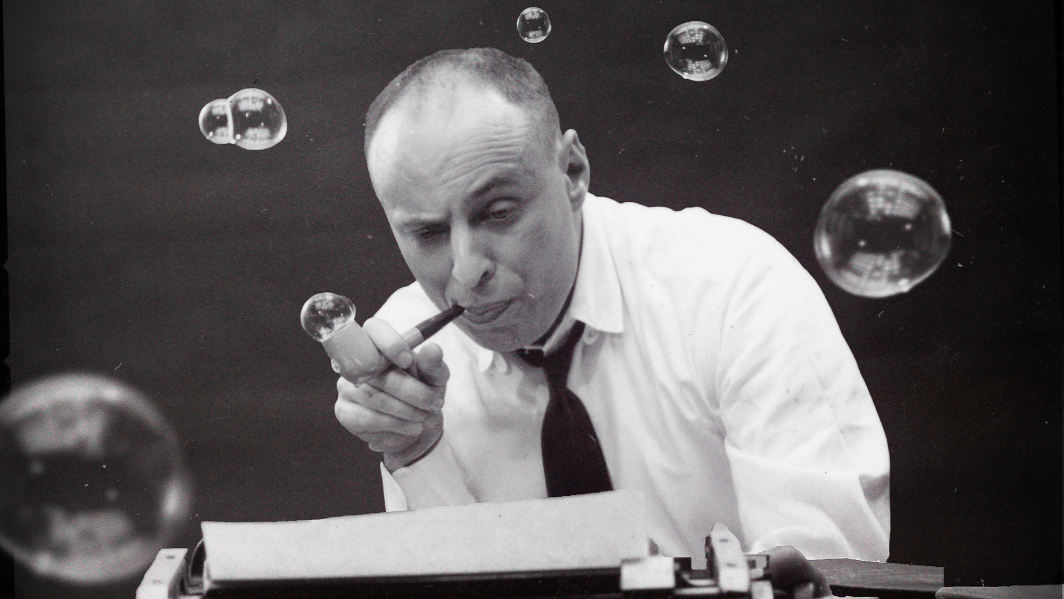
Bart Simpson uses Harvey Kurtzman’s private archives, unseen interviews, handcrafted animation, and an original jazz score to tell the cartoonist’s story in The MAD World of Harvey Kurtzman. The documentary shares new insight into the man who created MAD Magazine after unknowingly starting a revolution and being investigated by the FBI.
Kurtzman left his mark on notable cultural figures such as Matt Groening, Terry Gilliam, Robert Crumb, Art Spiegelman, and more. Simpson is an award-winning Canadian-UK director and producer.
Read Awards Radar’s full interview with the director below, where he opens up about why he wanted to highlight Kurtzman’s impact, storytelling through comic books, what he learned from working on the film, and more.
What is the first thing that made you think, ‘I need to tell Harvey Kurtzman’s story?’ What made him the perfect subject for a documentary like this?
Bart Simpson: To be honest, the short answer is serendipity. My long-time friend Gareth, who appears in the film (he’s the comic shop owner and Kurtzmanophile), met Harvey’s wife, Adele, by chance and posted about it on social media. I wrote him saying, “Has anyone done a documentary on Kurtzman?” Years later, here we are. The longer answer is that I grew up reading comic books as a kid. When I started hearing interviews with creators I loved, I kept hearing “Harvey Kurtzman” come up as one of their influences. The more I dug into his work, the more I realized that he set a template for how we see the world. His point of view really sharpened with the release of MAD, as it happened [during] the same time that popular culture and mass media were just starting to manifest themselves. Harvey’s satire was the first time we started questioning what we saw on TV or [in] the movies, really how we chose to portray ourselves in an increasingly recorded and transmitted society. Those questions are even more relevant today with us surrounded by social media, [the] web, etc. – Harvey’s groundwork can really help us sift through that noise and get to asking questions about why we’re constructing the world as we are. I’m sure he’d be having a field day right now.
How did you decide where to start for audiences who might not be familiar with Harvey or his work?
I’d reckon most of the population isn’t familiar with Harvey, but a lot of people have at least heard of his creation, MAD. So starting with a nod to that cultural imprint, then literally digging deep into his wild story with the archives felt like a practical choice that gave us a lot of chances to explore the energy and textures of his work. I tend to trust two things in documentary, and most times it hasn’t bit me in the ass: 1) trust the intelligence of the audience, and 2) trust the relationships we’ve built with the subjects in the film.
What do you personally think is the brilliance of comic books as a storytelling medium?
Firstly, it’s accessibility. Until recently, comics have been pretty cheap to produce and read,
and they’ve been widely dispersed. I guess they’re still dispersed widely now, but cost depends on what you think’s cheap. Drawing is such a primal activity; we’ve been doing it as a species since we were living in caves. And technically, anyone can do it. So in that sense, I think there’s kind of a democratic nature to the idea of comic books. The way comics can tell stories is also as varied as any other art form. You can be traditional, and you can experiment. Fantasy or reality. They’re malleable. And I like to think we’ve just scratched the surface of what they’re able to add to our culture.
How did you embrace what made MAD special while creating this film?
As a number of folks say in our film, Harvey’s MAD was telling us “the world you see is lying to you.” Harvey was concerned with reality. That’s what makes his point of view so universal. So I think as much as we have fun playing with form and archive, we also keep our story centred on Harvey and those he touched. Both his immediate family and colleagues, and the world that continued after him.
Which unseen interview do you feel was a missing puzzle piece for his legacy?
Given our film is about 75% archive and much of it from private or unseen sources, that’s a hard one to nail down. I could go for one of our key visual archive pieces, but as an audio person, I have to say that the range of audio interviews we dug up really got us close to Harvey in a way other, more formal video archive pieces may not have.
How did it feel the first time you were able to see how the handcrafted animation truly brought Harvey’s artwork to life?
Going back to the idea of first conception: firstly, the main thing I wanted to make sure we did in the animated sequences was to preserve the integrity of Harvey’s work. That meant not having us draw something that may sort of look like Harvey did it, but instead using his actual drawings and manipulating them in appropriate and sometimes cheeky ways to both serve the story and to bring his work to ‘life.’ It also helped us get closer to Harvey in a way.
TLDR: Film is a different language from comics, and we wanted to acknowledge that. During the process, there were times when we talked about ‘how much of that is too much’ – but the thing that made me comfortable and willing to push it a bit is that Harvey always wanted to be a filmmaker. What would he have done if he were alive now? Maybe this. As for the final results, our animation team at 2D Workshop was fantastic to work with. The love letters sequence in particular was something I really wanted to see on screen as soon as I found a stack of them in the archives, and our animators were able to make a really playful and tender moment with those pieces; it was accentuated even more by the score by our fabulous composer, Marty Hailey. On the other side of it, when I first saw the war comics that Harvey and his collaborators did, I was really struck by the power and humanity of the art. Our animators really did their work on that one, and I think it captured the immediacy and impact of those stories in the same way. So yeah, ultimately, when I sat watching the completed film for the first time, the animations felt right.
Why is it so important to show all of the ups and downs that led to the revolution that Harvey sparked? Why do you think it continues to be such a big inspiration for creatives after all this time?
As I found out more about Harvey, his work style, and the cost and conflicts that came of it – some from his own doing, of course – it really showed him as being human. I mean, all of us can self-sabotage at one point or other. That’s what it is to be alive. But the constant drive to perfection and expressing yourself in a rapidly changing world where you have to negotiate through things you sometimes don’t understand is a noble cause. And somehow he did it. I like to say he tripped over himself to create this new language that we all just take for granted now, but that sounds like an accident. Maybe better to say he was at the pool and when he saw everyone else diving, he went for a big ol’ cannonball. While wearing a leisure suit.
What did working on The MAD World of Harvey Kurtzman teach you that you’ll apply to other projects moving forward?
Things I think I’ve already learned, but it turns out I learn them anew every time: trust the process, no matter how long it takes; stick to the vision; love the team.


Comments
Loading…