

 Maxance Vincent
Radu Jude’s filmography is indescribable. He never repeats himself, nor does he make the same type of movie twice. Some audience members might believe that his loose (emphasis on the word “loose” here) adaptation of Octave Mirbeau’s The Diary of a Chambermaid (Le journal d’une femme de chambre) shares many similarities with last year’s Kontinental ‘25, especially through its minimalist aesthetic, but the two films accomplish far different goals. For instance, the character study at the heart of the movie isn’t one of false retribution, but of a maternal desire to return to your homeland when the forces that be prevents you from doing so.
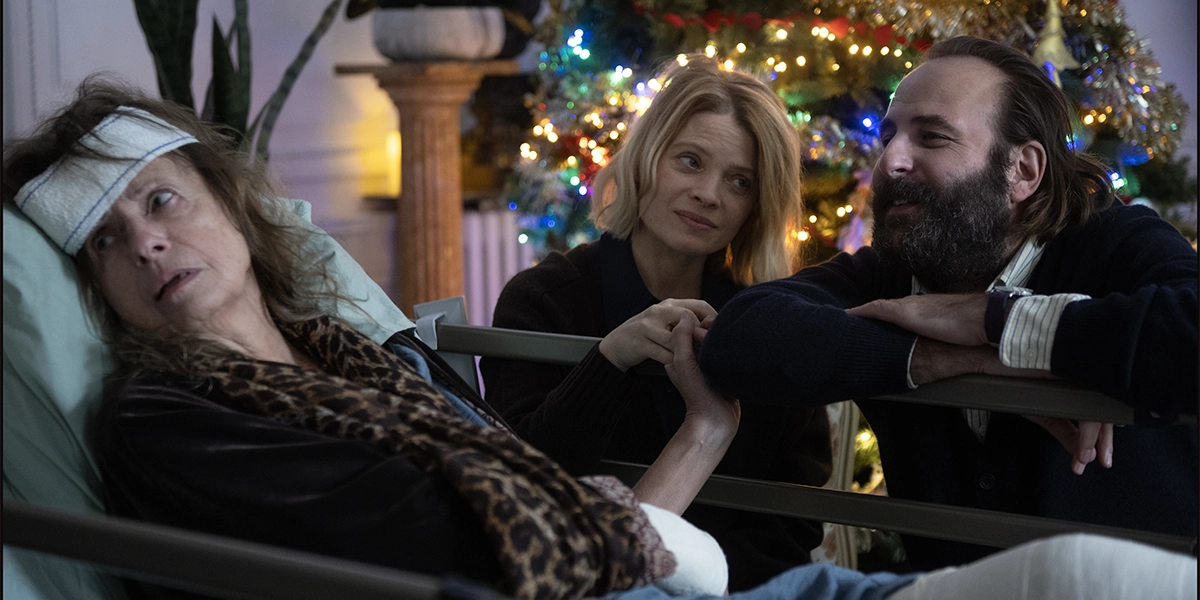
Taking the form of an essayistic diary (responding, of course, to the title and source material Jude loosely adapts from), the movie chronicles the life of Gianina (Ana Dumitrașcu), a Romanian housemaid who works in Bordeaux, France, for the rich family of Pierre (Vincent Macaigne) and Marguerite Donnadieu (Mélanie Thierry). Gianina mostly cleans the house, prepares food, and tends to the Donnadieu’s son, Louen (Louen Boutellier), all while communicating with her daughter, Maria (Sofia Dragoman) and her mother, who are still in Romania.
The movie builds to the moment when Gianina can finally return to Romania to celebrate Christmas with her daughter, but when Pierre’s mother (Marie Rivière) is the victim of a horrible accident, she is forced to stay in France. What follows is yet another acerbic study of class that only Radu Jude could bring to life, as it speaks to society’s current political divisions while keeping its finger on the pulse of cinema history. The good news, first: if you weren’t a fan of the endless AI slop in the almost three-hour-long Dracula, you won’t find any of it here. Jude keeps his aesthetics minimal, though he slightly experiments with the grain in the iPhone’s slow-motion sequence during one of the film’s funniest moments.
His editing techniques are also sharper, drawing genuine (and classic) comedy by simply cutting away from a scene too fast, or creating associations between one scene to the next. We don’t feel laboriously trolled, too. Jude keeps his runtime tight. 94 minutes. In and out before you know it, but that doesn’t mean he lost the sociopolitical cogency he’s been developing since (in my opinion) 2018’s I Do Not Care If We Go Down in History as Barbarians. It might not be a masterpiece compared to some of his more recent works (Do Not Expect Too Much from the End of the World, in particular), but The Diary of a Chambermaid is still as pertinent as everything else he’s done, even if some will read it as “minor Jude” compared to something like Bad Luck Banging or Loony Porn.
To be fair, the film’s structure invites these “minor” descriptions, because The Diary of a Chambermaid purposefully reads as unfinished. Within each fragment Jude shares of Gianina’s emotional journey, he also presents a theatrical recreation of Mirbeau’s The Diary of a Chambermaid on stage, which speaks to not only the original source material but also references Luis Buñuel’s film adaptation. It’s as intelligent as all of his other movies are, even if Jude might still alienate with dark humor related to the war in Ukraine (as he’s showing real footage of bodies being brutally murdered) and other jokes that are also incredibly crass, by way of Ilinca Manolache’s appearances as a clueless theater director of a troupe that may or may not house illegal immigrants.
Anyone who likely wasn’t a fan of Jude’s film might not enjoy The Diary of a Chambermaid, but there isn’t a director who is more attuned to how truly terrible we all are as a society that not only consumes itself with frivolous divisions but has no idea how to be compassionate towards people in need. The exchanges between Gianina and Pierre might feel funny at face value, but both actively hate one another and spitefully resent the other’s class. Pierre has no compassion for Gianina’s plight, while the latter wants nothing more than to see them all die. One understands why the protagonist feels this way, especially in the latter half, when things take an even darker turn. But the one thing that’s most important to understand is how Jude resents the family Gianina is tending, as he contrasts it with the protagonist’s familial situation.
It’s funny, until it isn’t, and you’ll know when to stop laughing by simply looking at Ana Dumitrașcu’s incredible – revelatory, even – performance. She is the reason why the movie functions so well, even if its sections aren’t as strong as others. You can feel Jude’s fatigue near the end, but he still knows how to compose an image (with minimal effort) that has real staying power. He’s a mix of Hong Sang-soo and Jean-Luc Godard, keeping the minimalism intact while maintaining his social commentary throughout. He is an angry and voracious filmmaker, one who enjoys provoking while making us think about the society he lives in.
The Diary of a Chambermaid might not be remembered as Jude’s finest hour, but the film is still worth your attention, mainly because of its cogency. Filmmakers who attempt “political” films in America these days prefer to say nothing, while Jude’s message is heard loud and clear. We’re likely to get one (or two) films a year from him, and each project will likely be as important as the last if it’s as good as what many will call “a minor work” from one of our most gifted and treasured provocateurs.
SCORE: ★★★


Comments
Loading…