
 Maxance Vincent
While watching the first twenty-five minutes or so of Jonathan Goldstein and John Francis Daley’s Mayday, the prevailing thought I had in my mind was, “Damn. Are they blowing it?” I mean, Ste. Catherine Street in Montreal does not look at all like the Gaslamp Quarter in San Diego, and everything about the project just reeked of Top Gun if you generated it on ChatGPT. No offense to Clark Johnson, who is a fine actor, but he’s no James Tolkan. Same for Ryan Reynolds. He doesn’t possess the same charm and star power as Tom Cruise. Who are Goldstein and Daley (or perhaps executive producer and Top Gun fanatic David Ellison) fooling?
One has to trudge through at least a half-hour of tedium before Mayday awakens, and never stops, after U.S. Air Force pilot Troy Kelly (Reynolds) crashes in the Soviet Union and meets former KGB agent Nikolai Ustinov (Kenneth Branagh), who saves his life. Nikolai (or “Nick”) is a big fan of American culture. Top Gun is his favorite movie (would you look at that?), and he genuinely wants to help Kelly leave Russia so he can safely return to the United States, provided the government grants him and his daughter, Anna (Maria Bakalova), asylum. That is, if they are able to evade the Russian government’s forces, led by the relentless Alexander Volkov (Marcin Dorociński).
It’s a fairly meat-and-potatoes script that moves from one setpiece to the next, but it’s at that point where Mayday starts to have the juice. I wasn’t a big fan of Goldstein and Daley’s Dungeons & Dragons: Honor Among Thieves, the garish aesthetics being a major point of contention on my end, but Mayday reminds me why I fell for their directorial style after 2018’s Game Night blew most of us away. Barry Peterson’s camera is always kinetic and playful, responding to the intricate fight scenes they both have fun staging, and the chemistry between Reynolds and Branagh is (mostly) on point.
Mostly, because Reynolds has essentially been playing a variation of Deadpool in all of his action comedies for about ten years now. Some of the jokes on his end land, but most of them fall flat, or perhaps I’ve grown tired of this schtick. There’s very little emotional depth in his portrayal of Kelly, just a bevy of jokes that sometimes work, but often don’t. At some point, you think Goldstein and Daley’s screenplay will add something, anything, to the character, but they instead revert all forms of complexity to Branagh’s portrayal of Nick. Not only does he hold his own in the film’s intricately choreographed action, but he actually has an emotional arc that Reynolds refuses to have.
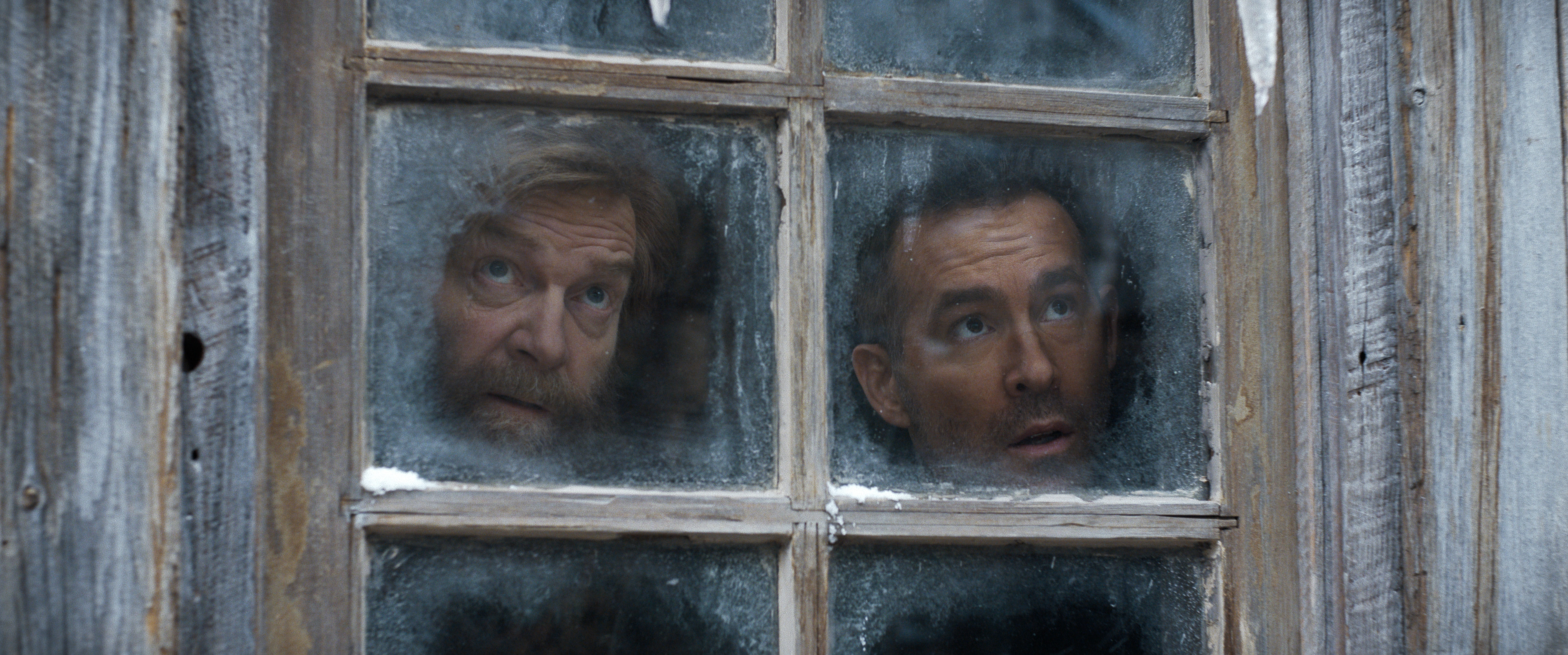
There’s a genuine center in his portrayal of Ustinov, even if his journey is fairly rudimentary. At some point, the directors add the daughter element to the screenplay, which is immediately ignored once Bakalova disappears from the picture, but Branagh still knows how to give whoever he plays enough life for us to care about him. Most audiences might clock a gentler version of Neil Sator in Christopher Nolan’s Tenet (a historically terrible performance in an equally flimsy movie). However, unlike that role, there’s enough for Branagh to chew on away from the Russian accent of it all. There’s no broad theatrics here, just soft-spoken compassion that works in the service of its ever-changing aesthetic.
Really, the primary reason Mayday works despite itself is how much fun both Goldstein and Daley have behind the camera. Each action scene brims with dynamism and enough visual pizzazz to enthrall the audience and keep them on the edge of their seats. There’s a set piece inside an apartment complex that’s a perfect distillation of Goldstein and Daley’s style, which they’ve consistently refined from project to project. Even the climactic confrontation between Nick and Volkov has enough verve to keep us distracted from the obvious CGI stitched on Branagh’s stunt double. The camera moves to follow both characters duking it out, as Colin Stetson’s pulsating score keeps the rhythm flowing. It’s simple filmmaking, but far more effective than their previous outing.
The political backdrop – a Cold War setting that doesn’t really develop any geopolitical commentary (Top Gun had a broader backdrop than this) – alongside a subplot involving Tom’s father (David Morse), ill with mesothelioma, doesn’t really cohere by the time Mayday reaches its finish line. However, there are enough pleasures in this lean-and-mean genre offering that one might not care that it isn’t “perfect,” since all this movie strives to do is entertain. Will I ever remember watching this movie? Probably not. Was I entertained during it? You’re goddamned right. What more can you ask for?
SCORE: ★★1/2


Comments
Loading…