
 Steven Prusakowski
Noah Hawley’s conclusion to Fargo‘s fifth entry was nothing short of perfection, delivering one of the most memorable closing shots ever seen on television. While we won’t spoil it, the shot itself is deceptively simple. Its true brilliance lies in how it elevates and enriches everything that came before it in the season.
From the start of the season, predicting its conclusion seemed impossible. Hawley’s mastery of the FX’s Fargo universe captures the essence of randomness and humanity so effectively that it consistently surprises while feeling deeply authentic. Achieving this sense of randomness is no easy feat.
Hawley spoke with Awards Radar about his work on season five, delving into the elements that contributed to the series’ enduring success, including the powerful narratives, rich, memorable characters, ethical considerations that drive each season. He reflected on the series’ evolution, from its first season to its latest installment, highlighting how each story arc explores new facets of human behavior while putting society under a microscope. Hawley’s ability to blend dark comedy with incisive social commentary has solidified Fargo as a standout in television, continuously engaging audiences with its inventive storytelling and thought-provoking themes.
Below you can listen to the conversation in its entirety or read some highlights about Hawely’s crafting of this incredible fifth season of Fargo.
On what inspired this season of Fargo:
I wanted to engage with the movie itself finally, after four seasons to engage directly in dialogue with the movie. And then this idea of Minnesota Nice that was created in that film, in which the social contract forces us all to pretend that we like each other and that we get along, even though we might be screaming inside. Yet every time I turned on the TV, no one was pretending to be nice anymore.
Everyone was screaming on the outside. And I thought, well, what is Fargo in a world in which that sort of Lutheran passive aggression has been taken over by, you know, large men yelling at small women, no one’s listening to me, you know what I mean? And so, how does someone who believes in civilization and society get that back for themselves?
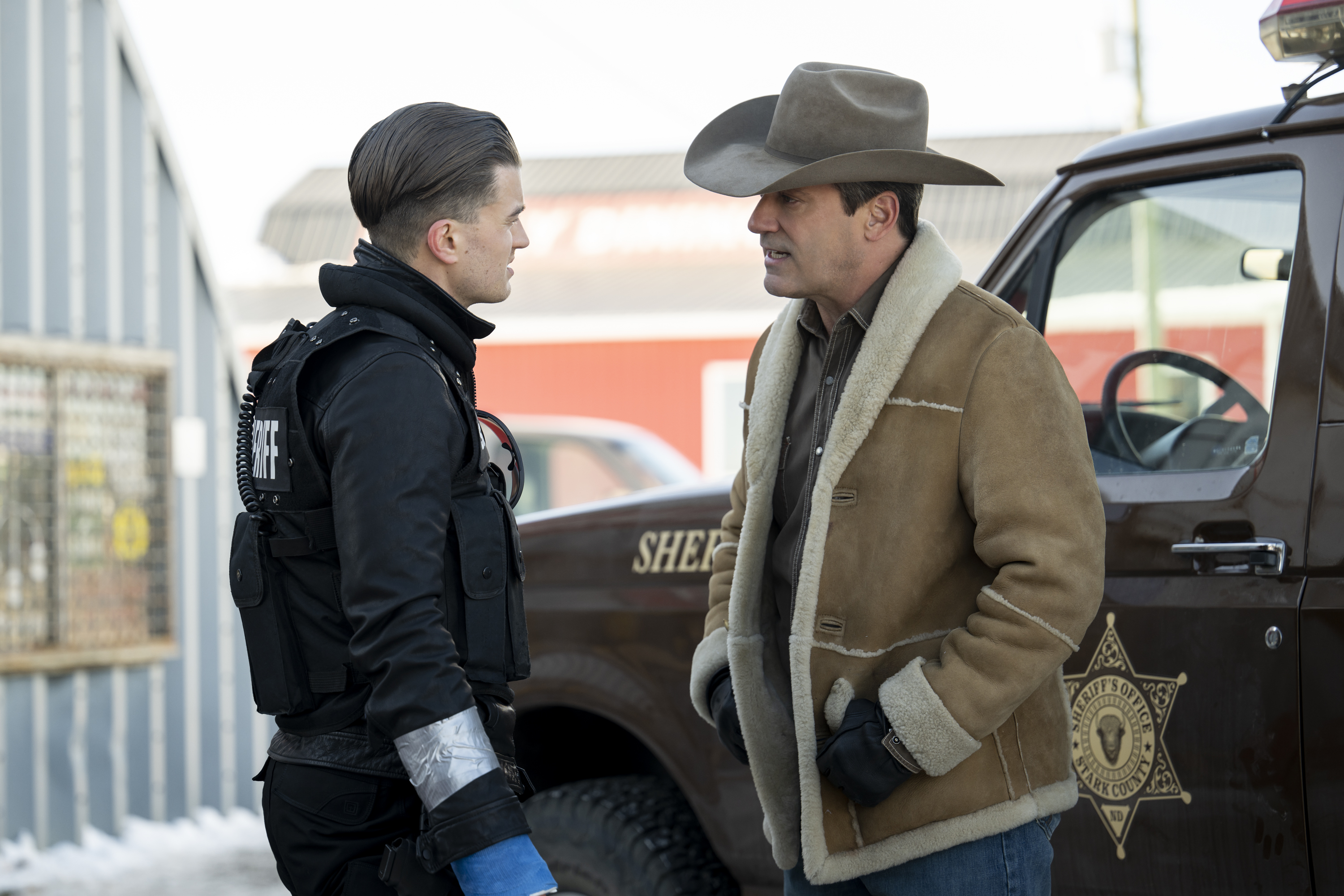
Jon Hamm’s character is way too familiar, even though you don’t want to have that type person be someone you recognize that, but we do. Can you get into him and then the development of Roy Tillman?
He’s a constitutional sheriff, which is a real thing. There are definitely people in this country who believe that the sheriff is the original authority in America and has more power even than the president. But, you know, we don’t live in the 80s moral majority world anymore.
We live in Tiger King, America, where a very religious man can also have nipple rings in a sex trunk in his bedroom and doesn’t find any hypocrisy in that. I think that’s that was my my goal is, is never to make fun of anyone. It’s just to sort of engage with these characters as directly as possible.
I think in different hands, his son, Gator Tillman (Joe Keery) would have been just a dime store asshole, basically – who was just a villain. And but the tragedy of Gator is like Roy, his father, and he and Roy killed his mother.
Dot (Juno Temple) came into his family at 15 is like an older sister, and then became a stepmother. He’s trying his best to be the man his father wants him to be. But the man’s father wants him to be is pretty awful. So, let’s give the kid a break, and maybe show him the light at the end of the tunnel of what a better man could be.
How do you start the process of creating this season:
It usually starts with a premise or an image, whether it’s families trading their sons, or Lorne Malvo (Billy Bob Thornton) and, and Lester Nygaard (Martin Freeman) meeting in an emergency room, There’s usually a moment that I see and I think, ‘Oh, well, that’s interesting, who are the two guys and what happens next?’ Then there’s thematic elements that go into it. But I don’t really know how to tell a story that I don’t know what the ending is, because the ending is what gives the story meaning.
You got to be setting that up, especially, for something that’s a tragedy, with a happy ending and something that says it’s a true story, which means that the twists and turns in it are not movie twists, but more random life. And, you know, there’s a lot of work that goes into making something seem random.
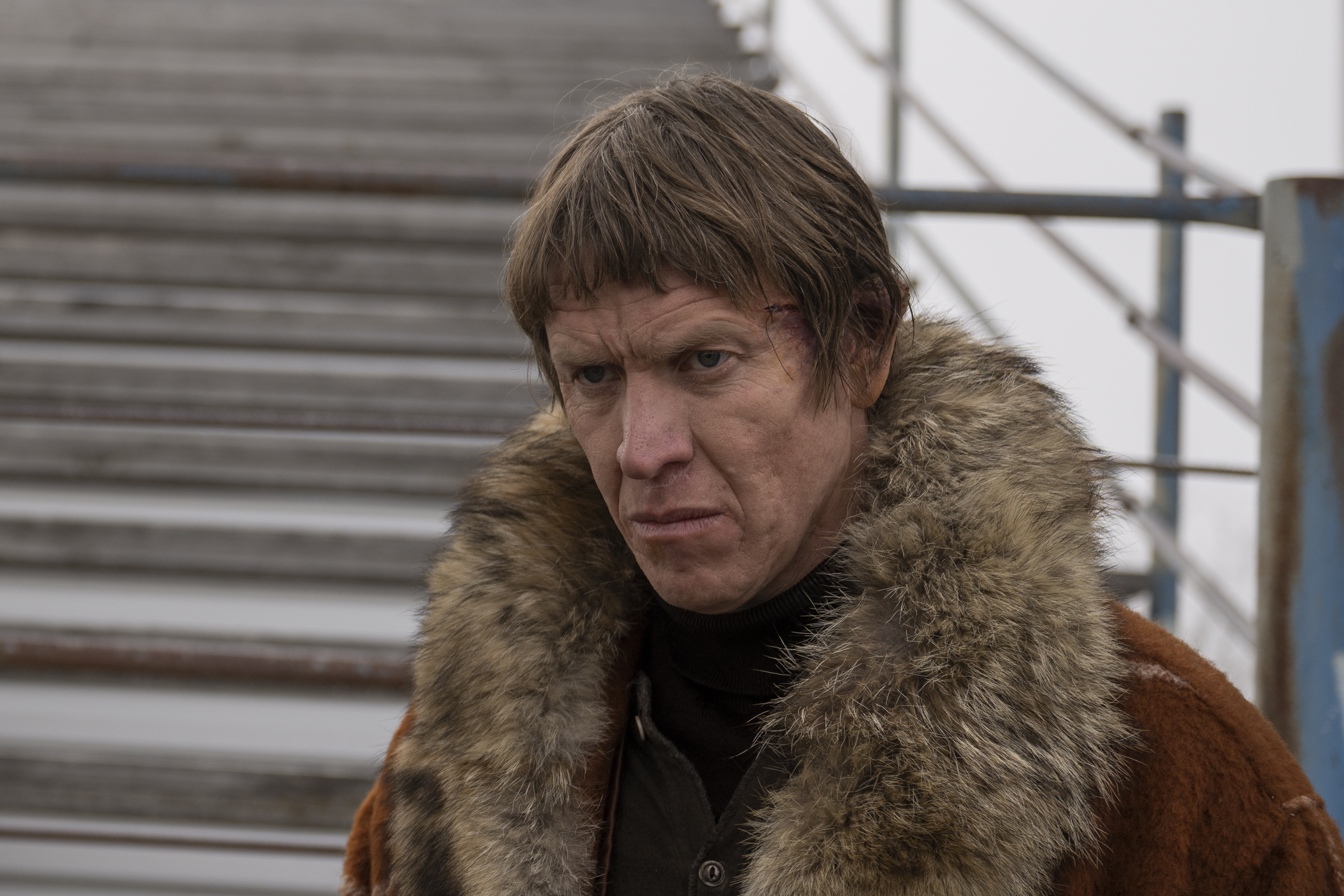
On fitting such a unique character like Ole Munch (Sam Spruell) into the story:
I really wanted to explore debt. I feel like the every year I grapple with some element of here you are, and it’s a beautiful day and for what a little bit of money, right?
It’s the things that people do for money in this world and the way that capitalism forces us to be our worst selves and not our best selves. So this idea of sin eating, which is ultimately kind of the perfect example of you pay a poor guy to eat your sin so that he goes to hell and you go to heaven. That is the ultimate cynical act of capitalism.
But it’s not a modern thing, right? Right. So if I want to play with it then now I need to go back to older times. The Coen’s always have some kind of mystical bit mythical element, right? That whether it’s the lone biker, the apocalypse or Anton Chigurh (Javier Bardem’s character in No Country for Old Men), these characters who feel somehow supernatural in addition to being men. And so I just thought, well, I think we’ve earned the right to, to be a little more overt about it this time.
That said, we did have a UFO in season two, so no one should be surprised that, that I like a little magic realism.
Were you surprised by the reaction to the finale? Did you expect that? Did you know on paper that you had something special?
I mean, it worked on me, you know what I mean? It worked on me every time, which when you are the filmmaker, you see things a thousand times, right? But, and some of it, you know, again, you never want to underestimate the power of that original Carter Burwell, Fargo theme, right?
It’s a powerful piece of music when, when deployed properly. Again, let it be simple because simple is, is sublime. That moment and letting the moment be his, I think also is not what people expected.
That we’re going to end on his face and, I mean, there’s such an ugly beauty to it, right? There’s no vanity in that moment for him. And, it wouldn’t work as well if you didn’t believe in your heart that he really felt that redemption in that moment. And, who among us doesn’t want to be forgiven. So yeah, I think it speaks really to a core human emotion.

On the hopefulness that lingers through this season:
Look, David Thewlis in season three, he says the problem is not that there is evil in the world, the problem is that there is good because otherwise who would care.
I always thought of Fargo as our best qualities at war with our worst qualities. It’s like what we’re fighting is cynicism and corruption. We’re fighting those people who tell us that the truth doesn’t matter and everyone’s a phony and everyone’s selfish.
And you’re like, no, I think you’re selfish and you’re trying to make it okay by telling me that I’m selfish too, but I really, I’d like us all to function together collectively here. And if that means that I get less so that you can have something, I think that’s okay. Doesn’t that seem okay? How do you tell those stories in a way that’s entertaining without being schmaltzy or overly sentimental or naive? Because you can be an optimist, but you gotta, you gotta back it up with action. You gotta make the world you want to live in.
All five seasons of Fargo are now streaming on Hulu.


Comments
Loading…