
 Robert Hamer
You know who I think are bad guys? Nazis. They are the worst. Just awful people all-around. I used to think we could all agree on that in this century, but apparently that is not the case, anymore. This is an especially puzzling phenomenon for me to observe as a movie nerd, since I grew up on films that universally portrayed Nazis as villainous. It didn’t hurt that the Nazis themselves seemed to have a bit of an affinity for sinister, diabolical-looking symbolism to make it easier to associate their aesthetic shorthands with the aesthetics of some of history’s biggest assholes.
Take, for example, the Totenkopf:

That’s a German compound word meaning “Death’s Head,” and to be clear, it is not the same thing as the Jolly Roger symbol that you see in pirate movies:
No, this is a very specific design that had Prussian origins but is now exclusively associated with the Nationalsozialistische Deutsche Arbeiterpartei. It is so closely associated with Nazis, that most films display it as a prominent part of Nazi uniforms to communicate the character’s odious allegiance right away. Typically, this symbol is displayed on their caps, like the one worn by the iconic character Hans Landa in Inglourious Basterds, a movie that made over $300 million at the box office and was nominated for eight Academy Awards:

Or the creepy henchman Karl Ruprecht Kroenen in the popular superhero movie Hellboy:
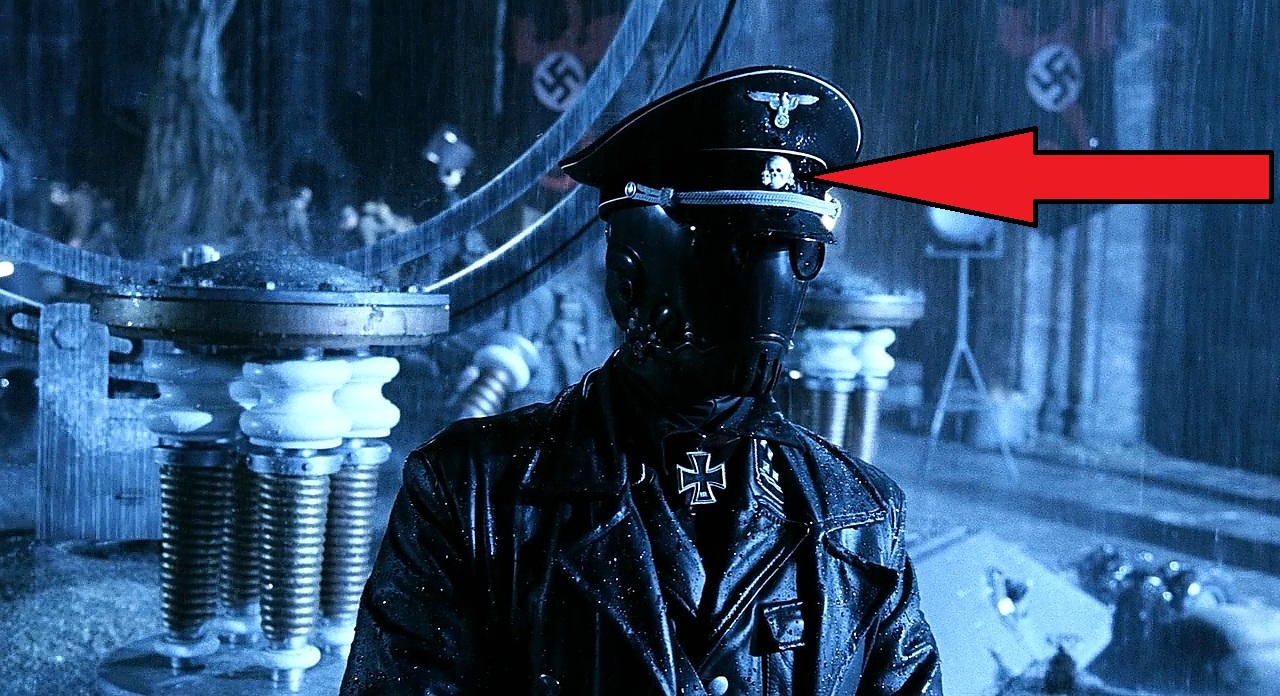
Or the also-creepy henchman Ernst Vogel in Indiana Jones and the Last Crusade, the third installment of one of the most popular multimedia franchises ever created and one of the highest-grossing movies of the 1980s:

But sometimes, they will show up on the collar device of a Nazi uniform. You can see one worn by this Nazi officer in Life Is Beautiful, one of the most successful foreign-language films ever released in the United States and a nominee for the Academy Award for Best Picture:

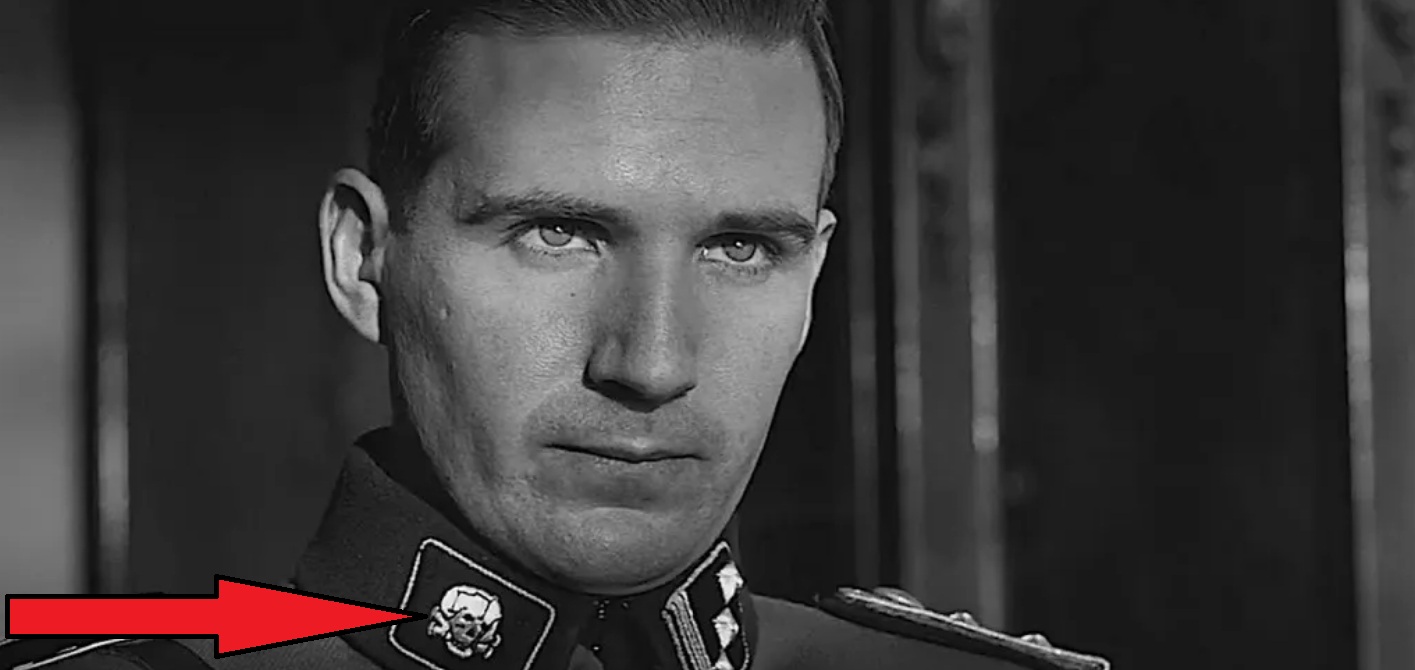
Or on the uniform worn by real-life monster Amon Göth in the even more popular and enduring Holocaust drama Schindler’s List, which actually won Best Picture and is considered “culturally, historically or aesthetically significant” enough to have been selected for preservation in the United States National Film Registry:
Chances are, if you are even a casual moviegoer, you have seen at least one of these movies. And if, hypothetically, you drunkenly got a totenkopf tattoo without knowing what it meant, chances are almost certain that you would have watched one of these movies, or most, or all of them, at some point in your life, and thought to yourself, “Hey, why are all of these Nazis sporting a skull-and-crossbones symbol literally identical to that tattoo I have? Did I accidentally get a Nazi tattoo? Which would be a bad thing since I’m definitely not a Nazi myself? And if it is a Nazi symbol, where is the nearest tattoo removal clinic so I can get it burned off my skin as soon as possible?”
Because, if that thought never crossed your mind, it might look a little suspicious if you decide to address the literal Nazi tattoo only after you get called out on it in public. At that point, you might have to ask yourself a similar question posed in this Mitchell and Webb comedy skit:


Yes, 100%. As a (way left) ME voter, it’s unnerving to see progressives try to wave away Graham Platner’s implausible denials about his tattoo. He’s a self-described military history buff. He sounded knowledgeable defending someone else’s Nazi tattoo on Reddit. Multiple (unconnected) people in his life say he knew what it was. His recent claim it posed no issue in the military is contradicted by his previous admission that he switched from the Marines to the Army because ‘the Army doesn’t give a $&@* about tattoos.’
At a minimum, he knew for years and kept it. And chose to jump into politics at the top rung without vetting himself around some basic stuff. Now he’s trying to whitewash the truth. Which belies the whole straight-talker image he’s selling.