

 Maxance Vincent
Cinema is dying, that much is clear. How it is dying is up for debate, but it is clear that the recent developments in generative artificial intelligence – from the launch of the tasteless Sora 2 to the “signing” of “the world’s first AI-generated actress,” Tilly Norwood – have accelerated its decline. There’s nothing “original,” “fun,” or “groundbreaking” about a technology whose entire raison d’être is based on theft and removes the fundamental aspect of all great pieces of creativity: human feeling. As sophisticated as an AI video may get, the one thing it will never attain is human emotion. Humans have their own subjective experiences that define their most creative aspects, while machines can only imitate them, without ever inducing emotions out of us.
Society is currently lapping up this technology that will kill the planet, create a dumbed-down culture that will not want to read, create, and, most importantly, think for themselves. Instead, they would rather ask ChatGPT about anything and everything than assimilate information on their own and reflect critically about the society they live in. How many friends have said to you, “I don’t research things on Google anymore. I ask ChatGPT,” ever since Sam Altman killed critical thinking with the launch of the most useless chatbot in history? In my case, far too many, and the decline is only getting stronger as these AI-powered softwares become an integral part of our everyday lives.
Radu Jude perfectly understands this inextricable fact when he opens his latest movie (his second this year, following the Silver Bear-winning Kontinental ’25), Dracula, with a two-minute montage of AI-generated videos of the film’s titular character saying, “I am Vlad the Impaler, you can all suck my cock!” It immediately sets the tone for the rest of this 170-minute-long art film? Shitpost? Large-scale troll? A continuing satire on society’s enshittification following Jude’s masterpiece, Do Not Expect Too Much from the End of the World? At this point in the review, I would encourage you to decide for yourself, but I’m not sure many will enjoy this deeply antagonistic movie that holds its audience in contempt for almost three hours.
In fact, during its second screening at Montreal’s Festival du Nouveau Cinéma, a good chunk of the audience walked out over the course of Jude’s lengthy, never-ending “digressions” on the myth of Dracula, which, throughout popular culture, has been stripped of its Romanian roots and turned into a pure object of spectacle and fascination. Instead of reinterpreting the figure within the aspects of Romanian culture, Jude dismantles it, at least fourteen (or fifteen) times, through the scenarios of a hack “filmmaker” (played by Adonis Tanța) who has been given the task to direct a popular, commercially-appealing adaptation of Bram Stoker’s Dracula.
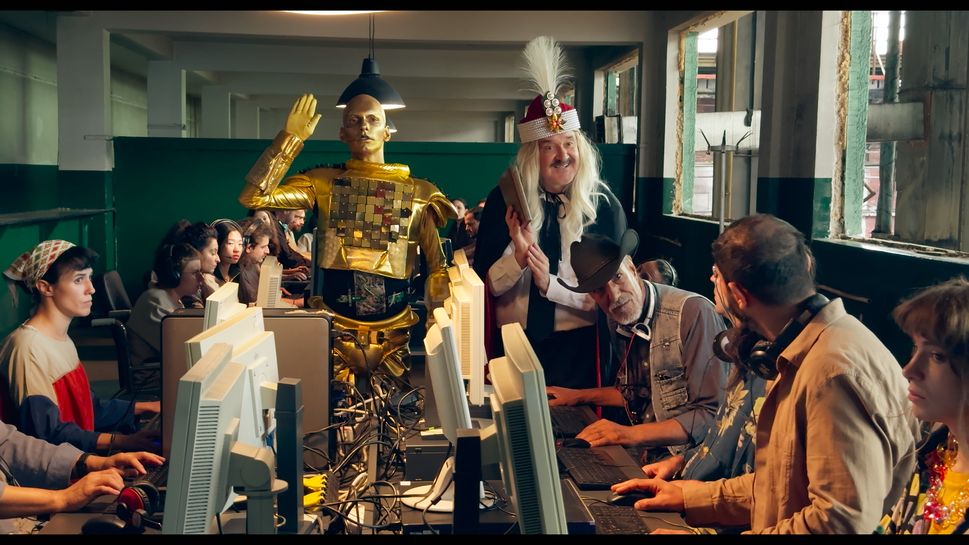
Instead of coming up with original ideas of his own, he asks an AI program, dubbed “Dr. AI JUDEX 0.0”, to generate several stories related to the character. I couldn’t describe half of them to you in this article, because the movie will fry your brain as it reaches its halfway point, after Jude exposes you to as much AI-generated slop as he can – from a “recreation” of Francis Ford Coppola’s Dracula (since, of course, they do not have the rights to show a clip from it, compared to F.W. Murnau’s Nosferatu, which is public domain) filled with phallic imagery to a Grand Theft Auto-like “video game” knockoff that becomes an integral part of its best “digression,” a Dracula riff via Karl Marx’s Das Kapital.
Jude is, of course, incredibly deliberate in showcasing the artifice of his Dracula production(s), shooting on an iPhone that constantly autofocuses and zooms in on frivolous details of various sequences, thereby pixellating the relationship between the audience and the screen. In one “digression,” an “adaptation” of the first Romanian vampire novel, G.M. Amza and Al. Bilciurescu’s Vampirul, Jude, and cinematographer Marius Panduru will purposefully show the shoddy nature of the environments he works in – from the cutout figures populating the inn’s tavern, to blocking each shot to reveal the light fixtures on top of the soundstage, going so far as not to remove the cars driving around in the background when the actors go outdoors. Bystanders also walk past them, with no desire to redo the shot to fit the times depicted in Amza and Bilciurescu’s source material.
The “digressions” are also not presented chronologically—they continuously interrupt a main (cyclical) story in which two actors portraying Dracula and Vampira (played by Gabriel Spaihu and Oana Maria Zaharia) are hunted by bloodthirsty tourists who want to drive a stake through their hearts. That story goes nowhere because Jude never allows the audience time to breathe and understand why it’s the central recurring object of his movie. Yet, none of the digressions go anywhere either. One introduced as a “silent film” becomes a talking picture halfway through (thanks to Dr. AI JUDEX 0.0). At the same time, some of the more significant sections are filled with as many empty provocations as possible, interspersed with AI slop to make it feel as amateurish as they can.
It’s a film so intent on taunting the public at every turn that one kinda has to respect it, even if the whole doesn’t work as well as some of his recent pictures – namely, I Do Not Care If We Go Down in History as Barbarians, Bad Luck Banging or Loony Porn, and Do Not Expect Too Much from the End of the World. The latter examined the history of Romanian cinema through a story that connects to its past and present, while also veering into B-movie territory when Uwe Boll appears in a self-deprecating cameo, discussing his boxing matches with critics and yelling “fuck off!” to all his haters. In that case, Jude’s reverence for the arform – whether good or bad – is felt in every second of his 163-minute story, presented in two parts, and is still his best film.
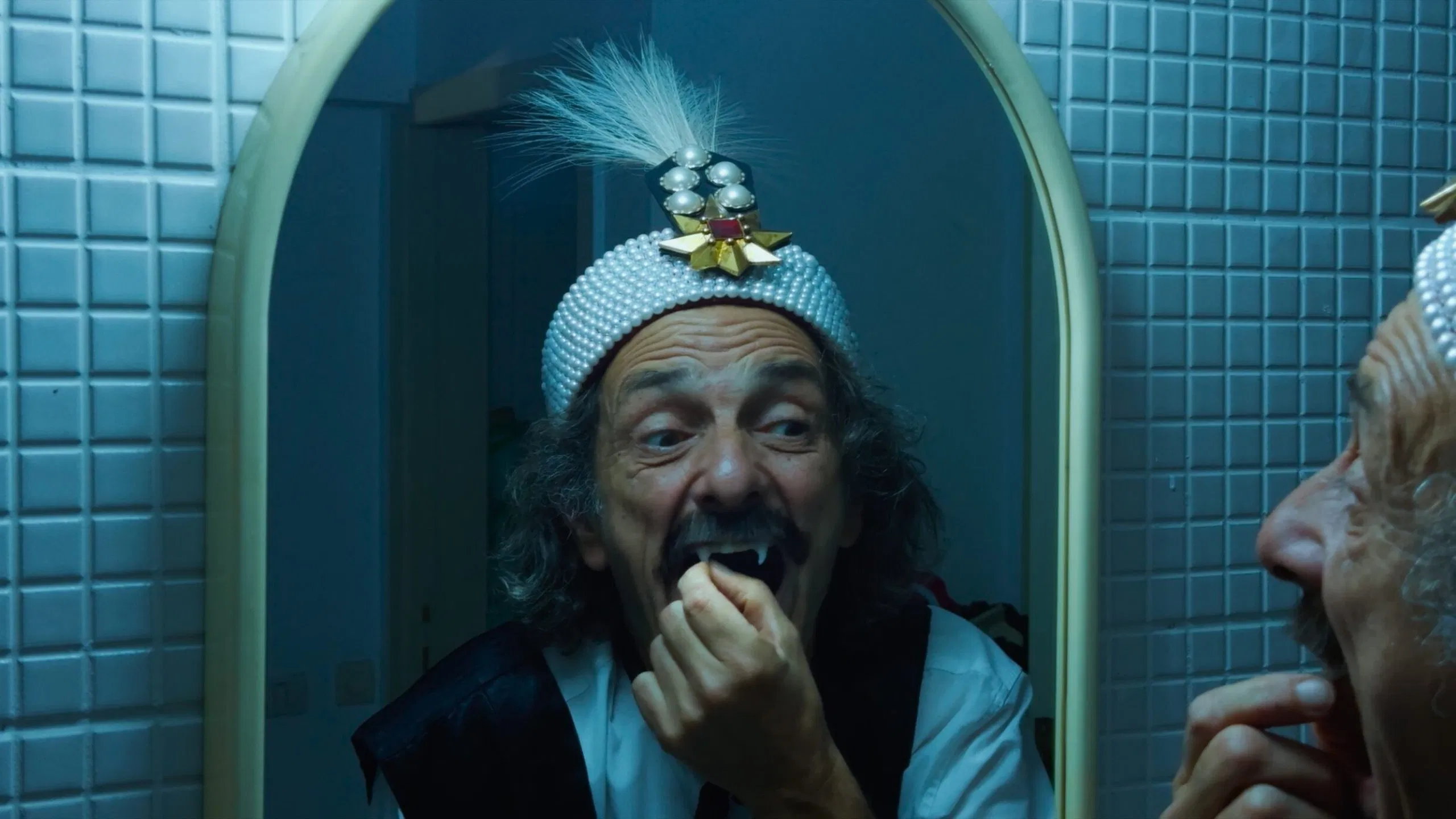
Dracula, on the other hand, is ready to write cinema’s suicide note before it eventually reaches a point of no return. Jude doesn’t dare to expose a culture in the gutter, where all of us realize how much the movies are doomed. It would be a dull thing to do. Instead, he demonstrates the slop all of us are inadvertently accepting, because the public consciousness is incurious about seeking out films past their birthday and developing a personal canon that will allow them to see the world differently.
Perhaps his methods are questionable. The use of AI, in particular, seems contradictory to the (very) clear anti-AI message he populates his movie with. Why use a technology that sucks the soul out of humanity and creativity if you’re against it in the first place? And why populate your movie with it, especially in shots that don’t need them, if not to push as many buttons as possible to antagonize the public?
Whatever reason he has to employ artificial intelligence in this bloated, and often messy, rebuke of vampirism doesn’t necessarily matter, because the provocations work as intended. People left in droves when the “recreation” of Coppola’s film began, which featured as much phallic imagery as one could generate with AI software. Many more did so after the Das Kapital version of Vlad the Impaler started to engage in racist diatribes. It seems to hate its audience as much as it hates the very technology it litters the movie with. Jude holds us in contempt and never gives them an ounce of satisfaction, consistently halting his main story to jumpstart more digressions on Dracula, which go from varying degrees of funny to incredibly annoying.
And yet, by bookending the movie with a contemporary coda focusing on a “garbage man” who essentially has to deal with the physical and metaphoric trash of the world he lives in, Jude’s message is heard loud and clear. If you manage to stick around to Dracula’s devastating epilogue (many didn’t), which drives a stake at the very nature of being human in a world that feels less human by the day, maybe this crazy experience will be worth it. I’m not saying you’ll like what comes before, especially if you’re unfamiliar with the Romanian filmmaker’s corpus, but no one operates at Radu Jude’s level. If anything, he’s having the last laugh, and that’s all that matters.
SCORE: ★★★1/2


Comments
Loading…