

 Shane Slater
Riffing on classic film tropes of forbidden love and coming of age, Lorraine Jones Molina and Cristian Carretero’s debut feature Esta Isla is at once familiar and distinct. Portraying the lives of a young couple from opposite sides of Puerto Rico’s socioeconomic divide, the film explores the underseen far-flung corners of the island to examine the society’s underlying tensions. Those tensions come to the fore for protagonists Lola (Fabiola Brown) and Bebo (Zion Ortiz) as they flee a coastal community’s cycles of violence to escape to the mountains. Their journey depicts the realities of the nation’s persisting colonial struggles, as Molina and Carretero explain in our Awards Radar interview ahead of the film’s premiere at the 2025 Tribeca Film Festival.
Shane Slater: This film is an expansion of your short film of the same name. Can you speak a bit about the journey to get to this debut feature?
Cristian Carretero: Our intention was always to make a feature. We had a treatment for this feature, which was, we’re taking this genre which we admired – lovers on the run, coming of coming of age -and using it to talk about these issues and talk about Puerto Rico and its society. now throughout through this, this vehicle, which is lovers on their own story. And we saw that many of these films like Badlands or Bonnie and Clyde, they always have the excitement of the genre, but also a layer of social commentary or philosophical ideas. So we had that, and we got a commission for a short film by the French Institute in Puerto Rico. So we used it as an opportunity to explore these characters and these spaces. But it was always meant to be a feature. So the short is the first act.
Lorraine Jones Molina: I think it was a really good way to get a feel for the world that we wanted to talk about, and get to know the main characters. So it went well for the short film. It also let us know that there was an audience that was interested in it.
CC: Eventually, we got a grant for development and since we were really busy at that moment, we got Kisha Tikina Burgos, who is the other writer from Puerto Rico. She’s also an actress and director. She does everything, and we really trust her. So we had all these notes and scenes, and it was kind of written out, in a way. But it was more like prose. And she took it and gave us the first draft, then years went by because we had work, you know? We had to survive, and we didn’t have the financing at that moment.
And when COVID hit, we were like, “We’re going to do this film, no matter what.” No matter what it takes, by any means necessary, with whatever budget. We obviously need to have at least some money to shoot it, but we wanted to shoot it with a small crew, very little equipment, kind of taking advantage of these spaces and communities. We also spend a lot of time researching in these locations and getting the trust of the people we’re talking about. That really informed the script as well.
We were always constantly adjusting the scripts to the reality we saw, and also a lot of crazy stuff happened before the first draft. And when we decided to make the film, there was Hurricane Maria, which destroyed Puerto Rico, and changed our lives and way of seeing things. Then we had a set of years after, where there was a set of earthquakes in the south of the island and we shot a scene there, the scene where the grandmother lives. It’s called El Faro, and that was the epicenter of these earthquakes. And that community sank eight inches. That’s why, when the tide comes up, it gets flooded. You can see a little bit of that in the film.
And then the people overthrew the governor also. So it was a bunch of different things that were happening. And since we wanted the film to be very contemporary and authentic, we were kind of molding it towards the reality we saw.
SS: There’s a sense of dread that counters the stereotype of the idyllic island, without being too bleak. How did you strike that tonal balance?
CC: I mean, I have a friend that said, “Oh, it’s like poverty porn.” But it’s not, it’s just real and there’s a lot of positivity. Puerto Rico is not that bad off, you know? We have our challenges, and we are a colony. We don’t have control of our own destiny. And there’s poverty. But this is more about these kids growing up just trying to understand themselves, you know? Trying to figure out who they are. But also Puerto Rico as a space, as a country, as a colony, is trying to understand where we fit in in this world. Through understanding our history, we also get to know who we are. So the film gives these little hints of Puerto Rican culture or history or our fight against colonialism, which is present. So we wanted to include all this.
Yes, it’s true that it’s gritty. But it doesn’t fall into bleakness because there’s always this balance or contrast between dread or need, and then this richness of this space, of the island. Also, I think the composer did a really good job with the music, because it’s trippy and it has the element of dread. You have this music, and the beautiful images and it makes you feel, you know? It makes you feel this underlying tension. But it’s not bleak, as you put it.
We didn’t want some depressing, sad film. Life is great when we get to take advantage of it and live in the moment. These kids, that’s what they’re trying to do. And in the end, I think that’s what they find. They find kind of awaken to who they are. Throughout this experience they have, they’re more aware of who they are in the society, and how the space you’re in also molds you and creates your identity.
LJM: Also, we went and we filmed on the other side of the island, where usually filming doesn’t take place. So we were really able to go into spaces that hadn’t really been seen before in this way.
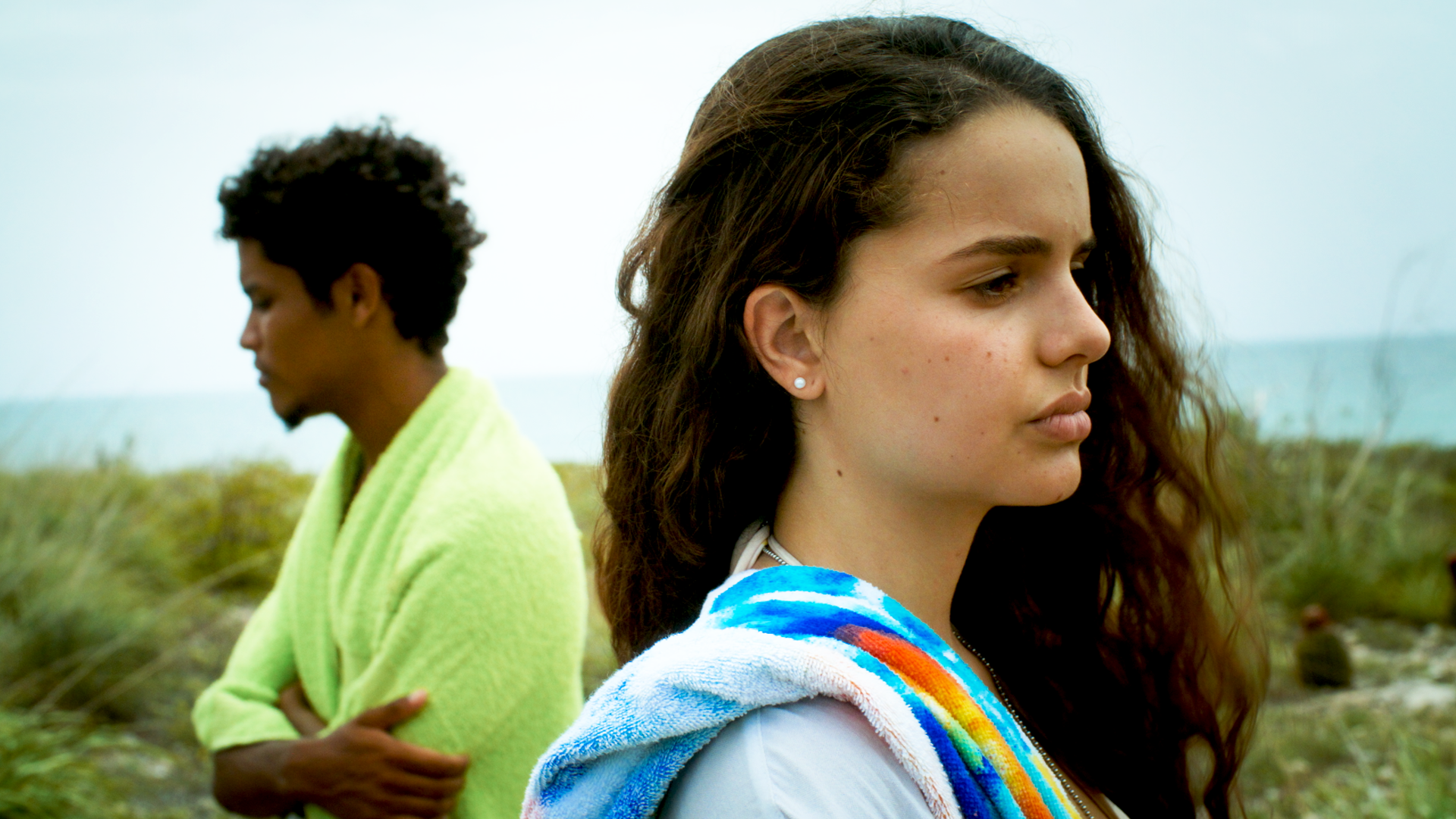
SS: I love the epic scale of the film, especially for an island setting. Can you speak to your approach to filming in these different environments and their cultural and racial significance?
LJM: Our locations are very important to us. They’re like characters, and we really want them to be honest and unique and genuine. The public housing projects where we filmed is like the second oldest one in Puerto Rico. It’s very old. And it’s called Columbus Landing.
CC: It’s very ironic because supposedly, Columbus arrived from the southwest, but he’s the first colonizer. And it’s very beautiful, this space. It had these huge ceiba trees, which are indigenous to Puerto Rico.
LJM: And we had a community leader who helped us a lot. I remember she told me how, before we went to go film, she had a meeting, so that people could know about the film. And she spoke to everybody so that everybody could know this is happening and be okay with it. And many people would say to her, “They’re gonna make a movie here? They’re gonna make a movie about us, with us? Nobody cares about us.” They couldn’t even believe it because they thought they weren’t important enough to have a film about them.
They were just so supportive and wanted to be a part of it where they could, or just be supportive all the time to us. And that was such a beautiful thing. And I feel like that happened in all of the spaces we were in. The community was really happy and excited, because I think it’s something so special to be able to see yourself in a film, to see yourself on screen, to see your stories. That’s so important for humanity.
CC: Going off what Lorraine mentions about seeing yourself, Puerto Ricans have this inferiority complex because of colonialism, 500 or 600 years of colonialism. We think we’re less, that we cannot survive by ourselves, that we’re dependent on the US, you know? Like we’re dumber. And we’re trying to also break that myth, and through cinema and you seeing yourself, it creates a better sense of self worth or understanding.
In terms of scope, we wanted to show also, although Puerto Rico is small, it has a mountain range in the middle, and then the South is a different climate than the north. And then you have so many micro environments. It’s like a little continent, in a way. It has dry parts, it has jungle, it has caves, rivers. So we wanted to show this, esta isla. Esta isla is the island where it takes place, but it’s also the island of of the self. And this idea of the individual within the collective, you know?
We see locations as characters, and we’re very informed by them. They tell us what the story is. We went to these locations, met people, and they will tell stories, and we were like, “Oh wow, that’s so much better than what we wrote in script. So let’s just put it in there.” It was a constant thing like this. So we’re very fortunate that these spaces opened up to us and let us show their essence. I think it made the film have this authenticity or honesty, and it’s because of these spaces. And because we did it with with our hearts.
LJM: The character of Cora in the mountain. He actually lives there where we filmed. And that was really beautiful, because he was just kind of able to be himself in many ways. He’s a great actor, but also he was just kind of acting himself in so many parts, and he was in his own space with his own animals, and even the party they have there, which is called a promesa (promise), that is something that he does as well there, and we didn’t write it thinking about him and knowing all of that, and it just happened.
SS: Could you speak a bit about how you approached Lola? I feel like that’s a tricky character, as she’s privileged yet she wants to throw it all away and go on this journey. How did you make her believable and empathetic?
LJM: In a way, it has to do with the casting. Choosing her, I think, was obviously the right choice, and she’s an interesting person herself.
CC: Her father is like the Puerto Rican Bob Dylan. He is called Roy Brown, and he’s really well known. He started making music in the 70s. You know, singer-songwriter, very political. So she comes from that. So even the character is similar. I mean, the photos in the room are his. So her father is basically like a real revolutionary through music.
LJM: And she is actually a ballerina. But she studied ballet in Cuba. So she has the ability to understand a lot of the world of the character. It was very natural to her. She told us that there were many things that she kind of didn’t have to act that much, and I feel like that definitely helped. And she just has an ability in how she moves and how she can express things without saying anything. Like, in between the lines.
CC: Between the lines is what matters most. What’s not said, what the character hides from you or the person. We also were very influenced by Robert Bresson. And for example, the party scene, we were referencing Pickpocket. Just the eyes, hands and things like that, you know? And he talks about that. What’s important is what’s not said. And then Fabiola and Zion too, in between the lines, they said something. I wasn’t even listening to the lines. I was just watching them behave and exist. And it was mesmerizing. So that’s the main reason why we casted them, because they didn’t have any acting experience before this, but they were so comfortable with us and with the camera and just being, you know? Just doing nothing.
[This interview has been edited for length and clarity]


Comments
Loading…