

 Shane Slater
For director Kristian Mercado, the past is present when it comes to his new short film Mataron A Pedro. Despite the historical setting, its protagonist’s fight against colonialism still resonates with the current moment. That contemporary relevance was one of a range of topics discussed in our Awards Radar, as Mercado explained the film’s own grassroots ideals and its artistic inspirations.
Shane Slater: The struggle for freedom and independence in Puerto Rico is still ongoing today. What drew you to this particular point in history to tell this story?
Kristian Mercado: I think Puerto Rico is always historically looked at as a place that has a lot of problems. And I think there’s something to be said about investigating those inflection points in history that kind of say a lot about where we’re at. There’s so many similarities to that time period to our time period now that I was really drawn to that. Like, a lot of the workers’ right issues, or like how did Puerto Rico get to where it’s at, you know? I mean, currently Puerto Rico obviously is having a water crisis, and before that it was the electrical grid crisis. So Puerto Rico kind of lives in a state of crisis all the time, and I think there’s something important in investigating how we got there.
SS: What was the process like to access this archival material which is so critical of American imperialism?
KM: It is critical, but it’s also factual. It’s interesting that when you tell the truth, people say it’s a criticism, but you’re really just stating the facts, you know what I mean? So if we all feel that there’s something critical there, it’s because probably there is some sort of truth to the idea that there’s something wrong.
The process of the archival stuff was so intensive because we went to libraries in Puerto Rico, but I worked really close with CentroPR in Spanish Harlem. So I would kind of go there and spend hours for a couple months. Honestly, it was kind of like a day job at some point. Like a side job because I was just going through so much archival material, reading so many letters, investigating so many things. It was such a a heavy process, just going through that. I was looking for stuff I had not seen On the internet, or like these archival commercials that we use that I feel there’s something interesting about the contrast of things that were happening at the same time. You’re seeing people sell sugar in so many different ways, but then here’s the reality of sugar as well, you know?
SS: I really got the sense that there’s so much more to Pedro that you couldn’t fit into a short film. Was there something particular that you zoned in on as you set out to portray this character along with your actor?
KM: Yeah, absolutely. I think with Pedro Albizu Campos, he has a huge life, and it is like hard to even contain it into a short. So really, I kind of try to simplify it. I was trying to give people a sense of the labor rights aspect of him. His motivation being strongly tied to whether it was fair for workers that are working the land to not own the land that they work and their relationship to it. Like, why is this country that is yours not yours?
I think that kind of was the main thing I focused on. But more also through the lens of a family man. Something that I was drawn to was this idea of how he sacrificed so much. I really wanted to hone in on him being a person who had a family, and he was doing these things, and it was almost destroying his family like it was destroying him. So, kind of just seeing the cost and the pain of what it takes to be a revolutionary.
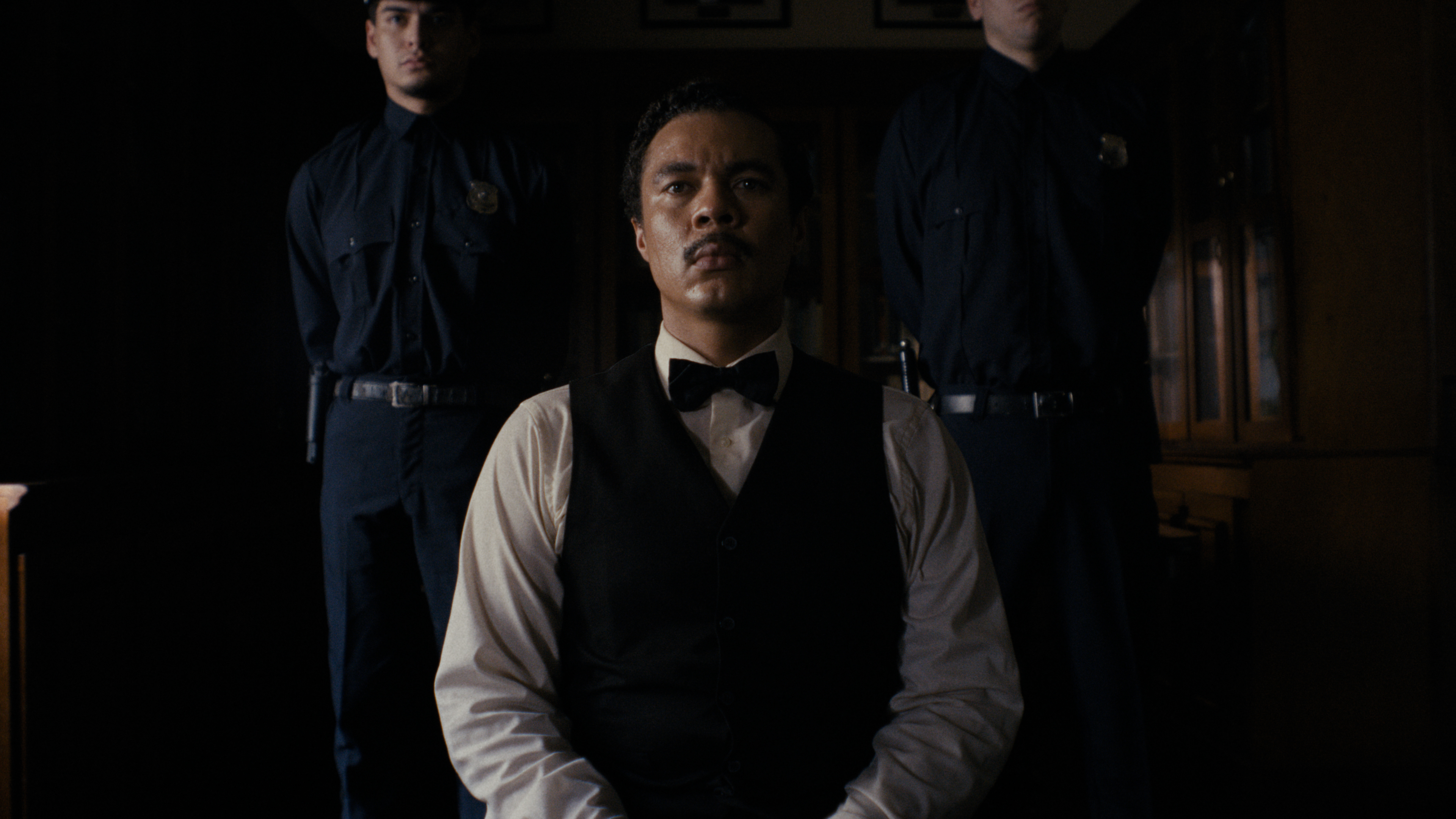
SS: Could you speak to the visual style of the film? The music has a sweeping, epic feel but the closeups and medium shots are so intimate.
KM: Me and the DP Diana Matos, we worked together on trying to emulate Francisco Oller’s paintings and this idea of the Velorio paintings, a traditional style of Puerto Rican painting that has a very dense packet. We have some of those paintings in the frames, like when we do the title cards. So I was trying to capture something that’s very Caribbean and very much like an image of Puerto Rico.
But I was also trying to be theatrical. I think about like, if this was theater, how would I treat it? So sometimes the visuals live in almost like a surreal limbo. I think I was kind of aiming for it to feel like I’m taking frozen moments of history and trying to bring them to life, but there’s something kind of incomplete in it, you know? Like this feeling that it’s lost in time, and you’re trying to gain it back, but you feel the resistance of that. So like sometimes having him in a shadow or having him in a silhouette or having him in a spotlight.
I was really interested in that a lot. This feeling almost like vignettes. Like a little weird theatrical moment that’s existing, and then putting those together. In my head I almost always saw it as a play, and there was stages. Even though obviously with film you are shooting in locations, but I kind of try to treat the frame as much as possible like it was a theater.
SS: I read that there were previous community screenings. What was it like to screen it in front of different generations of Puerto Ricans?
KM: I honestly have to say it’s remarkable. I’ve been so moved by the community screenings, and I am so honored and blown away. We’ll put tickets up for them and then it’ll sell out within the hour. Sometimes we sold out like one screening for 400 seats divided by two theaters or something, and that sold out in an hour. And anytime we put up the film somewhere in a community, it’s packed and it gets filled up. I’ve never seen that in a short in my whole life. I’ve been in the festival circuit for close to 10 years maybe.
So I’m really moved by that because I feel like there’s such a demand for this story to be told, and there’s such a demand for these type of stories to be told, and there’s a real hunger from the community. I see a lot of Puerto Ricans come to the screening, and there is a genuine sense of “oh, we don’t get these opportunities.” We don’t get these moments to see ourselves and to also just witness our own history and treat it in such a way. The Puerto Rican community can sometimes disagree a lot, but to be honest, this short is one of the few times I’ve seen Puerto Ricans from all generations and walks of life kind of agree.
There’s some footage of the audience watching the short in Puerto Rico, and there’s such an intense feeling in people’s faces as they’re watching it that I’m like, “oh, I really tapped into something that’s inherently true to a Puerto Rican in a deep way that they feel seen.” And even across the the spectrum of politics, everyone has to kind of almost accept that this is a part of our history. I find that to be really cool. I love the community screenings, and it also just shows you there’s just a way to show films in so many different ways now. And I think there is something nice about the grassroots approach to watching a film.


Comments
Loading…