

 Steven Prusakowski
Stepping into Furious expecting a serial killer series means you’re expecting the wrong show. This is not a serial killer show. It is not really a detective series, nor is it a traditional cat-and-mouse thriller. Those elements are certainly part of this unsettling Hulu series from creator and writer Elizabeth Meriwether, but they are the vehicle rather than the destination. What lingers long after the mystery moves forward is something far more poignant, eye-opening and sobering – the damage left behind when women are failed by the people and systems that were supposed to protect them.
Loosely inspired by the 1987 film Black Widow, Furious follows rookie FBI agent Alice Black (Emmy Rossum) as she investigates a string of deaths connected to a mysterious woman (Lola Petticrew) who targets wealthy and powerful men. But Meriwether quickly moves past the original film’s premise, as she explained in my interview with her and the cast. She shared that the story became an exploration of “how being a victim of violence can lead to becoming a perpetrator of violence” and “uncomplicating this idea of a perfect victim, trying to show the difficulty of that.”
That idea is what gives Furious its unexpected emotional weight. Alice and Catherine mirror one another, carrying some of the same emotional wounds while responding to them in very different ways. Catherine has turned her pain outward, using violence as a form of revenge against the people she believes escaped accountability. Alice has turned inward, becoming guarded, cautious and almost incapable of letting herself feel safe. Neither woman is a perfect victim, and neither fits neatly into the role the audience might initially assign her. They are reflections of one another without ever becoming the same person.
In my interview with Petticrew, she described Catherine as someone who “deserved the dignity of being allowed to be complicated and messy and morally gray. And I think that’s what makes it interesting for an audience. They come in and they have an idea of where they may stand for things morally and I think that the show pushes their boundaries a bit further and a bit further until all of a sudden they may be justifying things that they never dreamed of justifying.”
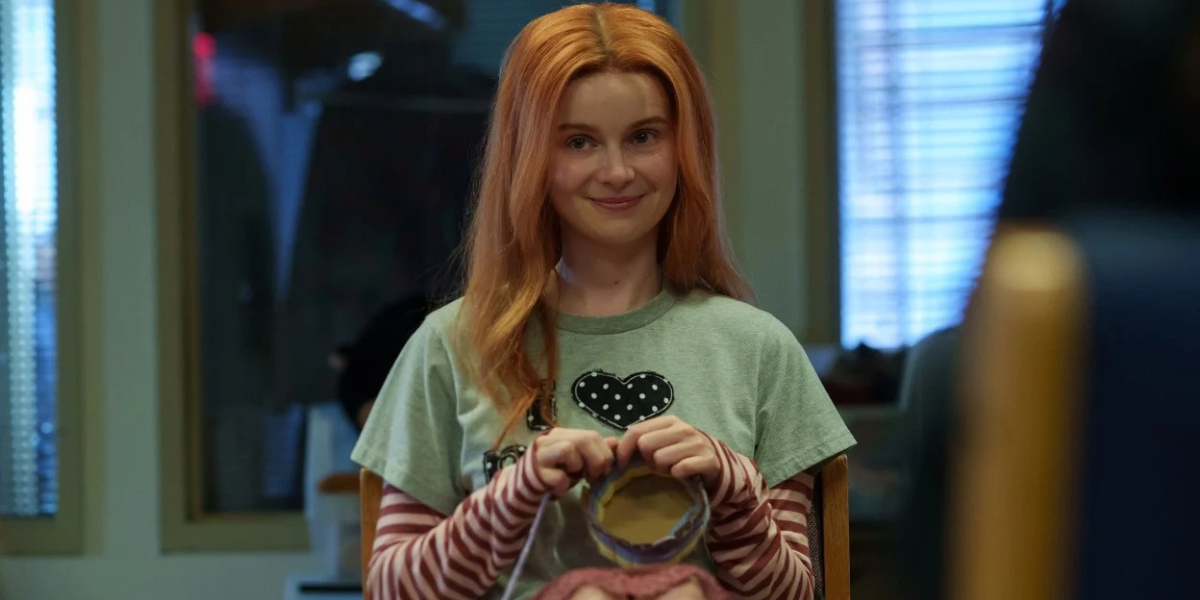
Catherine is not frightening because they are physically imposing, far from it. Petticrew is petite and often gives them an almost childlike innocence. The intimidation comes from the damage underneath it, from the sense that Catherine is constantly looking backward at the person she was before her life was tragically broken.
As discussed when speaking with Petticrew, Catherine’s arrested development is not sweet or cute, it is completely devastating. Part of Catherine is stuck in a version of herself that no longer exists. When the abuse occurred, the true Catherine did not survive. Whoever she is now is a new person she was forced to build as a result of the vile treatment she endured as a child. Still, Petticrew, even while often dressed in soft, almost childlike clothing, lets Catherine’s few glimpses of her former self coexist with a version that is frightening and manipulative. Even while she is the hunter, the prey will always remain part of her. She is a vengeful angel trapped between Heaven and Hell.
Rossum gives Alice an equally physical performance, raw and vulnerable, the most fearless performance of her career. As discussed in our conversation, she transforms into Alice, her pain is physically visible in the way she carries herself, guarded and withdrawn, as if some part of her is always somewhere else. She is tough without ever appearing comfortable in her own skin, someone who has learned to stay braced even when there is nothing immediately threatening her.
The preparation was extensive as Rossum told me, approaching the script “like a crime scene,” explaining that she filled the pages with clues through research, conversations with law enforcement and psychologists, physical training and an effort to understand “what being a victim of domestic violence does to you physically and psychologically.” She described eventually uncovering “all the secrets that are in the margins.” That work shows beyond the dialogue as Rossum carries it in every movement – from the character’s complicated and often violent sexuality to the barriers she creates, both socially and physically. The real Alice hides in plain sight, tucking away Rossum’s trademark curly locks and replacing them with an unbathed, gruff look which other characters complain also carries a foul body odor – a self-imposed barrier from human connection.

Following The Dropout and Dying for Sex, Meriwether continues to show an ability to build stories around complicated people rather than simply using people to move a plot. The supporting characters have lives beyond the immediate mystery and are not just there to add pieces to the puzzle. Nora (Quincy Tyler Bernstine) brings veteran toughness, suspicion and a sense of humor as she quietly fights a failed system. Danny, played by Scoot McNairy (so good in Halt and Catch Fire), is one of the few genuinely decent people in a world populated by plenty of jerks, creeps and other unlikeables. As a dad trying to make ends meet while caring for a child with medical needs, he gives us someone worth rooting for. Even if I could have used more of them, what Nora and Danny contribute makes the world feel more thoroughly established. So much so, they both have the makings of characters worthy of individually leading their own series. Sadly the same cannot be same for Jake Lacy who is not given as much to work with as the rest of the cast, a one-note antagonist you can spot a mile away.
Furious also finds room for humor without completely undermining its darkness. Steven Way is particularly good as Alden at using his disability as a source of comedy while holding his own against everyone else in the room. Alden knows most people are unsure how to act around him and cleverly, often hilariously, uses that as a weapon to take control of the situation. Those moments, along with his relationship with Catherine, inject the series with some light beyond the endlessly bleak.
Viewers are provided enough information to keep the investigation moving while carefully protecting its larger mysteries. By the end of Episode 6, plenty of questions have been answered, but the series still refuses to show its entire hand. Whenever Furious risks becoming just another elaborate crime puzzle, Meriwether redirects the focus toward the people caught inside it.
The biggest issue with the series to this point is that I am not sure who I am rooting for. Maybe that is the point. I find myself in a moral tug of war, often rooting for the serial killer. Unlike The Silence of the Lambs, where Anthony Hopkins’s Hannibal Lecter was almost too charming to root against, this goes much deeper. There is such a tangled web, and in a world full of creeps who go unchecked, it is hard not to find yourself rooting for Catherine. As the Epstein files remain a source of controversy and debate, there is something undeniably satisfying about watching these men finally pay for their sins. Alice’s own history of abuse is the only reason I find myself hoping she succeeds in catching Catherine.
What should be fascinating are where the opinions will land for the viewers. While some will certainly share my view, I can just imagine others feeling more mercy and others even shifting the blame and shaming the victims. Sadly, that is the world we live in right now, especially when certain powerful people need protecting.
That is what separates Furious from the standard serial-killer thriller it initially appears to be. The murders are the entry point, but the series is ultimately defined by what the violence leaves behind. Once inside its world, Furious will hold you captive.
SCORE: ★★★★1/2 out of 5 stars
You can find Furious streaming on Hulu. Watch my full interviews with Meriweather, Rossum, Petticrew, McNairy, Bernstein and Lacy and several more cast members below.


Comments
Loading…