
 Cory Stillman
Editor Jay Prychidny is one of Tim Burton‘s most trusted collaborators, cutting every Burton-directed episode of Netflix’s Wednesday, not to mention 2024’s Beetlejuice Beetlejuice. With additional credits on such horror hits as Orphan Black, Scream V1, and Ready or Not 2: Here I Come, it is no wonder that Prychidny’s work on the S2 finale of Wednesday is decidedly darker than the preceding episodes.
“The three prior episodes in the season had all swung very far into a comedic direction, and I just instinctively felt that the season finale needed to return to a gothic horror tone without losing the comedic moments,” he says. “The incredible thing about working on a show like Wednesday is that it can encapsulate so many different tones from slapstick comedy to absolute horror, and much of this is modulated in the edit room.”
Of course, Prychidny’s background allows him to traverse those different tones with ease. And in a S2 finale that could have gone in so many different directions, its editor’s deft navigation of those many elements allowed for a refreshingly tidy resolution to a sprawling season of Wednesday.
“It was Tim’s genius idea to center a lot of the finale around Thing’s storyline and emotional arc, and the comparatively small moments of escaping from Isaac’s wrist, instead of centering it around a massive CGI creature fight,” says Prychidny. “That gave me the clear direction I needed to always remember that this is a story centered around our core characters, not around spectacle. There was a real cleanliness to that, since this show normally has such a sprawling cast, it allowed me to just narrow down on the Addams and maintain a focus and drive throughout the episode.”
Focusing on Thing’s emotional arc proved to be a crucial decision, shifting the climax of the season finale away from its more action-heavy moments. It also allowed Prychidny to lean into the show’s horror gothic elements, and the shorthand he has developed with Tim Burton over the course of his career made this particular collaboration especially effective. If Prychidny needed to dial up Thing’s journey a bit more from either a horror or a sentimental standpoint, he knew his director was prepared to help make that happen.
“Tim put so much time and care into shooting the sequences involving Thing, often going back to shoot additional pickups once he saw my initial cuts, so we could fill out the sequence even more,” says Prychidny. “I think it’s only through editing and montage that such a strange concept can make any emotional sense at all!”
Indeed, Wednesday is a heartfelt and often unsettling show, unafraid to dabble in strange storylines and character arcs. Prychidny’s complete control of his craft makes S2E8 “This Means Woe” one of the best, and most surprising, episodes in the series.
Check out our full conversation with Jay Prychidny, CCE below!
How did you approach shaping the Season 2 finale in the edit?
I edited all of the Tim Burton-directed episodes of the series (half of season one and half of season two), and I think this was probably the most difficult episode of them all. From the very beginning of pre-production, there was a lot of concern about how to appropriately and satisfyingly wrap up the story of the season, and everyone had a different opinion about just how to do that! Very close to the start of production, it resulted in shifting a lot of the story planned for this episode into the previous episode, leaving a bit of a hole for the finale! It was Tim’s genius idea to center a lot of the finale around Thing’s storyline and emotional arc, and the comparatively small moments of escaping from Isaac’s wrist, instead of centering it around a massive CGI creature fight. That gave me the clear direction I needed to always remember that this is a story centered around our core characters, not around spectacle. There was a real cleanliness to that, since this show normally has such a sprawling cast, it allowed me to just narrow down on the Addams and maintain a focus and drive throughout the episode. I think that clear central concept is what allowed the moment of Thing detaching from Isaac’s wrist and returning to the Addams family to have such a surprising amount of emotional weight and power.
The finale feels noticeably darker than the episodes leading up to it. How did that tonal shift come through in the edit?
The three prior episodes in the season had all swung very far into a comedic direction, and I just instinctively felt that the season finale needed to return to a gothic horror tone without losing the comedic moments. The incredible thing about working on a show like Wednesday is that it can encapsulate so many different tones from slapstick comedy to absolute horror, and much of this is modulated in the edit room. Nothing clarified this for me more than editing the first four episodes of season 1 in a comedy style and not realizing until many months later that the other editor, Ana Yavari, was editing the last four episodes in a horror/drama style! We eventually had to make re-edits to make the first and last half of the season more tonally consistent. But it showed me just how much of this series’ tone is decided by the editor, whether consciously or not! Since I wanted to give this finale more depth, weight and more of an “ending” feeling, to me that meant returning to the darker gothic tone that was set up at the beginning of the season. I thought that bringing the style of the season full circle might subconsciously signal to the audience that we are indeed in the endgame of the story (without having to check the episode number!). This stylistic choice dictated pretty much all of my creative decisions, from performance and shot selection to music and sound design.
Morticia has a lot of story to deliver in this episode. What was the key to keeping that sequence engaging?
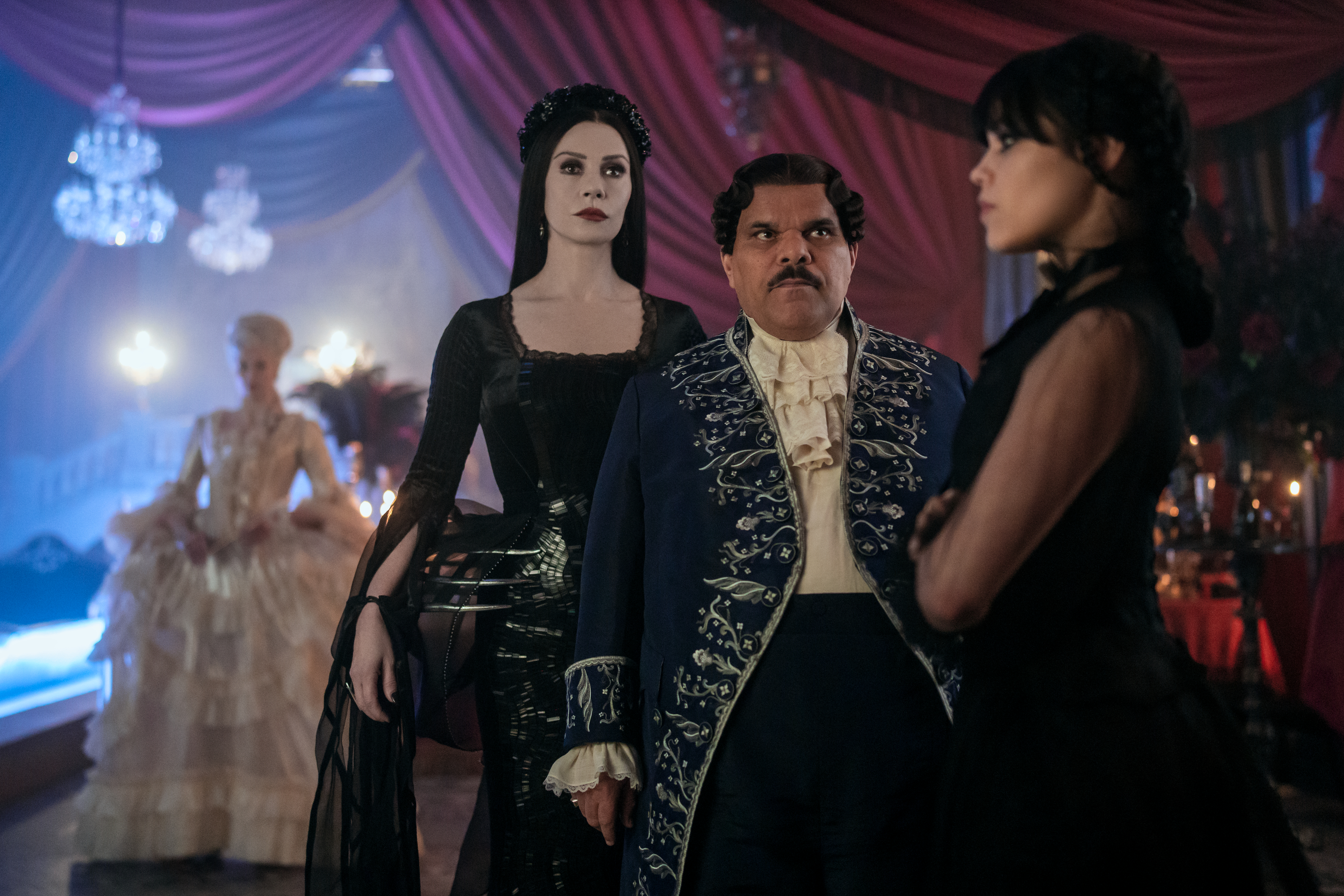
Moritica’s long expositional monologue was filmed near the beginning of production, and it was definitely a concern how to make it work properly, especially right at the beginning of a season finale! I did cut it as a stand-alone scene, and Catherine Zeta-Jones delivered a remarkable performance, but it was quite obvious it would never work as a standalone dialogue scene. The benefit of filming it early on was that Tim Burton and I could look at the rough cut as a baseline for how and where flashbacks would be used. It allowed this sequence to evolve quite a bit over the course of production. Tim would sketch out the shots that the second unit should film, but it turned out that we didn’t quite have enough to fill out the sequence. I edited on location at the studio, so we could always be in tight collaboration and looking at WIP edits to see what else we needed without having to schedule reshoots after the end of principal photography. But even so, I still pulled up a lot of footage that was filmed for other parts of the episode into this flashback sequence because it was feeling too unbalanced and “top-heavy” without it. That also gave the added benefit of being able to play certain moments in the episode twice, but showing them from different perspectives, which is always a fun little editing device I enjoy! Also, Tim made the genius 11th-hour decision to film the clock tower explosion as a real-model explosion, rather than do it in CGI. This meant we had tons of angles to show it from. So I was able to use it a total of three times in the episode, including this flashback sequence, but always showing it from a different angle. As a pure CGI shot, that would have been prohibitively expensive. Just one of the wonderful benefits of filming traditional model photography!
How did you and Tim Burton decide when to use flashbacks and when to let the performances carry the story?
I’m generally a proponent of the “more is more” approach! As wonderful and emotional as Catherine’s performance was, once we were deep into a flashback sequence, it felt important to me to maintain that kind of style. It didn’t feel right to me to just drop into performance close-ups for the back half of her story, when the front half was so well covered by flashback footage. So to keep it balanced, I scrounged whatever footage I could to maintain the flashback style for the entire backstory. But certainly Catherine’s powerhouse performance dictated precisely when I’d need to cut back to her in order to showcase the character’s emotional arc. I’m so grateful that her performance choice was to struggle with the emotional turmoil of it all, as it’s maybe not the first choice one would make in delivering an expositional narration. But it’s precisely what makes the sequence work at all!
The Hyde battle changed quite a bit during post-production. When did you realize the sequence needed a different structure?
Working out this sequence was a long, long, long process that stretched from pre-production up until about a week before the episode went up on Netflix. Over a year! Initially, it was spearheaded by the VFX department as a stand-alone sequence, but director Tim Burton was reluctant to have the episode launch into a pure CGI sequence, or what he called a “Jurassic World”- type action scene. He always wanted to make sure we were grounded to our human characters inside the clock tower. So it was a lot of tight, consistent collaboration between me, the VFX department, and the second unit production team to determine exactly what pieces would be needed to turn a stand-alone monster fight into an intercut sequence. Restructuring the sequence involved removing a lot of the storyboards that were designed for the sequence, but also reengineering the existing ones so they’d be able to work in a much more concise intercut format. The structure of the entire sequence was ultimately designed by me, so I was the only one with the overview of how, when and why we would cut inside or outside of the clock tower. It was my own sense of pacing and structure that dictated how long each of these CGI fight segments could be, which was always much shorter than what the VFX department initially had in mind. Because if we were ever away from the human characters for too long, the whole sequence would lose its momentum. But in the end, I think we were able to serve all the stories simultaneously in a fast-paced and action-packed way!
How closely were you working with the VFX team as that monster fight continued to evolve?
The entire sequence was shot over several weeks, so I’d meet consistently with the director, the VFX department and the second unit production team to look at WIP edits, discuss what we had and what we needed to still film. This sequence necessitated a closer collaboration with other departments than any other episode or sequence that I’ve ever been a part of! It allowed the sequence to evolve naturally as we filmed it, rather than waiting until production was over to assess and having to go back for reshoots. But even once production was over, it was a very tight collaboration with the VFX team. We were reengineering shots and adjusting the edit right up until going to air! They ended up bringing on an additional VFX supervisor just to deal with this one sequence, and I was grateful that he was so open and collaborative. Because, as discussed, so much of making this sequence work is about how it intercuts with the live action segments, and that’s not necessarily something the VFX department is thinking about when just looking at the CGI shots in isolation.
The reunion between Thing and the Addams Family becomes one of the episode’s most emotional moments. What was the challenge of making that scene work?
This was, for director Tim Burton, the real climax of the episode! In the early stages, the climax was more weighted to the action finale of the monster fight. But for Tim, he was always more interested in the simple emotional story of Thing fighting his way off of Isaac’s wrist and returning to the Addams family. He saw it almost like a lost puppy returning to its beloved home. Even in the early stages, without any visual effects, the sequence had a tremendous emotional power! But it really is remarkable if you think about it, as it’s really just about a hand that isn’t intrinsically able to convey emotions. And on top of that, there’s a performer switch in the middle of the sequence! At the beginning of the scene, when Thing is attached to Isaac’s wrist, he’s performed by the actor who plays Isaac, Owen Painter. Then, once he detaches, he’s performed by the actor who usually plays Thing, Victor Dorobantu. Tim put so much time and care into shooting the sequences involving Thing, often going back to shoot additional pickups once he saw my initial cuts, so we could fill out the sequence even more. I think it’s only through editing and montage that such a strange concept can make any emotional sense at all!
How did the idea of using “Sweet Dreams” in the finale come about?
I first discovered the Hampton String Quartet version of “Sweet Dreams” randomly on YouTube Music a couple of months before season 2 began filming! I filed it away in my memory as a piece of music that might come in handy somewhere in season 2. But it wasn’t until working on the last scenes of the finale that I realized the sequence was lacking a strong identity to launch us into season 3. The end of the episode wasn’t scripted to be a musical montage, but I just felt that that would be the strongest way to give the proper feeling of excitement and anticipation at the end of the season. The character of Wednesday plays the cello throughout the series, such as the “Paint it Black” sequence I edited in the first episode, so it was already creatively established to be able to use string covers of a pop song. Because of the length and complexity of the sequence, it’s very hard to find a piece of music that hits all the dramatic beats properly.
This arrangement of “Sweet Dreams” was the first song I tried, and director Tim Burton loved it right away! It has a certain darkness and weight to it that helps carve out the reveal that Wednesday’s aunt Ophelia is still alive, which is a major storyline for season 3. Deeper into the post process, it became clear that licensing the song would be difficult, so we went through the agonizing process of trying out dozens of other string arrangements of popular songs to replace it. We did have a couple that came close, such as the Vitamin String Quartet’s rendition of Billie Eilish’s “Bad Girl,” but Tim eventually made a flat-out appeal to Annie Lennox to use “Sweet Dreams ” in the episode, as it turned out that nothing else really worked as well as the song that I randomly heard in my car all those many months earlier!
Looking back on “This Means Woe,” what are you most proud of?
What I’m most proud of is the execution of the sequence that was the director’s central creative inspiration for the episode, which was the final scene between Thing and Isaac. It really is an example of pure montage, as it’s told primarily through imagery with hardly any dialogue. It’s almost like a little microcosm of the Wednesday series itself, as it takes the audience through a journey of so many wildly different tones. It begins with slapstick comedy as Thing, attached to Isaac’s wrist, starts fighting back and punching him in the face. Then there’s a moment of true gothic horror and triumph as Thing rips the bloody clockwork heart from Isaac’s chest, killing the last remaining villain of the season. Finally, a moment of strange emotional pathos as Thing pulls himself free from the stitches attaching him to Isaac’s wrist and stumbles back to his family. Having seen the sequence with a number of different people, I’ve been delighted and touched to discover that it has moved several viewers to tears. I think it’s no small feat to generate this kind of emotion for a disembodied hand! And I’m so pleased it works precisely the way director, Tim Burton had initially envisioned.


Comments
Loading…