
 Maxance Vincent
If you were disappointed that Crouching Tiger, Hidden Dragon: Sword of Destiny didn’t live up to the usual standards set by director/stunt choreographer Yuen Woo-ping for his wuxia films, then a film like Blades of the Guardians might be right up your alley. It might not be as good as some of the director’s best-ever motion pictures, such asIron Monkey and Tai-Chi Master, but there’s a reason why Yuen is highly regarded as one of the greatest martial arts choreographers of all time, who carved his legacy within Hong Kong before moving onto the Hollywood scene with films such as The Matrix and Kill Bill, going so far as to even lend his knowledge to Shankar’s Enthiran and I in India.
Blades of the Guardians also doesn’t possess the same anarchic mania that Yuen’s greatest films hold, but one can’t fully fault the movie for diverting away from what the Hong Kong filmmaker is mostly known for, because this adaptation of Xianzhe Xu’s Biao Ren was produced for mainland China, and thus has different aesthetic and thematic considerations. If anything, it reminded me of Tsui Hark’s Legends of the Condor Heroes: The Gallants, which felt like a for-hire gig, but held enough recognizable verve from the auteur that it ultimately won me over. Working with digital textures in Blades of the Guardians, Yuen stages a bevy of martial-arts-driven sequences that are far better than his failed Crouching Tiger, Hidden Dragon sequel in 2016.
One can’t necessarily qualify Blades of the Guardians as a pure wuxia epic (unlike the wirework insanity of Tai-Chi Master, his best-ever work), but Yuen’s sensibilities are still on full display, particularly when he reunites with one of his closest (and best) collaborators, Jet Li. While his presence in the film is limited compared to Tony Leung Ka-fai’s, who has a much larger role, the impact he leaves is long-lasting, especially as it gives us a taste of what’s to come in the action department. The setpiece Yuen stages with Li is a great primer for the surprisingly violent (and often comedic) action scenes that feel plucked straight out of a fever dream (or drug-induced hallucination, but you decide!). Describing them in words will do very little justice to the artistry and emotion on display, and their technical prowess can’t be overstated.
The story gets a tad complicated as Yuen keeps introducing a revolving door of characters (with their names appearing on the screen, à la Wuershan’s Creation of the Gods) whose importance in the broader picture serves to set up a sequel (or two), without much significant impact on the present-day story, but he will frequently grab our attention with a painterly sense of detail in its striking images, even if they often feel too “digital.” The thing is, there’s an aching sincerity to each frame that haven’t been felt from Yuen’s directorial efforts in a very long time that we, in turn, get swept up by the adventures of bounty hunter Dao Ma (Wu Jing), as he is tasked to transport wanted fugitive Zhi Shi Lang (Sun Yizhou), but are hunted by various clans who are attempting to kill him and the gang that accompany Dao on his perilous journey.
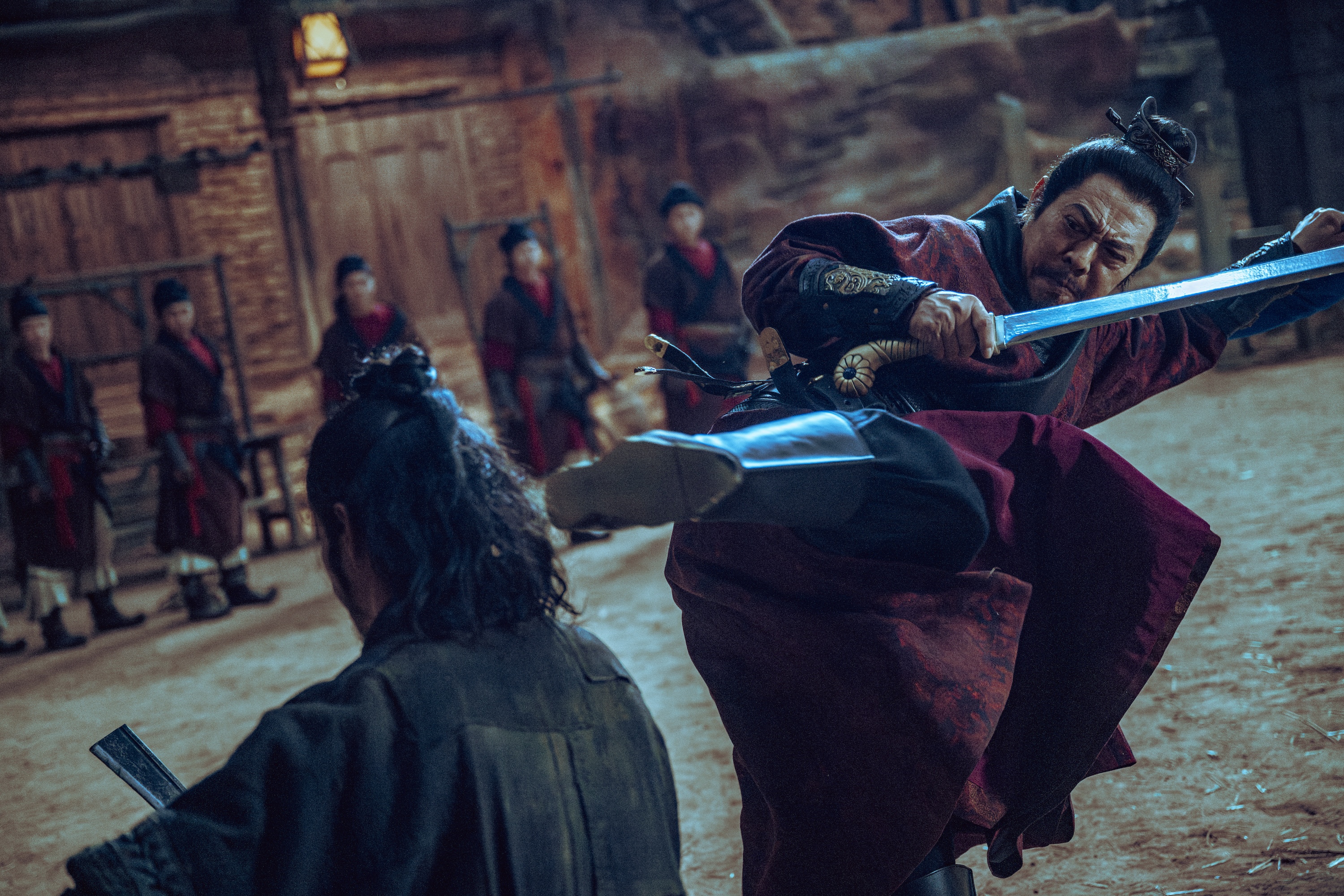
That’s basically the gist of the story, but most of the 125-minute runtime is focused on table-setting, which would’ve been fine if the dialogue didn’t feel so much like obvious exposition. It’s not quite digestible, and often hampers some of the momentum brought upon by its martial arts, which are, to say the least, show-stopping. If you thought the wirework in Yuen’s greatest films was astonishing, just wait until you see the aforementioned Chang Guiren (Li) scene, which blends high-stakes comedy with shocking violence, never neutering the impact of someone getting their leg severed or head kicked by an assailant. The violence is bloody and wickedly well-timed, adding a layer of urgency to the action that hasn’t been felt from Yuen since at least 1994’s Wing Chun.
One even wonders how in the hell Yuen came up with some of the action setpieces in this. There’s a duel that’s literally: “What if Mad Max: Fury Road had two people fighting in the middle of a sandstorm with their swords and had to use the elements as their gravitational force?” It sounds insane, and it is even more in execution. If that doesn’t sell you to run to your nearest cinema and check out yet another lesson from one of our greatest-ever martial artists, what will? I could literally go on and on describing the brain-melting, visually dazzling bravura setpieces, but it would be futile, since the movie is essentially dependent upon you knowing nothing else but the inextricable fact that one of the greatest martial arts filmmakers is once again giving another unforgettable lesson in pure cinema.
It absolutely does feel special that Yuen Woo-ping is still making movies and keeps finding new ways to enthrall audiences by showcasing images (and stunts) you’ve never seen before, when this man has actually done it all. No, really, his filmography is as diverse as it is revolutionary, having forever changed the landscape of action artistry in cinema alongside Lau Kar-Leung and Chang Cheh. Still rethinking what constitutes a great martial arts movie, even after blowing eighty candles and working within new technologies to bring it all to life, is a feat unto itself. Perhaps the story could’ve been less dense and interested in table-setting, but it really doesn’t matter. Once the action starts, lock in.
SCORE: ★★★1/2


Comments
Loading…