

 Robert Hamer
Note: Spoilers for a movie you should not waste any time actually watching are discussed below.
One of the most justifiably reviled films of last year was War of the Worlds. For a number of reasons, but a chief sticking point was how much of its runtime was devoted not only to advertising Amazon products, but also full-on advocacy for corporate mass surveillance. Protagonist Will Radford saves the world, in part, due to his experience with and willingness to utilize every trackable device to monitor whomever he pleases. That was what saved humanity. His arc was not learning that his prior enthusiasm for spying on everyone else was wrong, it was that he was merely using his privacy-violating skills for the wrong reasons, and that he will be joining the private sector to monitor the government! Whoa, what an iconoclast! Don’t worry about Amazon’s surveillance technology, they’re not the Big Evil Government so you can trust them! Buy those Amazon products that track your entire search history, your every move, and all your private data, because they’ll be used by the Good Guys!
I want to make this abundantly clear: what you saw in that film was not an aberration. We will see more of these kinds of movies. We will see more haphazardly produced, lazily written, almost incomprehensibly bad films promoting an ideology attempting to make us more submissive to the kind of society megacorporations like Amazon want to build. They want to beat us down with slop and choke out any competition from studios that actually value art so that our only source of “content” is corporate fascist propaganda that can be made for cheap and spat out on an overpriced streaming service.

Take, for example, Mercy. The setup is actually quite intriguing: a new fast-tracked justice system powered by artificial intelligence makes judgments on whether or not someone is guilty of a crime based on algorithmically-determined assessments of evidence, and one of its earliest advocates, ironically, has to prove his innocence of a capital murder he has been accused of to this program within ninety minutes or the program executes him. Pretty scary dystopian setup! I could easily see someone like Paul Verhoeven taking a premise like this and really running with it. Unfortunately, for Mercy, we have Timur Bekmambetov taking charge, who possess some… odd views on society and politics, which often results in films with really bizarre, borderline sociopathic themes. This latest directorial effort, depressingly, does not buck this trend at all, since it settles into a ticking-clock-whodunnit not only uninterested in wringing any emotional stakes out of the inherent horror of its own premise, but over time actually endorses it as… acceptable, even preferable, to what we have now.
The overtness of its endorsement came as a genuine shock to me, since I knew from the outset that its accused protagonist, Detective Chris Raven, was completely innocent of the crime of murdering his wife. I didn’t read any spoilers for the film ahead of time or anything. I just correctly deduced this because he was played by Chris Pratt, an actor whose choices of roles strongly suggest either a very insecure man or his agent possesses a full-on hagiographic agenda in crafting his client’s star persona. With the sole exception of the Guardians of the Galaxy movies (which he took on before he became a huge star), every major movie he has taken on a starring role since casts him as paragon of manly virtue who is good at everything, makes all the right decisions, and possesses no real character flaws requiring any arc or growth. In fact, it’s usually the supporting characters around him who have to change to properly appreciate just how unwaveringly spectacular Owen Grady / Jim Preston / Dan Forester / John Keats are.
But here is where the movie surprised me, and not in a good way. Because Mercy does bend over backwards to justify one of its main characters as faultless and above criticism… but it’s not Detective Raven. It’s Judge Maddox, the A.I. system determining whether or not he’s guilty. At no point does Maddox hallucinate evidence or make an illogical inference from a new piece of information. It never guesses at an answer or just straight-up lie about something obviously untrue when asked for cold hard data. It is everything the most shameless and sycophantic proponents of A.I. tell us this technology will one day become if we just funnel a few more billion dollars at them so they can build more data centers. Now, it does end up being wrong about Raven’s guilt, but solely because the information it was reasonably interpreting was planted and manipulated by sinister human saboteurs trying to frame him.
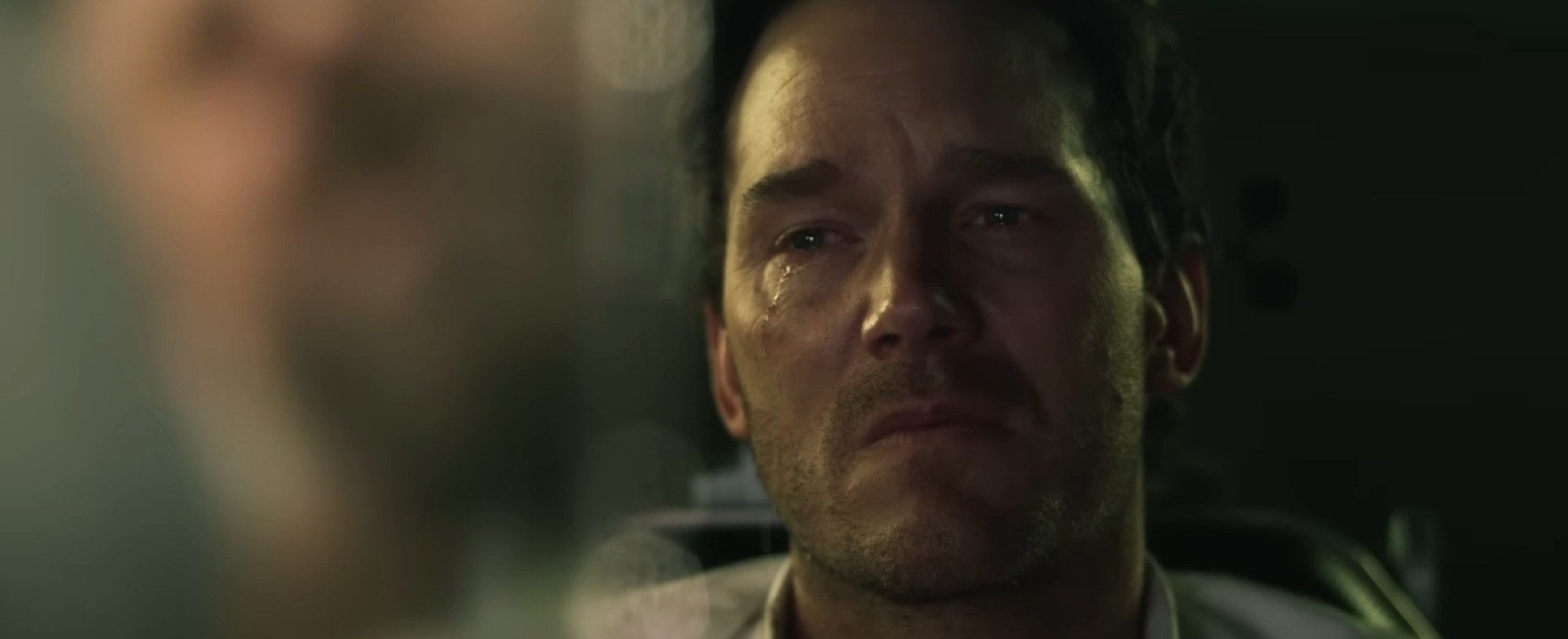
I am not kidding when I tell you that Raven’s arc is realizing that outside meddling from other humans is the only thing that could corrupt this otherwise completely just and reliable A.I. program. He says, and I quote:
Human or A.I., we all make mistakes and we learn.
That’s right, folks. Both A.I. and humans make mistakes! But we also learn and grow! We’re really not so different! Except that’s bullshit. A.I. is literally incapable of learning things the way humans do. But this lie is offered up by this movie as an attempt to condition us to believe Amazon’s mass layoffs and billions pumped into A.I. products are good, actually. And that we should help them prop up their A.I. bubble and cheer on their attempts to force it into every aspect of society. The odiousness of this movie’s ultimate ideological project alone guaranteed a failing grade from me, but it’s not like there’s anything in its execution that warrants praise. Sometimes, movies that mostly take place in a single location with a character interacting with desktop windows and digital icons can be a limitation that skilled filmmaking can turn into engaging cinema, but here, it’s very much a liability, with chintzy-looking holograph images cut together so sloppily that it’s often difficult to visually track how the screens that Raven is looking at connect to what he’s looking for or arguing to Maddox. Even worse is the inclusion of an omnipresent onscreen timer that undermines any subsequent attempt the script makes to up the suspense or manipulate our perception of what’s going on. Pratt frequently overacts except, bafflingly, during the occasional ill-timed MCU-style “quippy” moments where his glib demeanor feels completely at odds with the stakes of his situation, and the supporting cast all give varying degrees of community theater-level performances. The revealed True Villain’s motives make no sense whatsoever in driving his ultimate goal; he would have succeeded at destroying Raven and shutting down Maddox had he just gone public with what he knew instead of orchestrating such a cockamamie frame job. The craftsmanship never sinks to the subterranean depths of War of the Worlds… but it never rises very high above that now multiple Razzie-nominated classic, either.
I will give the film one point in its favor, though. The anthropomorphized image of Judge Maddox is played by Rebecca Ferguson, and while I won’t argue she delivers an Oscar-worthy performance or anything, there are several moments where she is afforded opportunities to Serve Face, and she does not waste any of them. Amidst such an across-the-board amateurish execution of a fundamentally detestable message, I did, however fleetingly, find much to enjoy from those moments at least.
SCORE: ★


Comments
Loading…