

 Steven Prusakowski
Jason Isaacs’ haunting performance as Tim Radcliffe in The White Lotus showcases his mastery of conveying profound emotion through silence, a skill refined over years of acting but sparked by fond memories of watching TV with his family as a child.
During a recent episode of TV Topics, Isaacs shared how those early TV nights in England were a cherished part of his upbringing, offering a glimpse into the emotional world that informs his craft. “I come from a household where all we did was watch TV, crammed together. I’ve got three brothers. Four of us and my parents were just crammed together on the sofa. Whoever, if the space was taken up, the others would sit on the floor. And we just watched television. That’s what we did in my household growing up. It’s all we ever did,” he recalled, painting a vivid picture of family bonding over shows like Star Trek and Hogan’s Heroes.
In The White Lotus, Isaacs embodies Tim Radcliffe, a wealthy businessman whose polished exterior masks a shattering internal struggle. Beneath his composed facade, Tim grapples with a devastating secret that unravels his life, plunging him into a suicidal despair and dark, homicidal impulses toward his own family.
Isaacs described the harrowing journey, “I’ve got to go on this massive journey where my life falls apart entirely. And I try and make a plan, I can’t. I drug myself into a kind of kaleidoscopic stupor, but I come up with a solution, which is to kill myself and then kill everybody else. And I’ve got to do it all by myself with no words.” This internal torment, conveyed through subtle glances and restrained gestures, transforms Tim into a tragic figure whose silent battle captivates and chills, showcasing Isaacs’ ability to portray a man broken yet tethered to a fleeting hope of redemption. The role demanded a performance where silence speaks louder than words, with Isaacs navigating Tim’s psyche with remarkable nuance.
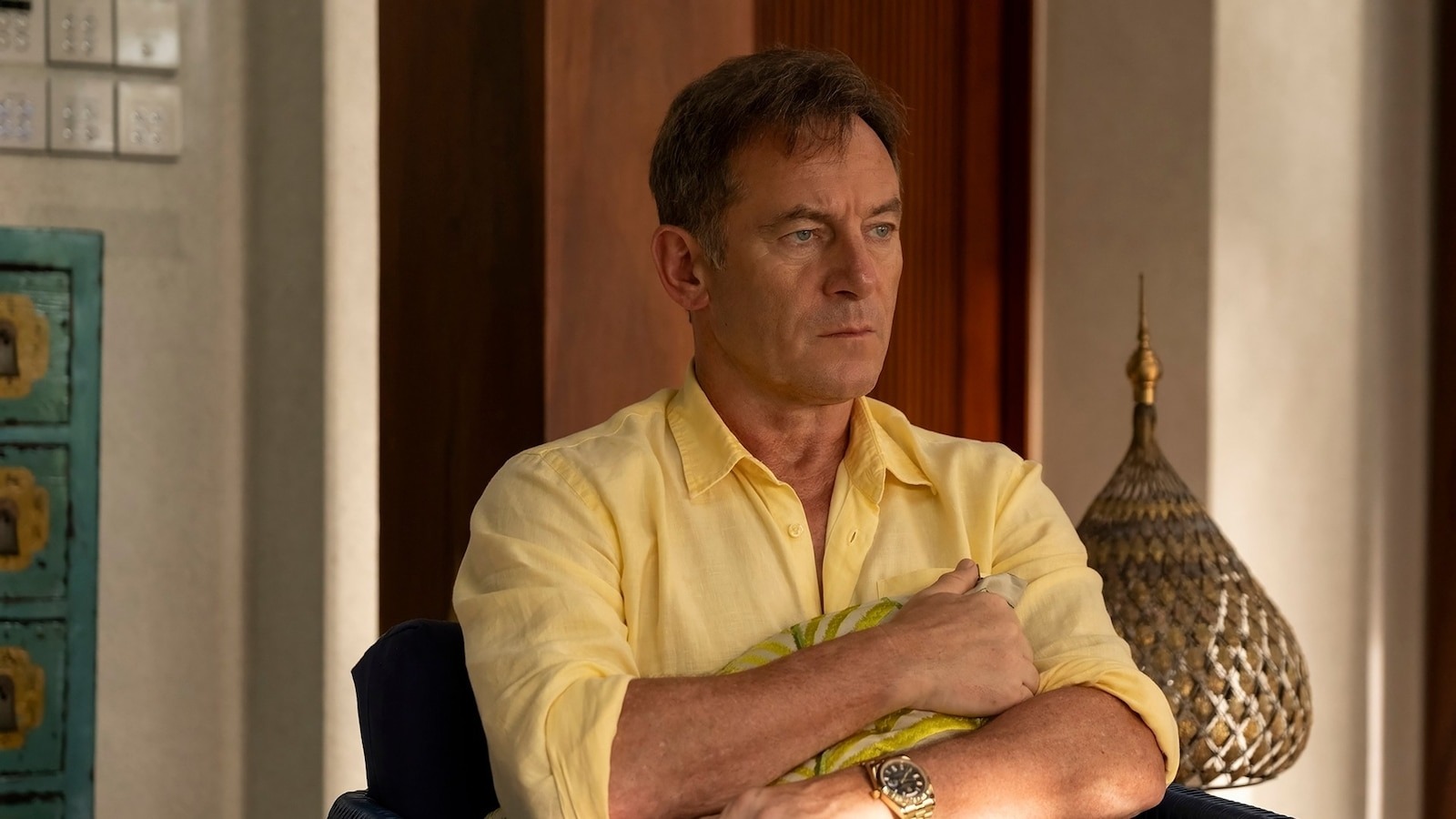
“I looked at this and I thought, wow, his journey is entirely internal. He’s disconnected from the other people. Acting is about connection. This is a guy, Mike White is creating someone I believe in, but 0.01% of the iceberg is showing. And in fact, it’s showing in a way that the people around him can’t even tell what’s going on,” he explained. This internality, where “it’s the 99.9% of the thing that’s not poking out,” required Isaacs to convey a crumbling psyche with minimal dialogue, a task he approached with both excitement and apprehension.
Isaacs’ ability to access raw emotion stems from his approach to acting, which he keeps close to the surface. “The thing about my job, oddly, is that I need to, or maybe I’ve always been like this, why I was drawn to it, keep childlike emotions very close to the surface. You ought to be able to cry and laugh and be responsive,” he said.
But, to play Tim Radcliffe, much of that approach had to stay in check as the character dealt with the inner struggles he could not reveal to his family. “For me, what I was, every single thought is catastrophe. Every thought I carry through, what’s it going to be like when I do this? What’s it going to be like in prison? What’s it going to be like when I talk to these guys? How are we going to live? And every thought I come, this is a man who’s been nothing but solutions his whole life. He’s rich and powerful. And everything has fallen in his way. Money and power and status will always solve any problem. And he can’t solve any of these problems,” explained Isaacs.
This emotional openness allowed him to portray Tim’s arc, from privilege to despair, with haunting precision. “Timothy has had a complete Damascene conversion. Having been the guy who arrives and goes, I don’t want any of this bullshit, man, I just want to go to the gym. He’s left and he is the literal, the physical and spiritual embodiment of Buddhist principles. He’s come to a place in his life through this crisis where he is accepting fate. And he looks at those drops of water and he thinks, he’s anticipating the bliss and the relief of just being part of the ocean, common humanity, no longer feeling like he has to be above or better than, superior to anyone else.”
Isaacs’ performance in The White Lotus is the result of years of craft, with those early TV memories serving as a nostalgic backdrop. “Acting isn’t, it’s pretend, but it’s as little pretend as you can make it. You have to trick your imagination into being the thing,” he explained. He credits much of hs performance to series creator/writer/director, Mike White, “One of the things that doesn’t get talked about maybe as much as his brilliant writing. Mike is a remarkable director in that he’s a very gentle hand, very gentle steering hand. He doesn’t, just never tells anyone what to do,” explained Isaacs.
“Some people think directing is telling people what to do. And in some cases, it is, when it’s done badly. But, he regards the performance like a soap bubble. Ever so gently, lightly suggesting things, but with utter brilliance to steer you towards something that you feel like you own yourself. And I felt like I was in safe hands very early on because he wants, he wants choices in the edit because he’s making, he’s telling so many stories that interweave. So he asks you for things you wouldn’t normally do, which is to give him lots of choices,” shared Isaacs.
The actor has quite the way with words making every story he shares quite riveting. Listen to the full TV Topics conversation with Jason Isaacs where he dives into his career of work including more The White Lotus, the historical inaccuracies/accuracies of some of his most memorable of his his ill-fitting Star Trek costume that shared more about his than he would have hoped and much more.
Watch all of Jason Isaacs’ Emmy-nominated work in The White Lotus streaming exclusively on HBO Max. You can find a previous Isaacs conversation with Joey here about his performance in the film Mass.


Comments
Loading…