
 Cory Stillman
Prime Video’s The Wheel of Time has been lauded as a delightfully risky adaptation of the fantasy series of the same name, occasionally straying from the source material while still staying true to what fans love most about Robert Jordan’s work. Composer Nikhil Koparkar had already read all 15 books in the series by the time he was tasked with writing “The Hills of Tanchico,” the musical number that unexpectedly arrives in S3E6 “The Shadow in the Night.” His love for this epic fantasy world even compelled him to write a “musical love letter” to the series in 2019.
“I still remember how amazed I was by the fandom’s support,” says Koparkar. “They embraced the piece wholeheartedly, sharing it widely and even tagging the production team to show their excitement.”
If Koparkar was thrilled with the love for that initial tribute to The Wheel of Time, just imagine his reaction to the enduring fanfare around “The Hills of Tanchico.”
“Getting to contribute a song to the world of The Wheel of Time, and now seeing fans singing it at JordanCon and creating T-shirts inspired by it, has been one of the most humbling and joyful experiences of my journey,” says Koparkar.


The song was crafted in collaboration with writer Rammy Park, who penned the lyrics as part of her work on “The Shadow in the Night.” Park’s script for the episode heavily informed the melody and tone of the piece.
“I immediately noticed how expertly she wove together the layers of meaning,” says Koparkar. “There’s the playful double entendre on the surface, but underneath it all, there’s this sense of melancholy, a song that’s been distorted over time into a raunchy bar anthem.”
Therein lies the brilliance of Koparkar and Park’s work. “The Hills of Tanchico” functions as a kind of coming-out for the otherwise shy Elayne Trakand (Ceara Coveney), but it is also an effectively playful and catchy tune, replaying in the minds of fans over and over again.
Check out our full conversation with Nikhil Koparkar below!
Hi Nikhil! “The Hills of Tanchico” has received widespread praise from The Wheel of Time fan community—not just for its catchy melody, but for how well it captures the spirit of the books and the world they love. What has that response meant to you, especially as a longtime fan yourself? And did you anticipate it would resonate so deeply when you were writing it?
When working on an adaptation with such a rich world and dedicated fandom, you hope the music will resonate and feel like it belongs in-world — but I could have never imagined the response “The Hills of Tanchico” would receive.
As a lifelong voracious reader, diving into all 15 books of The Wheel of Time before starting work on the show helped me develop a deeper appreciation for Robert Jordan’s rich, multicultural world, and for how he masterfully balanced darkness with light, gravity with humor.
Back in 2019, I wrote a musical love letter to the series, recording it with the Budapest Scoring Orchestra. I still remember how amazed I was by the fandom’s support! They embraced the piece wholeheartedly, sharing it widely and even tagging the production team to show their excitement.
That early enthusiasm eventually helped open the door to one of the most meaningful opportunities of my career — working alongside composer Lorne Balfe on Season 2 and then 3, based on the books that shaped so much of my imagination.
Getting to contribute a song to the world of The Wheel of Time, and now seeing fans singing it at JordanCon and creating T-shirts inspired by it, has been one of the most humbling and joyful experiences of my journey.
Tanchico is a cultural crossroads. How did you approach the challenge of representing that musically, especially when fusing influences from Malaysia, East Africa, and Eastern Europe into one cohesive piece?
One of the things I’ve always admired about Robert Jordan’s writing is how seamlessly he wove different cultures together, creating a true confluence where it’s difficult to tell where one culture ends and another begins.
Throughout my composing career, I’ve been fascinated by taking non-obvious, non-traditional instruments (often steeped in centuries of tradition), and recontextualizing them. When you lift these instruments out of their expected settings, you unlock a completely new universe of sounds, which can be incredibly powerful for musical world-building.
For The Hills of Tanchico, production wanted a sea shanty-style bar song that could function as a sing-along. To build on that foundation, I kept the familiar elements one would expect in a song like this at the forefront — vocals, acoustic guitar, mandolin, and accordion, but layered Malaysian plucked instruments and African percussion underneath in a rhythmic and supportive role.
The goal was to create a sense of familiarity without tethering the listener to any one real-world location. In a fantasy world as richly unique as The Wheel of Time, it was important that the music felt equally unplaceable, rooted in emotion and texture rather than geography.
What was the collaboration process like with Rammy Park, who wrote the lyrics for “The Hills of Tanchico” and the episode itself? How did her script inform your musical interpretation of the song?
When production sent me the script containing Rammy’s incredible writing and lyrics for The Hills of Tanchico, I immediately noticed how expertly she wove together the layers of meaning. There’s the playful double entendre on the surface, but underneath it all, there’s this sense of melancholy, a song that’s been distorted over time into a raunchy bar anthem.
I really wanted the music to reflect that, so I decided to start the song almost tentative and bittersweet, to mirror both the deeper meaning of the lyrics and Elayne’s arc (which actress Ceara Coveney plays so brilliantly.) She’s shy to sing at first, just like the song itself feels a little hesitant.
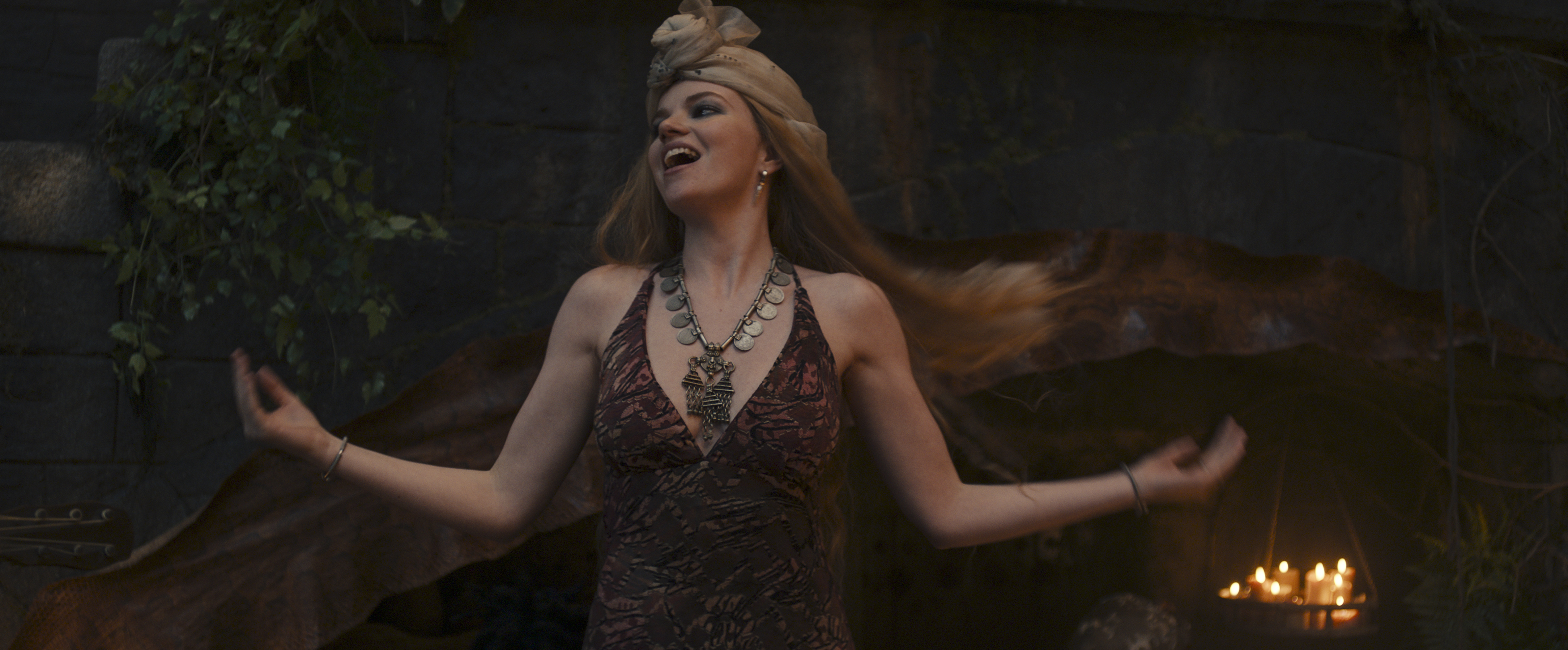
As the scene goes on and Elayne realizes what The Hills of Tanchico is actually about, she leans into it, and the song shifts with her. It starts to feel almost heroic, like she’s stepping into a “timeless legend” kind of moment.
By playing the music straight, rather than leaning fully into the joke, we gave the humor room to land naturally through the situation itself. It made everything feel more grounded and true to the spirit of the story.
Deadline-wise, things were moving insanely fast. I had to create and send in a demo that same morning. Definitely a bit of pressure! But honestly, sometimes those kinds of time constraints are the best thing: They force you to trust your gut instead of overthinking every detail.
I’m just so grateful I had read the books beforehand, as it gave me the foundation I needed to approach it with a desire to do justice to the spirit of Robert Jordan’s world..
Did you draw on any specific musical themes or sonic textures from other songs or parts of the score in previous episodes or seasons of The Wheel of Time when developing “The Hills of Tanchico”, or did you see the song as a standalone musical statement?
This song was a little unique in the world of The Wheel of Time, since it’s a departure from the often darker tone of the show. It was meant to not only serve as a lighter counterpoint for the season, but also to reflect a shift in Elayne’s story arc as she comes into her own.
Given its independence thematically, I wanted to mirror that musically too, leaning into a different musical genre while still feeling rooted in the magnificent score that Lorne and the team have built.
There’s definitely some overlap in instrumentation, especially with the acoustic guitar and vocals, but the goal was for it to feel distinct from the rest of the score, whilst serving as a reunion with a certain Gleeman everyone had been missing since Season One.
The song plays in two pivotal scenes and during the end credits of Episode 6. How did you time the emotional beats of the piece to support those moments onscreen?’
When I spoke with production about the overall arc of the song, they mentioned wanting Mat (played by Donal Finn) and Thom (played by Alexandre Willaume) to come in for the reprise.
With that in mind, I structured the original demo starting with Elayne, and then had Mat and Thom join in after the first chorus.
Production ended up weaving the song into the choreography of that first intro scene, and then brought it back during the second scene as more people are singing and dancing, which I thought was such a fantastic choice.
The second half of the song naturally feels more celebratory, which fit perfectly with where the characters are emotionally at that point in the story.

As someone tasked with contributing to the musical identity of a sprawling fantasy world, how did you decide when to use traditional orchestration vs. unconventional instrumentation?
Since the beginning, Lorne has incorporated a lot of non-traditional elements into The Wheel of Time score. Most fantasy shows rely heavily on sweeping, bombastic orchestras, but Lorne’s approach has always been different.
He’s used everything from a Carnyx (an ancient Celtic horn) to ethnic percussion to solo instruments that are processed and shaped in new ways — so we were never beholden to any one musical tradition when it came to choosing the right instrumentation for The Hills of Tanchico.
That freedom made it both easier and more challenging to figure out the right approach.
I’ve always found that starting with a melody you can play on a single instrument and sing along to is a great foundation. Once I had that melody locked in, it became a lot easier to find creative ways to use instrumentation to support it.
How has working on The Wheel of Time influenced your own artistic evolution? Are there techniques or approaches you think you will take on with you for future projects?
Working on The Wheel of Time has been the greatest gift of my artistic career so far. Not only did I get the chance to work on a true dream project, but Lorne really put his trust in all of us, allowing us to take the lead on cues and bring our own voices into the music while incorporating his amazing themes.
That trust has been transformative. It encouraged me to explore even more non-traditional instrumentation in my own compositions.
Most recently, I scored a psychological horror film set in Cape Cod called Dead Whisper, where I taught myself to play a Thai bamboo instrument called the khaen, used Mayan death whistles, and experimented with non-traditional percussion techniques to mimic other instruments and create otherworldly textures — all as part of the musical world-building process.
Working on The Wheel of Time helped me realize that even though media might fall into a specific genre, there are so many ways to approach it. One can draw inspiration from theme, setting, character, and atmosphere rather than feeling bound by genre conventions. It opens up an entirely new universe of possibilities when you start there first.
I’m excited to keep exploring this path and see where it leads next.


Comments
Loading…