

 Maxance Vincent
*Warning: The following interview contains spoilers for Daredevil: Born Again*
While following the narrative of the Netflix television series, Marvel’s Daredevil: Born Again has a distinct look and feel that sets it apart from what came before, while also paying homage to some of its most notable hallmarks. Cinematographer Pedro Gómez Millán helped establish the look of the series for episodes four and five, which Jeffrey Nachmanoff directed. While episode four is more in line with what was visually set up in the previous three by director of photography Hillary Fyfe Spera, episode five puts Matt Murdock (Charlie Cox) in an entirely different situation than what we expect coming from the character, and teaming up with an unexpected ally in Yusuf Khan (Mohan Kapur) to foil a group of bank robbers.
Episode five was also the only one that remained untouched from a creative overhaul, after Marvel replaced showrunners Matt Corman and Chris Ord with Dario Scardapane and brought Justin Benson and Aaron Moorhead to direct a brand-new pilot alongside two additional episodes. For Gómez Millán, the creative overhaul helped the show elevate its visual style and made it even stronger, which allowed them to refine several techniques, such as Matt’s sensory abilities and making the camera more intuitive.
During our interview, which is seen below, we broke down the process of shooting episodes four and five, including some insights on its most notable sequences and images, such as a meticulously crafted one take in the fourth episode, or how the aforementioned sensory abilities were employed as Matt looks for the bullet case that killed Hector Ayala (Kamar de Los Reyes). We also discussed how it was important for Daredevil: Born Again to find its own visual identity and make New York a character in its own right.
Listen to the full audio conversation below:
Read the transcribed conversation below, which has been edited for length and clarity:
Were you familiar with the character of Daredevil, or had you watched the Netflix series before you joined Born Again?
Yes. When I got the script, I came in for an interview and put together a visual treatment. I had to familiarize myself with the character of Daredevil. I knew about the character, but I wasn’t a hardcore fan until I start watching the show and preparing myself for the interview. I was like “Oh, my god! This is amazing! This is such a great show, the character is so great, and the scripts were amazing.”
In terms of setting the visual look and language of the series, was it an intentional choice to differentiate it from what we saw before in the Netflix series, and for Born Again to be its own distinct entity?
We all loved the original show. We all loved how amazing it is and how the fans respect it. We definitely took that into consideration and brought a lot of those elements back at the same time. However, you’re dealing with a new script and a new story. So you want to make it feel new and fresh in its own way. We still want to keep the street level and the dark aspect of New Yok. But we also wanted to make it feel authentic, organic, and unique. It’s a very visual show, and I was very excited to be part of it.
I think that in this series, more so than the original show, the city of New York feels like a character in its own right, and there are numerous distinct locations that have a unique look and feel, truly setting it apart from what we saw before. Was there a desire, for this show in particular, to make New York feel like its own character, and have the camera showcase just how layered the city is, and show the different features of the locations you were filming?
Absolutely. I’m so glad you picked up on that, because it was definitely an intention to do that. We wanted New York to be a character, and a little bit more than the previous show. We wanted to shine a light on those New York City street corners that were not as much of a feature in the Netflix show. New York develops as a character through the show. You have amazing locations, like Red Hook, for example, where you see Fisk coming in and discussing his plans for the city and the port. You also see Red Hook at night, with the mafia and Vanessa making deals with them. The locations are layered, and there are different angles to the story, which help push the story forward. We wanted to go to iconic places. We also have our stages and recording sets, but we really wanted to explore aesthetically pleasing locations in the city. Our production design is amazing and really supported the show and the story.
How much of it was actually shot on location in New York?
I think a good amount. I don’t have the exact number, but it’s definitely more than half. The episode in the bank is all on location. But with a show like this, you have to shoot on stages as well, because of budget, scheduling, and other reasons. We wanted to go out on location as much as possible, and I think you can see that in the show.
The series underwent a creative overhaul after many episodes were shot. Did that affect the visual look of the show, or did it relatively stay the same?
I think that ultimately helped the show. Coming back from the pause made the show even stronger. There was a unique opportunity to sit down and see what was working and what was not. Coming back after that, the team knew what they loved. It’s a rare opportunity to have that. After revising the footage, we went more specifically into the visual look. For example, regarding Matt’s sensory abilities, we were trying to keep everything within the camera’s frame and find flares when possible. Those things were working, and we did more of that. We had the camera be more intuitive with Daredevil, and make it a little bit more loose, and make it feel less rigid, instead of symmetrical and in studio mode. Coming back from the pause, we were able to focus on what was helping the show, and that was a great opportunity.
When the show visualizes Daredevil’s powers, I don’t remember that they were visualized that way in the original Netflix series. And it’s really cool to see this great dolly zoom in the fourth episode, when he hears the bottle clanking, and this is where he realizes the bullet that killed Hector is also at that same place. Can you describe how that specific moment was captured and achieved?
Yeah, totally. It’s a variety of visual elements, because not every moment is the same for Daredevil. There are also types of flashbacks, where he’s hearing something particular, and remembering something. Then, there’s a scene where he’s searching for the bullet case and focusing on a specific sound. Those different moments also require different visual techniques. You cannot shoot everything the same. You have to make it more specific for the character. Aaron and Justin, the directors who shot episode one, really set up the aesthetic of how things would look, especially with his superpowers. They came up with the Zoom technique, and that was what we embraced after the pause. There’s an amazing zoom in the pilot that requires a very complex rig and a lot of time. Sometimes, you cannot take that amount of time to shoot every time Matt hears something. But we try to incorporate a more schedule-friendly version of it.
We had a few Zooms. We’re shooting anamorphic, and anamorphic zoom lenses are quite heavy and very long. It’s not easy to handhold. The specific moment you’re talking about was a dolly and zoom, and I feel like he’s listening to try and figure out where the bullet case might have fallen. He finds this bottle, knocks it down, and listens to the sound of it hitting the sewage. That moment is accomplished with the camera dolly zooming. You see the perspective of the background changing as he goes through all these emotions and through his senses. I think visualizing these moments is very fun, and I’m glad you picked up on that.
I think it’s also important for the camera to respond to the sound. Was that also an intentional thing to shoot as well, because what we’re hearing also has to respond to what the audience is seeing?
Yes, the camera needs to be reactive and very sensitive. If the camera was in studio mode, it would be really hard to find interesting angles or flares that respond to Matt’s senses. In that case, an old camera interacts a lot more with the actor, too, with an operator present. Sometimes, we repeat take after take, and the actor will do something different. The great thing about an operator is that they are present and able to react. Sound is also a particular element in the story. We discuss those things frequently, especially with the director. What are we listening to when we’re seeing this? What type of camera movement do we need to do if we’re listening to the bottle? These were all conversations we had during the pre-production process.
There’s a great shot in the fourth episode, which begins with Daniel Blake in the cab, the camera pushes towards the window, and transitions to Leroy getting arrested. I think the police cars act as the transition. How was that shot achieved? Was it a one-take or made to appear that way?
It was a one-take! I’m so glad you’re asking about this. To be honest, we shot this before the pause. We wanted to shoot all these transitions in one day, moving from one space to the next throughout the episode. I talked to Jeffrey, the director, and asked him, “What if we go through the window of the cabin, and then we see Leroy sitting across the street?” It’s a very good, quick shot, and most people may not even notice it, but it requires a significant amount of effort from multiple departments. It was one of those shots that involved many moving pieces. We needed to wrap and get that shot right. Long story short, we found a cab that could accommodate a camera. We removed a piece of the roof. It was a technocrane that came near Daniel; he leaned back, the cameraman kept going, and found Leroy on the other side of the street. It was great. I love that shot. It’s probably one of my favorites.
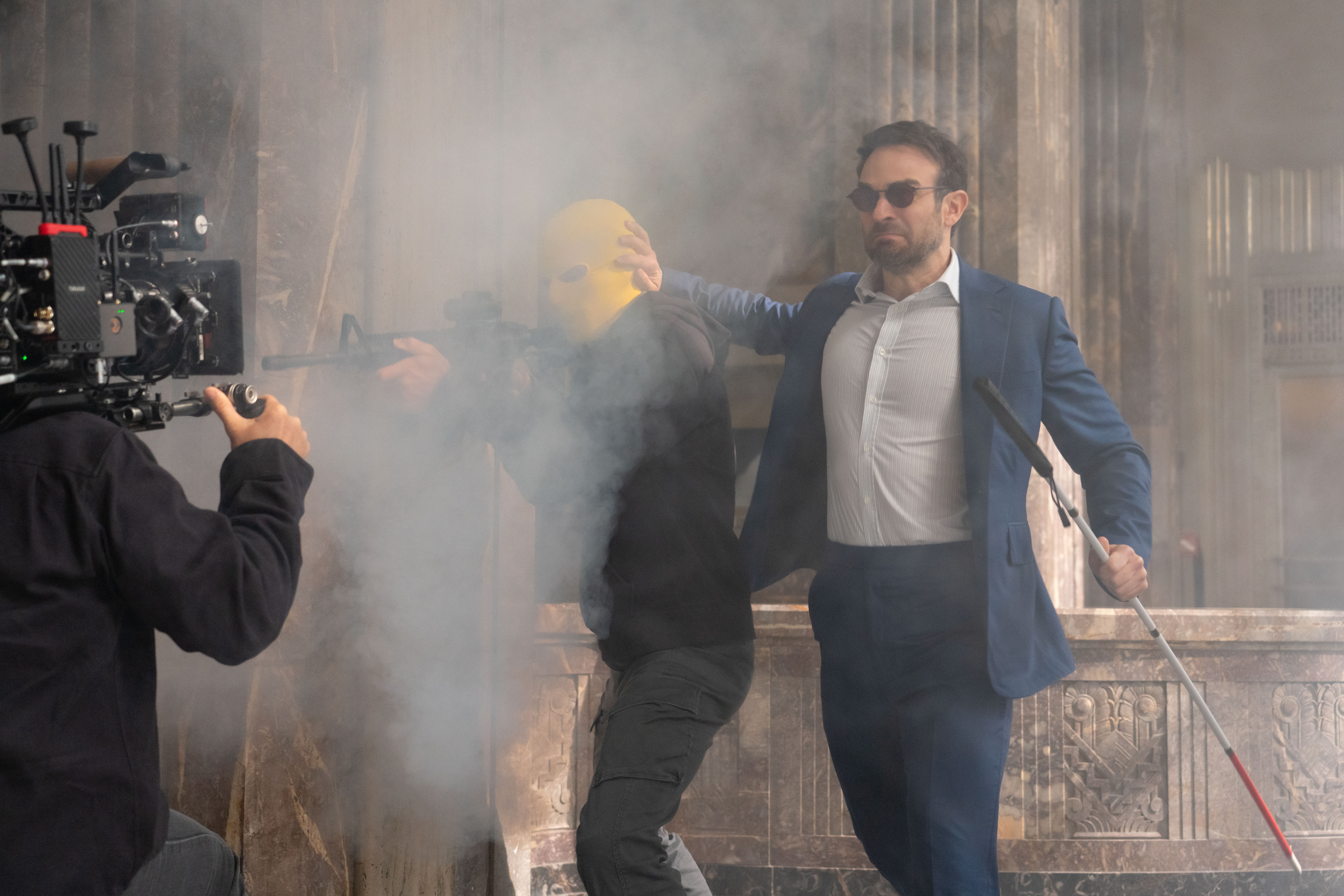
I think you also worked on the fifth episode of the show. That’s a very different episode than what came before, because it puts Matt and his sort of side quest, if you will, with Yusuf, as they’re caught in a bank robbery. Was this an intention for you and the director to visually set it apart from the rest of the pack?
This was shot before the pause, and if we had shot it after, we would have probably shot it differently, to be honest. This was also a bottle episode, which means, in TV,, sometimes scheduling actors, locations or a budget, you need one of those episodes to come in the middle of the season to focus on one location, and not have too many actors so you can regroup and keep going for the second half of the season. We also didn’t touch it after the pause. Dario rewrote some scenes, and we had to reshoot a lot of things, or shoot additional material for most of the episodes we had shot at that point, but episode five remained untouched. It was a very complicated. A lot of things happened. It was set on Wall Street, and in the same location where they shot Inside Man. Technically, it required a lot of logistical effort to light the inside of the bank, because there is no sunlight that comes in through the windows. It had two roads and big, expansive windows. However, because it sits in the middle of the financial district, there are numerous skyscrapers, and the streets are quite narrow. It’s difficult for ambient light to enter. Because of this, we had to light everything, almost as if it were a stage. It was actually a practical location with many practical issues, such as not being able to close down Wall Street during shooting.

There’s a fairly significant moment in that episode at the end of it, where Matt confronts one of the robbers and breaks his leg. That’s a significant turning point for him, because he’s inching closer and closer to becoming Daredevil again. In the sixth episode, he actually does suit up. This was shot before the creative overhaul, as you said, but it’s still a really effective fight sequence that’s very much in line with what we saw in the show in terms of the action.
Yes, this was an important fight. We had the location, but there was one scene that we still couldn’t figure out where to put it, and it was a fight that the team had to film in one day at the bank. I remember one day driving in the van on the scouting union. You’re scouting, and you’re talking to the producer and the director. I remembered seeing an alleyway somewhere. I felt that it could be a really interesting place to set up the fight. With New York in mind, we want to showcase the city. The entire team were wandering around all those blogs to find an alleyway, but it ended up being a great location for us also. Visually, as you said, Matt is getting closer and closer to that inner devil and closer to suiting up. He’s also getting more violent. It’s a very graphic scene. Visually, we wanted to convey that it’s like boiling water. It’s not necessarily boiling now, but it’s simmering and getting in there. That scene was a part of the whole process.
And is there something that you would say was the most rewarding aspect for you as a cinematographer to work on a show like Daredevil: Born Again?
The most rewarding aspect was working on a show for the first time with such a large following worldwide. It’s so rewarding to also be part of a team of filmmakers and artists that want to bring the best show possible to the screen for people to enjoy. This one, particularly, was such a challenge, but also such a reward, to see people being excited and passionate about what they see on the screen. I haven’t seen that before, and in other superhero projects. Working on this show felt like a lot of responsibility, but I felt very grateful and honored to be part of the team.
All episodes of Daredevil: Born Again are now available to stream on Disney+.


[…] Первоисточник: awardsradar.com […]