

 Steven Prusakowski
When you enter the world of Schmigadoon!, it starts with an ominous candy vending machine on stage, a phrase I am not sure has ever been muttered before, and soon we are crossing a bridge not only into the magical town of Schmigadoon, but also into the Golden Age of musicals for a feast of singing, dancing, color, comedy and heart.
The Broadway musical, based on the Apple TV series of the same name (created by Cinco Paul), is a love letter to the Golden Age of Broadway, following New York doctors Josh (Alex Brightman) and Melissa (Sarah Chase) as they find themselves in Schmigadoon, where the townspeople cannot stop singing and dancing all of life’s moments in the grandest way possible and the only way to escape is by finding true love. Unfortunately for the couple, but fortunately for the audience, they are in the middle of questioning their love, meaning they are stuck there for a prolonged time. Which only means more extravagant numbers, laughs and all-out Broadway spectacle.
The show is one of the biggest success stories of the 2026 Broadway season, earning 12 Tony Award nominations and ultimately winning four, including Best Musical, Best Book of a Musical, Best Original Score and Best Orchestrations.
With the musical filled with humor, romance, great characters, heart and lots and lots of music, it is vital that the audience can hear every note, every lyric and every perfectly timed joke if it is going to connect with them. That is where Tony-nominated sound designer Walter Trarbach comes in. His work on Schmigadoon! earned him his second Tony nomination for Sound Design of a Musical.
It is not simply about recreating the look of an old-fashioned musical. It is about making the audience feel what it was like to experience one, while using every tool available to a modern Broadway production.
“Well, in terms of big musicals, we did this one on a very short timeline, which I think is kind of a testament to the confidence that the director and the producer had in the project and how well developed it was. Normally, there’s a longer load-in period where we put the equipment in the theater. There’s a longer tech period. There’s a longer preview period. And this we did the whole thing pretty fast, I’ll say. So in some ways that was kind of nice; in some ways it was like once we started, you got to get on the train or the train is gonna be at another station.”
“One thing I really liked, it’s fun to work on a very Golden Age style musical with the orchestrations and the swells from the reed sections and getting to do something that’s like a real love letter to Broadway and be kind of part of that. That was a real treat for sure,” said Trarbach.
Trarbach’s own journey to Broadway began long before Schmigadoon!. He started doing theater when he was just 14, working in community theater in Wisconsin before going to college to study sound for theater. He moved to New York in 2001 and has been working on shows ever since. His Broadway résumé includes 700 Sundays, Jersey Boys, SpongeBob SquarePants and Water for Elephants, for which he won a Drama Desk Award. Schmigadoon! earned him his second Tony nomination for Sound Design of a Musical.
“I’m fortunate in that I’ve met some great people along the way who have really helped me and taught me how to do it. And I’ve gotten to fall into some great projects. I feel kind of like I fell backwards into Schmigadoon!,” revealed Trarbach. “It’s such a beautiful show. I just feel grateful to be involved with it.”
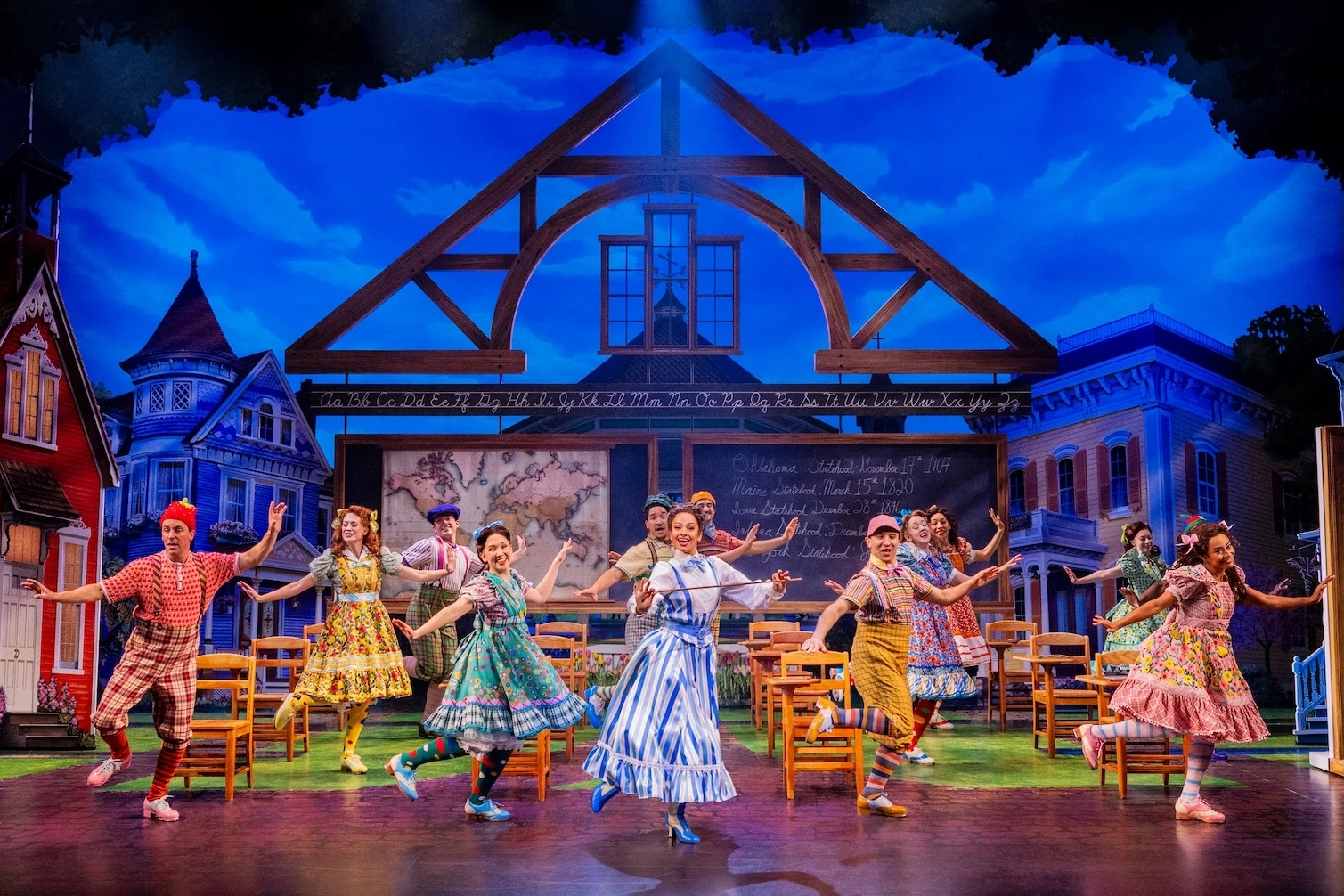
The show is intentionally looking backward at entertainment’s past, but at the same time it uses the modern technology available to bring that world to life. The irony is that Trarbach’s use of contemporary technology is so important in creating something that feels as though it existed decades ago.
“I wanted it to have the feel of one of those open, Golden Age musicals like The King and I or musicals that I loved growing up and still love, those beautiful Rodgers and Hammerstein songs,” expressed Trarbach. “And so, to do that, in terms of our audio production our kind of North Star was that less is more.”
That philosophy was followed throughout the show’s sound design. “We don’t really use any of the tricks that you would use in a more produced rock album or show. We kind of just try and rely on the orchestra to blend internally and we try to present that to the audience,” he continued. “So we don’t use compression. We don’t use a lot of reverb. There are no vocal tracks. There’s no metronome. The musical director Stephen Oremus just feels the tempo like he feels it should go. He follows the actors; the actors follow him. So in that way, it is very true to the style that it is presenting.”
Trarbach is at times the air traffic controller of sound, taking the sound created by the performers and musicians and carefully deciding how those sounds reach every person in the theater.
“It’s such a crazy thing. I think it’s a wild job because sound design barely even exists. It only happens when the show is happening, right? And for most of the show, we’re not making sound. We’re just taking the sound that everybody else makes, all the performers, and then we basically just set the relative volumes of it and send it out to the speakers to the audience at relative volume levels depending where they’re sitting and what they need.”
“It’s almost like curating exactly what the audience should be hearing out of everything that’s done on stage,” explained Trarbach. “We put microphones on every actor, every musician. I think there may be like 18 or 20 microphones in the percussion area alone because they’ve got all these little things. Then we just kind of take it moment by moment and we try to mix the songs, try and make them sound a little better every time we do it.”
For such a sound-focused job, a surprising amount of physicality was required of Trarbach, as he had to move around the theater from seat to seat to experience that difference for himself because there is no single place in a Broadway theater from which the audience experiences the show in the same way audibly. A sound that works perfectly in one seat can feel completely different several rows away.
“[The sound] definitely changes in every part of the theater. So in every performance basically, I’d get a different seat from management. I’d sit in this place, then I’d sit in the next place. And sometimes if it’s good, like after an act I’ll leave and go to a different part of the theater and kind of see what it’s like there.”
“But in every area of the theater you kind of have to recalibrate the blend of the vocals versus the band versus the reverb versus the sound effects versus the whole thing. So there’s sort of a macro mix, which is what the operator is doing of the relative instrument levels and vocal levels, and then on top of that there’s a secondary mix which is just specifying the sound for every part of the theater and the different speaker systems.”
That becomes quite complicated on a show like Schmigadoon!, where comedy and music are constantly fighting for the audience’s attention. Trarbach explained how the blessing of laughter was also one of his biggest challenges. “That was really a challenge of the show. And we work in the sound department to try and get those out and really punch them. Because it’s funny, when an ear acclimates to a loud sound, even a normal-level sound feels under and it’s hard to understand. So we really had to kind of experiment with it.”
The problem was not simply making sure the jokes could be heard. The audience’s reaction could actually change the rhythm of the show.
“And everything changed when there was laughter, and that changed the entire rhythm of the show, obviously for the better, but it also… if there’s kind of a rolling laugh it would step on jokes. So the actors had to feel out the timing, and we also worked with the orchestrators and the music supervisor. I think they were very conscious of getting the band kind of out of the way when there’s a joke and making space for it.”
Sometimes, the solution was not something Trarbach could fix from behind the sound console and the show needed to be slightly reworked to ensure that the audience reactions did not step on the joke or the emotion of the show.

“There were times when we’d have discussions that I’d say, ‘Look, I cannot get this up because this swell is happening in the orchestra. So we either have to cut the joke or we have to kind of revise the structure of the song,’” Trarbach revealed while still holding back some show secrets. “And those were conversations that happened, and I think we resolved everything. There’s one or two things I wish we could do a little better, but I’m not gonna tell you what they are. You can’t win them all.”
It is another part of what makes live theater so different from film. There is no opportunity to simply move the camera closer or cut around a problem. Everything has to happen in the room, in real time, and it goes both ways, with the audience participating in the experience. If you lose the audience’s energy, that reverberates back onto the stage.
“If you were doing a movie, you can do close shots and frame the audience’s attention that way. But in theater we have to do a lot of it with lighting and sound. So we rely a lot on the lighting designer to train the eye of the audience. But we also, in terms of sound, want to keep everything moving along and keep it cohesive.”
Keeping the cohesion and retaining the natural feel of the story becomes quite technical. While it feels effortless, there is a precision to the sound design that extends throughout.
“There are several volume levels at which a show exists: when two people are talking and there’s no orchestra playing it’s quieter than when two people are talking and there’s underscoring, it has to be louder, and then when people are singing and there’s a huge big dance number that’s gonna be even louder still. So it is a little bit of trial and error, some of it’s instinctual, just kind of figuring out how the musical needs to work, what the orchestra is doing, and what the whole sound process of the show and the experience is going to be.”
Trarbach’s work revolves around the unusual task of using modern technology to recreate an experience that existed long before much of that technology did. “When they were doing those musicals on Broadway, there weren’t microphones. The actors were pretty much unamplified, which I think is a huge reason why there’s kind of a stereotype of a hammy, performative actor who gesticulates wildly, because they were all just working to make sure 1,500 people could hear and see them.”
“I think the microphone has actually helped actors give a lot more sensitive performances, which is a great thing about it,” said Trarbach. “But we made the design decision early on that we didn’t want it to sound produced or slick or like a modern musical sound. We wanted it to be very open and expansive and focus on just what the performers were doing and presenting that to the audience.”
Being set in the Golden Age, the sound design’s most unlikely challenges came from the wardrobe. “It’s funny, on this particular show, what I think I did very well and what I’m probably happiest about is that I kind of anticipated all the problems and solved them before they started. Which is something I always try to do, but it went very well on this.”
“Something that is always troublesome for sound in theater is when actors wear hats. They wear their microphone right there in a best-case, and when they wear a hat like that the sound goes into the microphone, then it bounces off the brim and goes back into the microphone, so it starts to interfere with itself. So we worked with the costume department before we started and we looked at all the hats they had lined up.”
The solution was to put microphones directly into the hats.
“Okay, we need to put a different microphone and transmitter in each one of these hats. So every hat in the show that an actor wears pretty much has a microphone on the tip of the brim. And when they put that hat on we turn off the microphone on their body and turn on the microphone on their hat. So we coordinated with them. I think we have seven or eight mics in the show that have hats in them.”
“They just kind of tip them back so that the sound doesn’t bounce off the brim. So if you actually pay attention to the angles of some of the hats in the show, they’re preposterous, they’re just kind of on the back of the head hanging on for dear life. But that’s just to clear it out so that the sound is a little less affected.”
There is an even bigger example of old and new coming together in the show’s A/B sound system. Trarbach describes it as essentially putting two speakers everywhere a normal Broadway show would have one.
“Our sound system for Schmigadoon! is an A/B sound system, which means basically everywhere that there’s a speaker in the theater there are two speakers next to each other.”
The reason goes back to the show’s desire for natural sound. The result is a system that allows the actors to sound like they are actually standing next to each other, rather than sounding like two microphones being electronically blended together.
“We did that because when actors sing into each other’s mics or they talk close together, the sound goes into their mic and the other person’s mic, and then when they mix electronically it distorts because the waveforms kind of bounce up against each other. But if you mix their sounds acoustically instead of electronically, then they sound natural.”
“That’s something they used to do, like Phantom of the Opera was an A/B sound system. I think The Lion King is maybe the only one on Broadway besides Schmigadoon! But we thought it was the appropriate time to pull that out of the trunk and deploy it,” shared Trarbach enthusiastically. “And it worked out very well. I’m delighted by it.”
There are moments that still move Trarbach, even after experiencing the production over and over. “I’m gonna say… there are parts of the show that move me and that I think are beautiful. There are parts where I cry when I watch it. Like as we get toward the end and the story starts to resolve, I think there’s some emotional stuff that’s very well earned and I really like those.”
“To be honest, I love it all. The cast is just a murderer’s row of Broadway talent and they just come out, they do a great number, and then somebody else comes out and does a great number. It’s kind of non-stop in that way.”
Schmigadoon! asks its audience to cross a bridge from one world into another. It starts with something as ordinary as a vending machine and somehow turns it into a doorway to the heyday of Broadway’s Golden Era. Walter Trarbach helps build that bridge. But, as is so often the case with the best theater artists, the goal is not for the audience to notice the bridge, it is just for them to cross it.
As an audience member, everything I discussed with Walter during our conversation never crossed my mind while watching the show. My daughter and I walked out with smiles on our faces, feeling like we had been to a mythical place. It is a magical, hilarious and often moving adventure.
“Like in sound, in a show like Schmigadoon!, we work so hard to try to not call attention to ourselves. When it’s really working well, no one knows that we did anything. And that’s kind of the dream,” expressed Trarbach.
You enter Schmigadoon! as an audience member, and, if Trarbach and the rest of the creative team have done their jobs, somewhere along the way you forget you ever were one and hopefully never want to leave.
And the Schmigadoon! journey is far from over as it continues its Broadway run which was recently extended to April 2027. The musical will launch a North American tour in September 2027, beginning at Baltimore’s Hippodrome Theatre before traveling to cities including Chicago, Los Angeles and Washington, D.C.
Listen to the Original Broadway Cast Recording below. You’ll eat it up like Corn Puddin’.


Comments
Loading…