
 Steven Prusakowski
To transport viewers across continents, decades, and deep into the secret rooms and meetings of the Cold War, costume designer Anastasia Magoutas put great research, experience and passion into creating the vivid and often stylish look for Peacock’s Ponies. This required dressing two wildly different American women thrown into a world of espionage.
Magoutas designed costumes that captured the spirit of Emilia Clarke’s Bea, an over-educated perfectionist embassy secretary, and Haley Lu Richardson’s Twila, an abrasive fearless small-town woman who does not take no for an answer as they stumble from embassy secretaries into reluctant spies in 1970s Moscow.
The costume designer digs into character psychology through their clothing, telling their stories and giving viewers a more thorough idea of who they even before a word is spoken. Like her previous work on films like The Hateful Eight, Captain Fantastic, and Baby Driver, Magoutas brings meticulous historical research to find that playful 1970s flair. Her costumes don’t just reflect the era, they tell the evolution of Bea and Twila as they navigate danger, friendship, and their own shifting identities.
Magoutas answered my questions about how she created the wearable storytelling devices.
What kind of research do you do to prepare for a series where you have to capture both the look & feel of a specific era as well as across two continents, in addition to clothing inside the workplaces at government facilities, and the streets of international cities?
I always love to use primary research sources when getting inspired for a project – I find real people incredibly interesting and full of specificity. The global nature of this project meant that my research spanned a really wide and diverse set of sources, including some worlds I could really only read about, like the inner workings of the CIA and KGB. I read memoirs of spies, looked at pages and pages of news photography from the period, and consumed lots of the media created at the time by both the US and the USSR. Knowing that we were aiming to create a really style-forward show, I of course also drew lots of inspiration from the pop culture side of things; fashion shows, musicians, movie stars and subcultures on both sides. It was a lot to take in, but I had such an amazing time learning about, and then playing with the iconography of these warring ideologies; where they differed and where they intersected.
With a time such as this which is not as documented is the biggest challenge associated with the research and preparation?
Yes, specifically the spy work is, of course, inherently secretive and not visually documented. I think this presented a challenge for my research but also offered an opportunity to use my imagination and create the version of this world that we needed for our specific show. I could always use politicians as references, and other adjacent types to base things on.
Once you’ve established the look you’re going for on paper, What are your next steps? Do you begin acquiring fabrics/clothing that would match the style of the era or do you produce?
I am, throughout the process, constantly sourcing fabric, clothing items and references (i.e. catalogues, sewing patterns, etc) so there is always a huge stock to work with. Additional sourcing will happen if the stock doesn’t yet contain what is needed for a particular costume. Sometimes I will imagine a specific look that doesn’t exist at all, which might even require creating a fabric from scratch and developing the entire look start to finish to get it just right. More often than not though, I am pulling my costumes together from a combination of existing vintage pieces, altering some and then filling in gaps with custom made items that achieve the desired effect.

Was there one costume that you were most excited about creating? Were there any hurdles along the way that caused stress and or compromises?
I love script moments that allow for the costumes to take big swings. Having everyone attend the Elton John concert meant we could turn the volume up on the 70s glam and make everyone some really fun stuff – Bea’s Bianca Jagger inspired look was all custom, as was Cheryl’s purple number. We also had fun creating Bea’s daring outfit to wear to the KGB casino which was the culmination of her fully stepping into her alter-ego Nadya and finding power in the side of herself that was brought out by pretending to be her. Twila’s wild night at the hotel, pretending to be a secretary and then stealing Pierre’s clothes – lots of fun was had, I could go on!
As far as challenges, the sheer quantity of costumes and the short time in which they had to be completed in a location with limited resources was a constant stress, but as a designer you are always making compromises based on your resources. It’s part of the job. Every day you make tons of decisions and you can never have everything be exactly as you dreamed it, as there is a reality and a schedule and a budget to contend with. So you learn how to navigate these things and still have the vision come across.
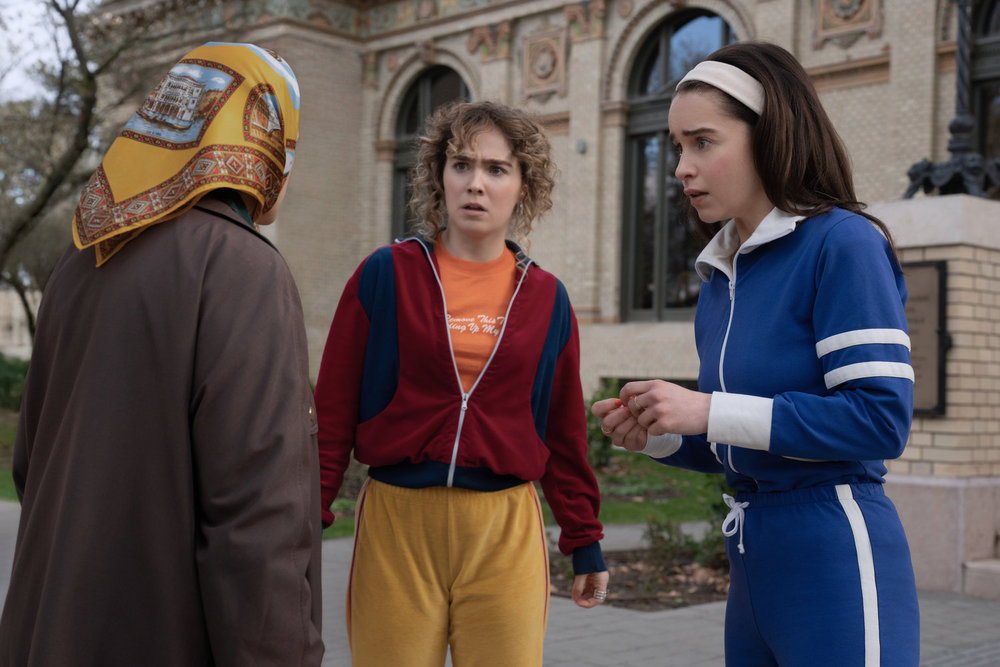
Bea and Twila have very different personalities. How did that shape your approach when creating their individual style? How much do their backgrounds and personalities factor into their designs?
A character’s backstory is always my starting place, it is the foundation of who they are and is always present, whether they like it or not. I always thought of Bea and Twila as a unit from the very beginning. The story is about their relationship, and how each of them grows within it, so I always imagined their color palettes, silhouettes and textures in relation to one another. Twila is wild, irreverent, loud but guarded. Bea is a perfectionist, timid and lacks confidence. They come from different worlds and imagine their places in society very differently in the beginning, so it was important to show their opposite natures in their costumes right away from the first scene. My goal was to then develop their looks alongside one another throughout the season; to watch Twila maintain her wildness but with a sharper cleaner edge, while Bea loosens up and find confidence in her own skin.

As they transform from embassy secretaries into active CIA operatives, were there deliberate shifts in their wardrobes as their confidence or roles changed?
There was very much a deliberate shift, and they each have their own relationship to the work itself. Twila shows up demanding to do high level work but her office attire is extremely casual, and somewhat immature. Bea as a goody-two-shoes dresses for secretarial work as a secretary. It’s almost a costume in itself. She’s office appropriate and classically feminine. A major turning point for both of the girls is the morning after they’ve had these wild nights of serious and dangerous spy work, and they must follow the KGB vehicle. They’ve been emboldened by their success and I put them in suits for this sequence both as a nod to the genre subversion the show is playing with, having two women on a spy mission together,but also to show that they are fully embracing their new roles with confidence in the face of real high stakes situations.

How long of a process is it to research, design, and create all the costumes for the series? And per individual costume?
Creating so many looks for a series means that the design process is a revolving door. There are always multiple costumes in different stages of process at any given time. On any given day I am researching, sketching, shopping, working with my workroom, having fittings, having discussions with my collaborators, oftentimes working on three or four episodes simultaneously. So it’s sort of impossible to say how long an individual costume takes! Additionally, there are some costumes that might come together very quickly and easily in a fitting – magic moments where the vintage piece fits just right, etc. And then there are pieces that are custom from top to bottom that take weeks or months because we are custom printing fabrics, or experimenting with fabric manipulation techniques. Each costume has its own journey into being. I spent 7 months in Budapest and I would say I was actively designing up until the very last day of filming.
Are there any Easter eggs or specific details that you hope the general public will spot? Or others you did just for you?
One thing that comes to mind is our homage to Robert Redford. Chris’s costume in the pilot is a direct reference to Redford’s costume in Three Days of the Condor, which was a huge inspiration for the showrunner and myself on this project. I loved the idea of playing into the bait-and-switch of the opening of the show, where we think we are seeing another typical 70s spy thriller with our classic male lead, but everything soon gets turned on its head.
On a personal level, there is a special piece of my family in the show. There was a dress that my mother wore in the late 70s, which I altered and wore myself in my 20s. I brought it to Budapest thinking it could maybe be used on a dayplayer or featured extra. But when I was trying to figure out Twila’s look for the dinner with George and Cheryl, I thought it might actually be perfect. It had a bold color and a fun edgy shape. We tried it on and it really worked, it looks great in the scene and my mom was very excited to see her dress on TV.
Each costume tells a story, which is the most interesting story your work told.
I think there are two overarching stories being told, one is the macro story of two societies which are diametrically opposed to one another – old world vs new world, communism vs capitalism – and revealing the ways in which human nature remains universal across these two peoples separated by distance and ideology. There is still fashion, art, ambition,
romance and connection happening all around and I wanted to tell a story of the Cold War that was different from what we’ve seen.
But the most important story happening in front of this geopolitical backdrop is Bea and Twila’s friendship. It is the relationship upon which the entire series of events is anchored, and my goal was to show, with each choice of hat or glove or sweater or scarf, their development both as people and as a unit – friendship is powerful, and our friendships are some of the most important life-changing relationships we develop and is so rarely featured in media!


Comments
Loading…