

 Maxance Vincent
Earlier this summer, I had a chance to see Hélène Cattet and Bruno Forzani’s incredible Reflection in a Dead Diamond, on the big screen, at the Fantasia International Film Festival in Montreal (and reviewed it for Awards Radar here). It’s one of those films you can’t believe exists, but are so glad it does, especially when witnessing it in a cinema with a packed crowd at one of the most important genre film festivals in the world.
Cattet and Forzani have very fond memories of attending Fantasia as burgeoning filmmakers, early on in their careers, and, during a Zoom press day for the upcoming Shudder release of the movie, explained that “the festival is very important to us. Mitch [Davis] has been a great supporter of ours, and it’s at that festival that we discovered Satoshi Kon’s Millennium Actress. It was one of the most incredible moments we had, because we were able to meet the master, who was there.”
Millennium Actress not only had an indelible impact on their careers, but also on the making of Reflection in a Dead Diamond. At Fantasia, Cattet and Forzani recorded a video intro and contextualized the film, calling it their own version of Satoshi Kon’s masterpiece. In writing the movie, Forzani talks about Kon’s process of “stereoscopic writing,” meaning that the Japanese filmmaker “wrote his stories through several layers. Every time you watch the movie, you can see a new layer, and more meaning develops. There’s more depth to each viewing. When I saw Millennium Actress, it felt like a revolution in storytelling, because it was like a book. When you read a book, as a reader, your imagination interacts with the material, but in films, most of the time, there’s not a lot of room for your imagination. However, with Satoshi Kon, there was that place, and I loved that.”

Not only is Reflection in a Dead Diamond inspired by the work of Satoshi Kon, but it also celebrates the Eurospy pictures of the 1960s and 1970s, a sub-genre of spy films produced mainly in Italy and closely imitating the James Bond films of the era. The archetypal character that Cattet and Forzani visualize in the movie is based on James Bond, but according to the former, “the Eurospy is even better, because the world feels like a place where you can have anything you want. It’s very pop and psychedelic. The world presented is quite naive, which contrasts well with today’s world, which was a good starting point.”
The movie consistently blurs the line between reality and fiction and traverses different temporalities as we peer inside the mind of agent John Diman (played by Fabio Testi and Yannick Reiner), whose life flashes before his eyes and reaches a point of finitude. All of these permutations, according to Cattet and Forzani, were in the screenplay, and divided by colors, for each of its temporalities:
“When we have finished writing the script with all the colors, and you read it at a distance, you see all of the colors. We wrote it like this because, for us, it’s a playful movie. We want to play with the audience. Each element of the film, each character, can be seen in two, three, or four different ways. When we began writing, it was a simple story, and each time we tried to open the possibilities and make this kind of florilège near the end. It was the same kind of writing as Satoshi Kon’s, very technical, and we wanted to approach the movie the same way.”
The experience of seeing Reflection in a Dead Diamond in a cinema is multisensory, especially in its sound design. For Cattet, sound is extremely important in their work, and the process of designing the movie’s soundscape took over six months on its own:
“For us, the sound is 50% of the experience of the movie. We want to be sensitive and play with many sensations for the audience. For this movie, we did not record the sound on the set. We’re doing like animated movies – we recreate all sounds in post-production. We put the movie entirely on mute, then, with a Foley guy, sound editor, and sound designer, we recreate everything in the movie. This allows us to be very precise for each sound. It took us about six months of work. It’s very long, but it’s really efficient. When you watch the movie in the theater, like you at Fantasia, you have all the power of the sound, and you have the physical experience we try to make you feel.”
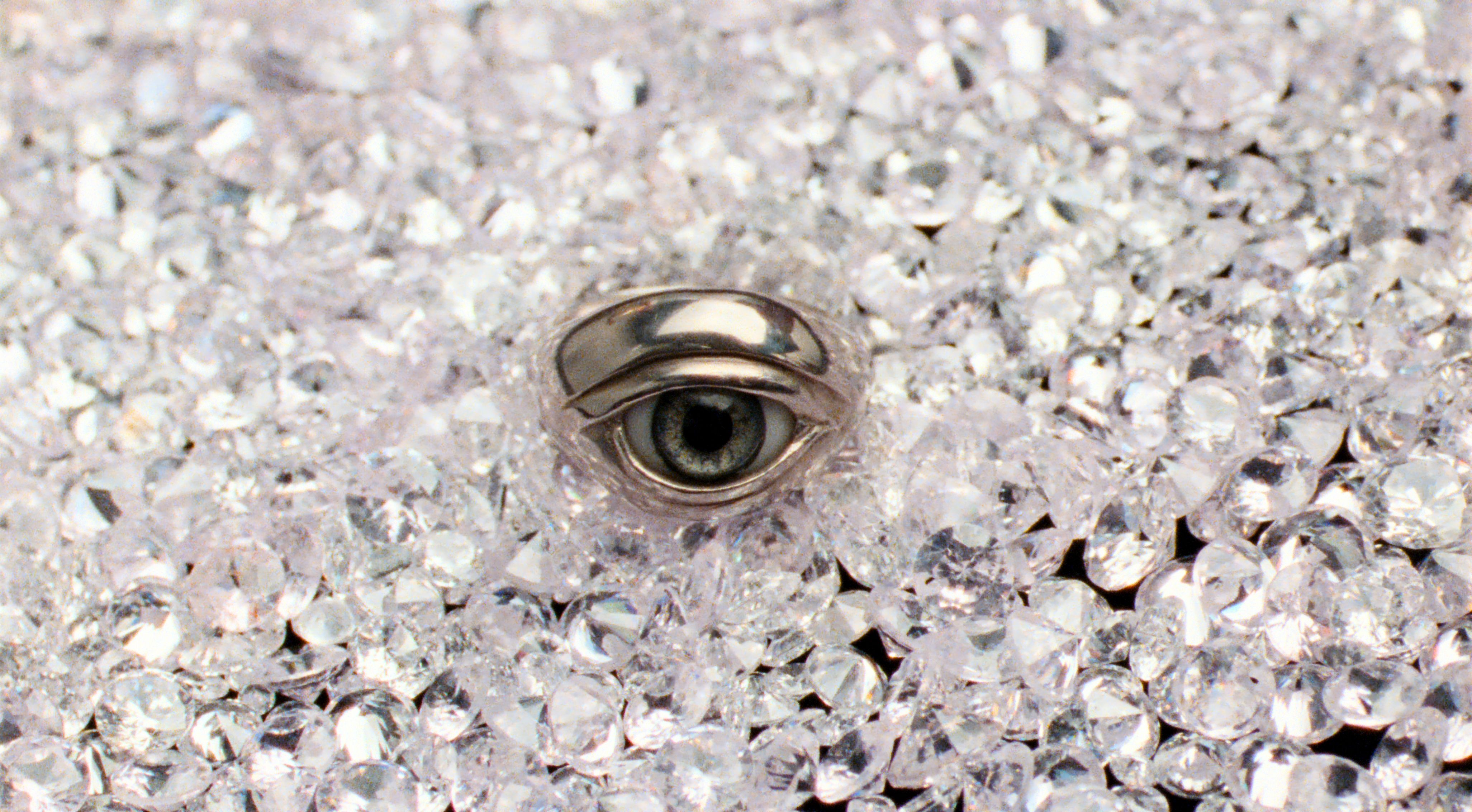
One of the biggest challenges Cattet and Forzani had while directing the film was its staging of action sequences, because, as Cattet describes, “it was the first time that we had fight scenes, and I really wanted to make one, so it was the perfect moment for us to do it. Usually, it’s a choreographer who does that kind of sequence, but we were afraid it would change the directing. We then decided to make it by ourselves.”
Adds Forzani, “We wanted to do fight scenes and car chases, not only because we are in the genre of spy movies, but because we wanted them to tell something about the characters and the story. They were all exact in the script, and so it wasn’t complicated in the end. However, it took a lot of preparation, which was a huge challenge for us.”
As more and more people finally get a chance to see Reflection in a Dead Diamond, Forzani recommends, if possible, seeing it in a cinema, because “we have done it for the theatrical experience. The first time you watch it, to fully appreciate it, the film plays better on the big screen in a theatrical setting. It’s a movie that you can revisit. You can find new keys each time you watch it. And the streaming is perfect for that. It’s complimentary.”
For those interested in exploring Eurospy cinema or perhaps broadening their horizons in the spy genre itself after seeing Reflection in a Dead Diamond, the directing duo recommends a few titles to get you started:
- O.K. Connery (AKA Operation Kid Brother) (1967, Alberto De Martino)
- Black Tight Killers (1966, Yasuharu Hasebe)
- Danger: Diabolik (1968, Mario Bava)
Reflection in a Dead Diamond is now available to stream on Shudder.
[NOTE: Parts of this interview were conducted in French. Some of the quotes in this article were translated by the writer and/or edited for length and clarity.]


Comments
Loading…