

 Maxance Vincent
No Other Choice is one of the year’s best movies, and it sees director Park Chan-wook at the height of his filmmaking powers. Seeing it with a packed audience at the Toronto International Film Festival was an experience I’ll never forget, especially attending the conversation with the filmmaker, actor Lee Byung-hun, and screenwriter Don McKellar, which also occurred during the festival. It’s as formally inventive as it is incredibly precise in its messaging, and it may be a movie that won’t leave with you for a long time (spoilers: it still hasn’t).
Fresh off my TIFF viewing, I connected via Zoom with director Park and Lee Byung-hun, who portrays Man-soo, a recently fired paper factory employee who will stop at nothing to get a job, even if it means eliminating the competition to be the first in line. We were able to discuss the film’s broad reception, the differences between Park’s adaptation of Donald Westlake‘s The Ax and Costa-Gavras‘s, and how he refines his visual language, among a plethora of other topics.
Please note that, while the transcribed interview is in English, the following conversation was conducted in both English and Korean, with the aid of interpreters.
You have both been touring at several film festivals to promote the movie, including Venice, Toronto, New York, and London, and it was also released in Korea. How has that experience been for you both in not only premiering this movie around the world but also seeing how amazingly it has been received among audiences?
Park Chan-wook: It has definitely been a happy experience. What I find interesting about it is that it’s all been very different. It varied by city, even within the same city, depending on whether it was a press screening or a public screening. Since we already had a release in Korea, audience reaction varies by city and by whether it’s a morning or afternoon screening. Everyone has different responses, and it’s easier to compare because the film features such strong comedic elements. You can clearly tell when people are laughing and when they’re not, as well as which scenes they’re laughing at. Seeing these differences in reactions has been a truly special experience for me, and it’s been a great deal of fun. Nothing makes me happier than hearing the audience laugh. It makes me happier than listening to Mozart’s music.
Lee Byung-hun: Humor differs culturally. As we traveled from Toronto to London, throughout the U.S., and, of course, also in Korea, I realized that the laughing points of the audience were different, and the reasons they were laughing were different. We’ve been invited to all these film festivals, and I think the press schedule has been more intense than our shooting schedule. I’m just joking. I feel so lucky to be able to travel with this film, and when I hear the audience’s laughter, it makes all the exhaustion of travel disappear.
This is not the first time that Donald Westlake’s The Ax was adapted into a movie. There was also an adaptation in 2005 by Costa-Gavras. Was there a desire for you, director Park, to set it apart when you wrote the screenplay from that prior adaptation? And did you change anything from the book to fit the story you wanted to tell in the movie?
Park Chan-wook: It was after I decided that I wanted to adapt this novel into a film that I found out about the French film. I was scared at first, because it was by this master I respect so much. However, after watching the movie, I felt relieved, not because the quality was better or worse than I had imagined, but because it was so different from the adaptation I had in mind. Mr. Costa-Gavras was actually one of the first audiences for the film. He was very happy about it and gave us numerous great compliments. During this very nervous time, when I was thinking about how the audience would react to the film, it was a great encouragement to have him say that.
In terms of differences, if I get down to the details, there are probably thousands of differences. However, if I could mention one of the biggest differences, it’s the fact that the wife and son of the main character find out about what he’s been up to. As a result, the film’s ending is fundamentally different in nature. Man-soo did all of the bad things in the movie, and he told himself that he had no other choice because he was doing it for his family. However, it’s precisely the things he did that we would foreshadow would shatter the family in the future, creating a tremendous paradox. That’s the most significant difference between this film, Gavras’s French film, and the original novel.
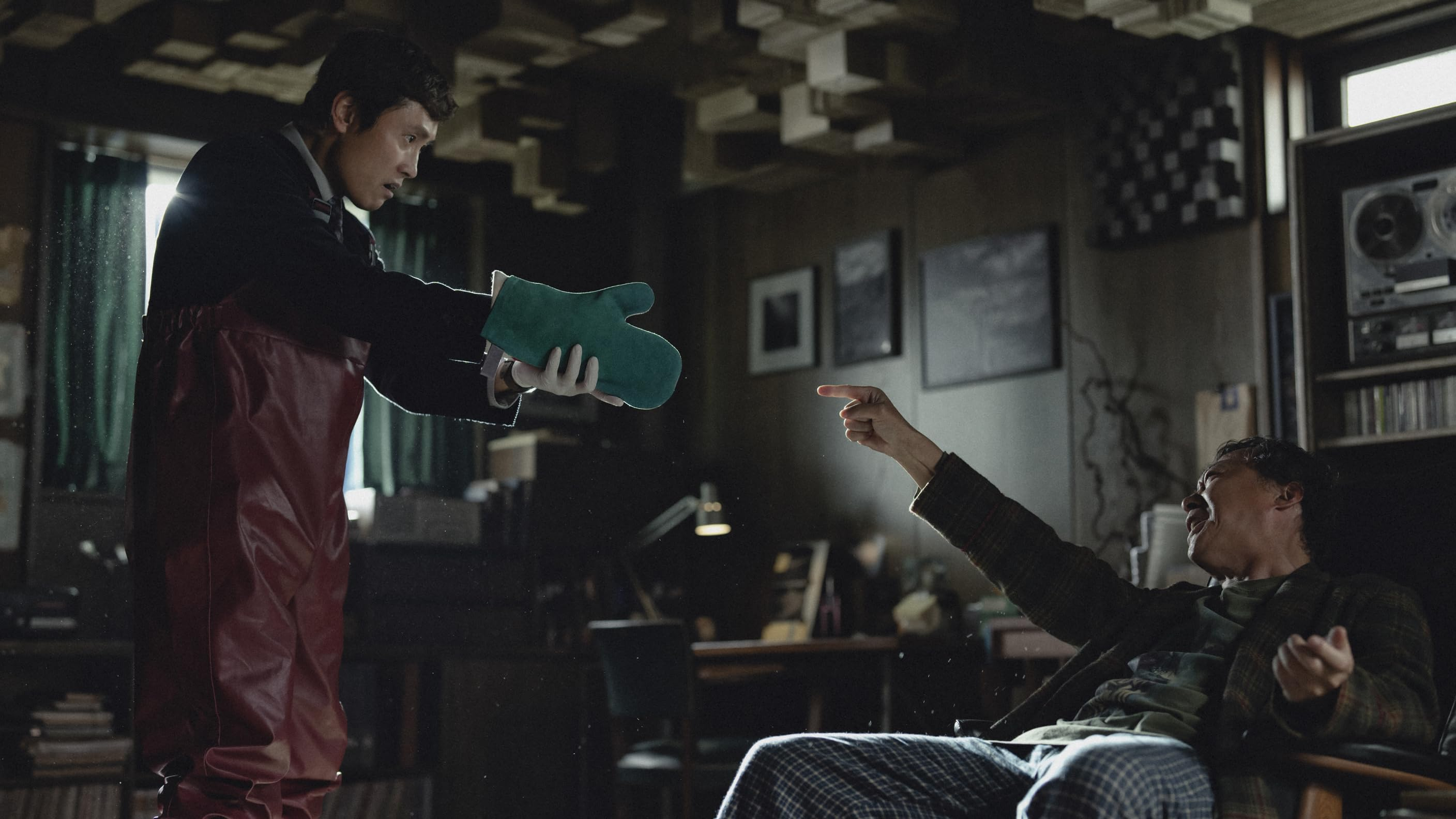
For Lee, what struck you the most about your character when you first started to read the screenplay, and was there anything that surprised you about the way in which Park wanted to treat his story, in particular?
Lee Byung-hun: Before I mention my character, I just thought that, while reading the script, the story was so much fun. Man-soo is just a regular guy who loses everything, and he is faced with the question: What do I have to do for my family to maintain the status quo? In many ways, the film can be seen as violent or frightening, but it also features a great deal of humor and fun as Man-soo undertakes problem-solving to protect his family.
In terms of character, Man-soo experiences a wide range of emotions throughout the film. He experiences extreme emotions, as well as the quotidian emotions of a normal patriarch, as he embodies over a thousand faces throughout the film. When I was offered this role, I really wanted to take it on because it was so ambitious. Even if I didn’t like the character, I would’ve done it for Director Park.
What I especially love about your movies, Park, is that they always feature images and camera angles I haven’t seen before. No Other Choice has plenty of images that, without revealing anything specific, truly blew my mind. Whenever you make a movie and think about how you’re going to film it, is there a desire for you to push yourself and experiment formally in ways that you haven’t done before? I also assume that, because the material is different, No Other Choice can’t be visually treated the same way as, for example, Oldboy.
Park Chan-wook: I respect filmmakers with that consistent trademark style like Ozu, but I myself get very easily tired of the same thing. As you’ve said, the story and characters differ from film to film. Even within the film, their emotions fluctuate according to the situations the characters find themselves in. I believe it is the director’s job to find the most precise form of expression and convey it to the audience, which is why I think there should be different stylistic approaches for every project I make.
I know that precision is not exactly the most highly regarded value in the arts, but it is very important to me. Of course, people might have different ideas of what that precision means, but I really prioritize precision in my expressions, and that philosophy guides my filmmaking and art. My goal has always been to find the most precise expression in my works. The techniques that you mentioned, that’s brilliant or new in my work, weren’t coming from an effort to try something new or to experiment with the technique. It is simply the result of my attempts to show the most precise expression of the character and the situation that they were in.

As more and more people get a chance to see this incredible movie, is there anything that you both hope people will take away from No Other Choice as it expands to cinemas around the world?
Park Chan-wook: I think some audiences might watch the movie, talk about Man-soo’s actions, and question him, like, “Who does something like that just because they got fired?” However, that was precisely my goal with the film: for them to have those questions for Man-soo. At the same time, I wanted them to feel sympathy for the character through his facial expressions, since the character is played by an actor like Lee Byung-hun, who gives such a moving performance. The audience wants to root for Man-soo and understand what he’s going through. Yet, at other times, they don’t, because they know that he shouldn’t be doing what he’s doing and that the actions he is taking are unforgivable. I wanted the audience to move back and forth between those opposing feelings constantly.
Lee Byung-hun: I think this film has a very unique sensibility. One moment, you’ll be laughing, then you’ll quiet down to have a little bit of a bitter aftertaste, or it’ll be a very serious moment, you’re quiet, and you feel a laugh bubbling up. I really hope that the audience can feel this complex set of emotions watching this film. The ideal audience for me, after watching this film, is one that is having so much fun in the theater but, as they walk out, feels almost as if a hammer has hit them, and it’s so thought-provoking that they’re having conversations about it. That is my hope.
No Other Choice releases in theatres on December 25.
[This interview has been edited for length and clarity]


Comments
Loading…