

 Maxance Vincent
While many know Finneas O’Connell from his creative collaborations with his sister, Billie Eilish, the two-time Oscar-winning singer/songwriter has also done incredible work as a film and television composer. His latest work on TV comes in the form of Beef‘s second season, where he takes over the scoring duties from season one composer Bobby Krlic to create a new sonic palette as the show introduces new characters and an entirely different setting than its Emmy-winning previous season.
In this interview with Awards Radar, Finneas discusses how he became involved in the series, his initial discussions with showrunner Lee Sung Jin, the process that went into scoring the season’s cold open, how he wanted season two’s music to differ from season one, how he balanced the different tonal shifts of the season, and the process that went into scoring its action-heavy finale.
Read the full interview below, which was edited for length and clarity:
Can you talk about how you became involved in the show, and what your initial discussions were like with [Showrunner Lee Sung Jin] on what he was looking for in the music of season two?
Yes. I was a fan of season one, just like everybody else. Its release happened to coincide with Barbie, so Billie and I were going around doing press, showing up at award shows for that, and Beef was winning everything. I remember Sonny making a couple of funny, heartfelt speeches, and I loved season one, so my agent told me that he was in town and asked if I’d like to get coffee with him, since he is a fan of Billie’s music. I loved to do that. We had a general meeting at a coffee shop in the valley in March of 2024, and we hit it off.
We did not talk about season two of Beef; we just talked about music, albums we loved, and movies we grew up liking. I didn’t know if we’d be working together, but I liked hanging out with him. Months went by, and my team told me they were cooking up season two and asked if I was interested in meeting Sonny about it. Of course, I said yes. I loved Beef, and it would be an awesome opportunity. When we started meeting, he didn’t send any scripts, and was just explaining this world, these characters, and the inciting incident that happens to them, and I thought it was so cool.
He sent me the first couple of episodes, and I made a demo for him off of them that had all of these sort of weird mechanical sprinkler sounds that I’d recorded, and people hitting tennis and golf balls. It was super literal, but because we don’t have a single frame of this show filmed, I could make it sound like what the show will look like. I played that for him, and he found it inciting, so I jumped off from there.
They started shooting the show in 2025. I would go to the set and see what it looked like, felt like, and sounded like. I started making all this music while they were shooting, “Vicious Thoughts” included, which is the piece of music that plays over the sequence outside of the medical facility at the end of episode eight. That was the preamble to being in the actual room while they’re editing the episodes, and making music that’s exactly 40 seconds long for the 42nd shot, and stuff like that. That’s the overall picture of the show for me.
Was it your intent to distinguish the music of this season from the last, since we follow different characters in a different setting with a different story?
First of all, the music in season one rocked. It was really good. One of the first questions that I actually had for Sonny was, “Because I love the music of season one so much, why am I even doing season two?” He said, “I want it to feel like a totally different thing this season. If I were working with the same composer, I’d be asking him to reinvent the wheel anyway.” If there’s a season three of Beef, I imagine that there will be a third composer. I think that my instincts and my abilities are very different than the composer of season one, who rocks.
For season two, I had to trust my gut to make the music. A lot of the process involves aligning the score with the great needle drops. Season one has that Incubus song, which is so good. Obviously, the score doesn’t sound like Incubus all the way through, but there’s a hand-off between the score and these soft rock ballads of the early aughts and the 2000s. That music captures the period when Billie and I started putting out music, and it certainly is the era of music that I was most hyperanalyzing. With the score, I tried to support the great needle drops, because many of them were written into the script, so I knew how to get in and out of those.
This season begins with a very long cold open. I really like that scene because it introduces us to the main characters, shows us the traits they’ll explore this season, and explains what this season is about. It’s building up to that moment when Lindsay [Carey Mulligan] and Josh [Oscar Isaac] realize they’re being recorded by Ashley [Cailee Spaeny] and Austin [Charles Melton]. After that cold open, you immediately want to watch the rest of the season. I’m wondering if you had a specific process in trying to figure out that specific piece, because I think it’s a really great opportunity to establish what the musical palette of the season will sound like.
Yes, totally. Early on, Sonny and I made a very “arty” and rhythmic theme, with arps. There are various ways to achieve rhythm. You could all be drums and percussion, but we found that these kinds of sharp-attack, short-release arps had a percolating momentum over melodic themes layered on top. You hear the melody during the ending of the show. You hear the “Vicious Thoughts” theme overlaid on Austin and Ashley. I hope we’re strong-arming the viewer into believing that this older couple has to get a divorce. They do not love each other. However, this young couple is where it’s at. They love each other so profoundly.
Ultimately, the season examines the nuances of love and acceptance and how our perceptions shift our relationships. The first ten minutes are such great screenwriting. As a viewer, I have loved shows that do not do this, but I also love the show where, by the end of episode one, you’re like, “I think I know what this is about.” Then you watch episode two, and by the time you get to episode three or four, you’re like, “Alright, I’m rolling.”
True to the term “Cold Open,” you’re ten minutes in, you’ve seen all four of these characters’ dynamics, you’ve seen the place they all work, their work dynamics, where the couples live, how Lindsay and Josh procrastinated and failed at their dream of turning their home into a bed and breakfast, or remodeling their house. By the time we see title card one, you know what you’re watching. You know we’re watching these four characters in this sticky situation. So it was very important to get the music right. We worked on the music for that cold open forever, because it’s such a roller coaster, going from ominous to light and airy, and moments where it flips from the fighting to Austin and Ashley driving to the house. It needed to keep supporting what we’re seeing, and you know that it’s going to collide because you’re an audience member, and you assume this is probably what’s going to happen.
When it came to writing music specifically for Josh, Lindsay, Ashley, Austin, Dr. Kim [Song Kang-ho], and Chairwoman Park [Youn Yuh-jung], did you want to set them apart sonically?
I’m always a fan of motifs. Everybody has distinct things, and the written character deserves it. The actors in this show are so good, so I thought they all deserved a theme. Josh and Lindsay totally deserve a theme. Austin and Ashley deserve one. The chairwoman deserves a villain’s march, and Dr. Kim also deserves a piece. As a writer of music for the show, that was a very helpful tool for me to know who we are right now and who’s in charge.
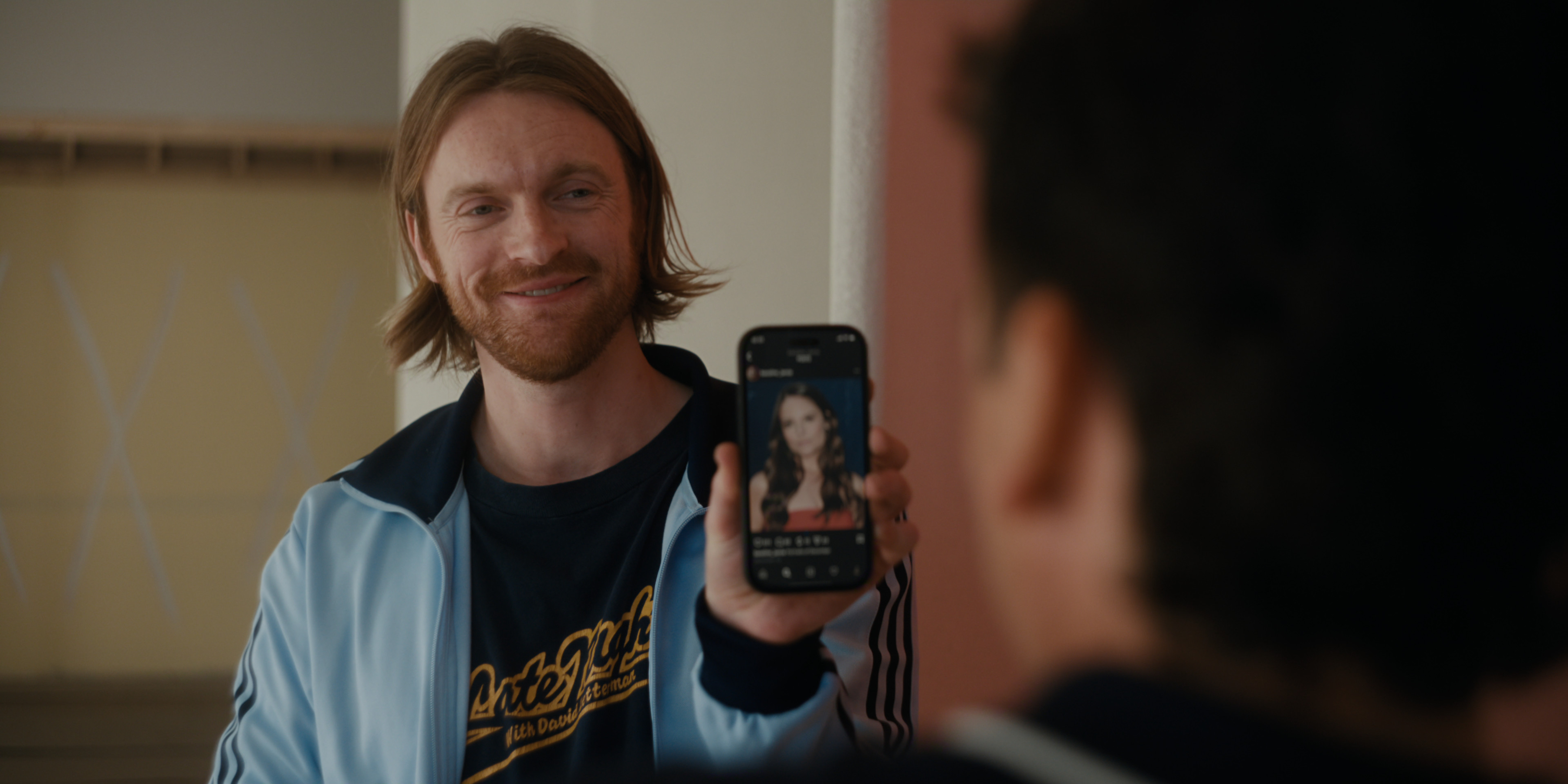
What I like about the show is that it moves between different tonalities. It can be very funny at times, but it can also be quite serious, especially with everything revolving around Ashley’s health issues. That’s quite serious. But the show also blurs the line between reality and fiction as we get into the characters’ headspace from time to time. When you compose a score like this, how do you balance everything out and think about which tonalities you want to set a given scene?
I totally agree with you about the show’s tone. It’s so funny, and sometimes it’s at its funniest when it’s at its most serious. The example I could point to is a sequence in episode seven when the characters are on the plane. Austin and Eunice [Seoyeon Jang] are devising a plan to save the data, and Austin is confessing that he thinks he’s in love with Eunice. There’s a lot of information being exchanged, and again, the stakes are high. They’re on their way to Korea. They’ve found out that the chairwoman is having people killed, but he’s being so silly. He does this silly spin, where he stands up and spins around. The music has a lot of momentum, and it’s intense. If I were a mixer, I would keep turning down the fader. I would just ride with it. There would be a dark thing, he would do something silly, I would get out of the way of the silly thing, and then come back in, because I felt like I didn’t want to step on it. I didn’t want any comedy music. You have to know when to dip in and out.
Were there any specific instruments that you employed to represent a mounting sense of tension between the main couples, because the whole season plays within that tension?
We decided very early on that it would be synth-heavy rather than orchestral or piano-based. Synths have limitations, but they’re very versatile. They’re one of the things that felt really effective, especially for tension. You can play notes until they get harsher and harsher, and you can bend the pitch wheel up. There’s no string being plucked, there’s no drum being hit. However, the circuitry is transformative enough that, hopefully, when the note started playing, you didn’t even notice it as an audience member. You were paying attention to the dialogue, and suddenly the music crept in. The notes are rising, the chord is shifting from one place to another, and that became the tension mechanic of these scenes.
The scope and scale of this season open up when the characters go to Korea, and the show becomes an action movie or a high-pressure thriller in this episode. The pace is very frenetic. There’s a big chase scene in the clinic. The tension is very high as well. Can you talk about the process of working on that specific episode and scoring action as well?
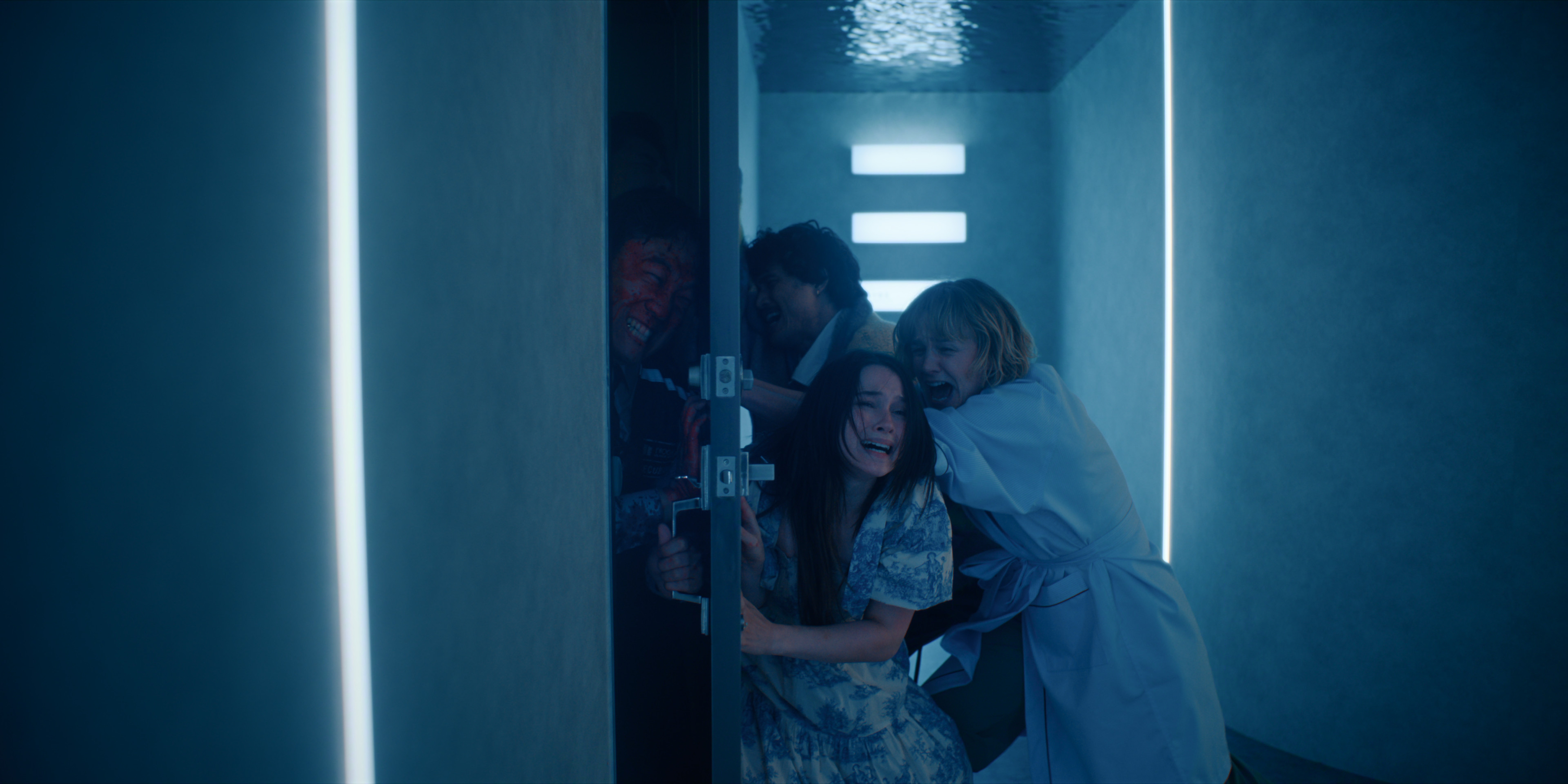
Totally. I was hyped. There’s s a bunch of great sequences in the show to score. However, when we get to that oner in episode eight, I was like, “Oh, what a gift.” There’s barely even dialogue in that scene. You can hear the punches and the drums. One of the early things we talked about was how the music would shift when they went to Korea. It was very important to me not to do my white guy take Korean music. I thought that that would be so terrible. So I had to think about it through the narrative.
They’ve gone into the belly of the beast here. The characters have been looming over them the whole season. They’re in this maze at this lab, and I think that meant that the music had to get bolder, more menacing, and more powerful. The country club and the clinic are two great tentpoles. On the score album, I have these two pieces called “Monte Vista Point: Part One and Two,” which is the country club. I also have this piece called “Trochos,” which is the lab’s name, and it’s so harsh and intense. I was heavily inspired by rap albums from 2013 or something, and that was a great juxtaposition for me to play with.
Do you have a particular piece of music that you’ve composed for the season that you’re the proudest of?
When I listen to the whole thing or watch the whole show, I want the score to feel cohesive. That was my goal, because I didn’t want the music to feel too standalone. I love “Vicious Thoughts (reprise).” I really enjoy thinking about the music as a critic. I’m thinking about how I felt making them, making the Dr. Kim suite, which plays when he’s giving that monologue that we think Austin’s understanding in episode eight. I had so much fun making that piece.
I had so much fun making that fight scene piece, and that was probably the most confident I’ve been. By episode eight, I’m not as nervous. I feel like I know where I am, and I am having a great time working on these pieces.
Season two of Beef is now streaming on Netflix.


Comments
Loading…