

 Maxance Vincent
With over 100 movies (124, according to Letterboxd, though shorts are included in this list) under his belt, you would think that Japanese genre legend Takashi Miike would eventually get stale and lose the initial passion he had in moviemaking. Of course, his filmography hasn’t entirely been incredible, but one can count by hand the number of disappointments the prolific filmmaker delivered. What’s most impressive about his varied body of work isn’t necessarily the sheer volume of films any Miike fan can dive into, but how versatile he is, and, even after making more than a hundred features, the director is still refining his style and cinematic sensibilities.
Case in point: Sham, the third Miike-related project screening at this year’s Fantasia International Film Festival, feels so different from what we’re accustomed to seeing from him. Namely, visually striking works that often teeter the line between extremely violent and darkly funny, as the structure is constantly experimented with. But since Miike is not confined to one specific style – or mode of filmmaking – each of his pictures always offers something new to the audience. That’s why, when Sham opens in a twenty-minute sequence of harrowing intensity, one wonders if Miike was in the director’s chair at all.
Don’t worry, this is meant as the highest possible compliment, because we’re immediately pulled into a story that will get reshaped as soon as its title card abruptly appears on the screen. However, for its first twenty minutes, we observe an elementary school student, Takuto Himuro (Kira Miura), constantly belittled and abused by his professor, Yabushita Seiichi (Gô Ayano), who puts the idea in his head that, because Takuto is of mixed blood, he should die. And that’s what he attempts to do, until his mother, Ritsuko (Kô Shibasaki), saves him from jumping off the building.
That’s when she decides to press charges and take Yabushita to court. Of course, the professor vehemently denies any wrongdoing and calls the entire trial a sham (where the title card appears). This is where Miike shifts perspectives and shows us Yabushita’s side of the story, where it paints a much different chain of events than what we saw from Ritsuko’s point of view. However, unlike Akira Kurosawa’s Rashomon, a clear inspiration for this movie, which examines each side through a linear perspective, Miike’s approach is much more distinct, as he doesn’t wait for one side to finish their story before presenting another one.
For instance, as the court cross-examines Ritsuko, Miike will suddenly stop it dead in its tracks to flash back to the plaintiff’s past, where he gives the audience critical information about who she was, and who she now aspires to be. It makes her cold, emotionless responses (in the eyes of Yabushita, always) much more poignant, because, as much as she wants to leave her dark childhood behind, it will always come back to haunt her. It’s at that point where I knew I was watching something special, as different as it feels formally and thematically for Miike.
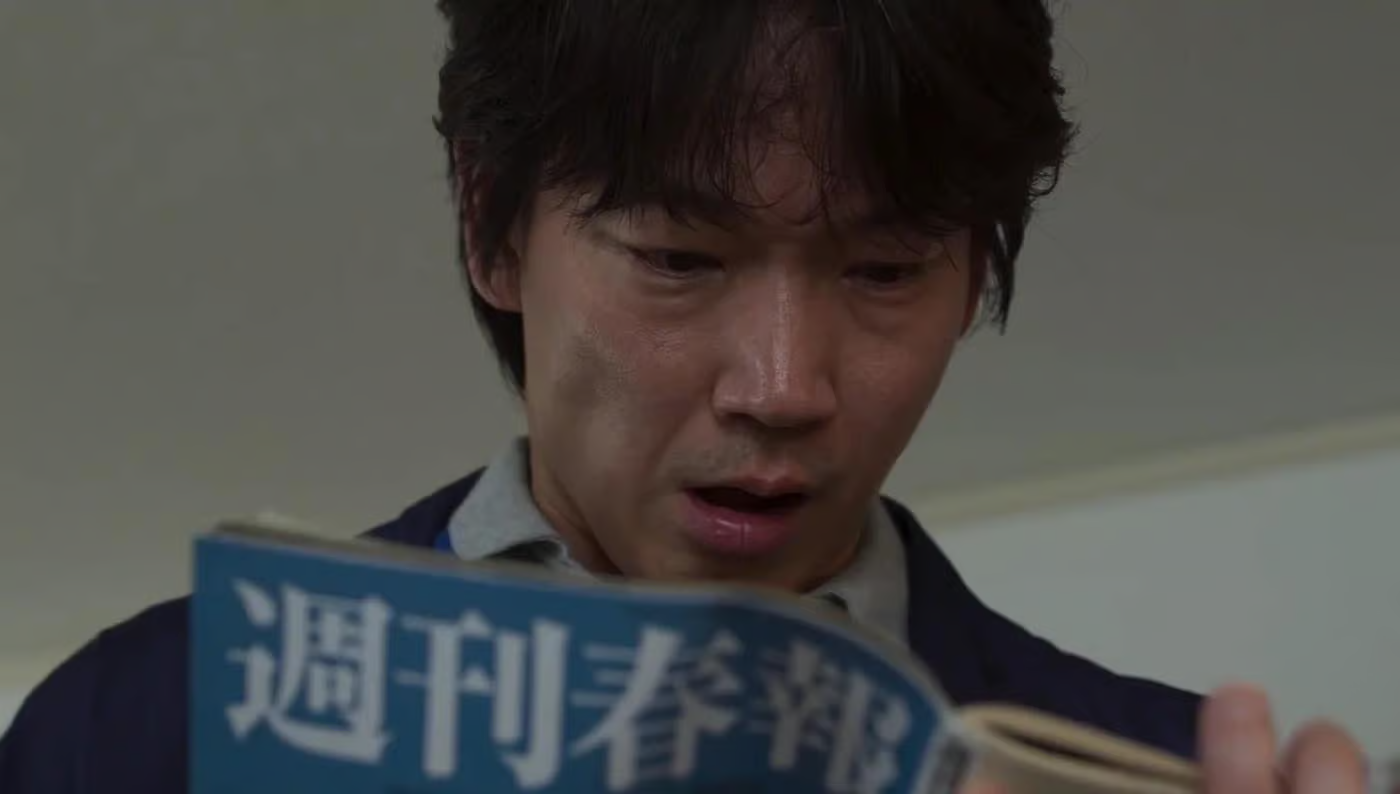
Even more impressive is how Miike, for the bulk of his 130-minute runtime, will attempt for the audience to sympathize with Yabushita, and, in many occasions, it works. However, in the back of our heads, we’re never sure if we can trust him, considering the hard-to-watch succession of abuse we’ve seen from him that he gave to Takuto in the opening scene. Yet, this sequence always gets questioned, since Yabushita’s side paints him as the nicest guy in the world who has been framed through a series of misunderstandings. The school didn’t help him, nor did it want to hear what he had to say, and forced him to apologize for something he allegedly didn’t do.
However, as the trial gets unraveled and irregularities arise (such as how Takuto was diagnosed with PTSD), the audience is forced into a corner: should I believe Yabushita, who has lost everything despite being a relatively fine teacher (in his eyes), or Ritsuko, who has almost lived the unthinkable if her son did jump off the roof and she wasn’t there to save him? Miike walks a fine line, encouraging us to listen and assess what’s truly going on, before concluding his film on a coda so somber it may repurpose the entire narrative for you. In courtroom dramas, the audience’s thrill is in finding out whether the accused did what they are accused of. Justine Triet’s Anatomy of a Fall bases the entire narrative on this, but lets the audience infer whether or not they think Sandra killed her husband.
For a while, we try to figure out who the reliable narrator is in Sham. Is Yabushita in the right, or is Ritsuko telling the truth, considering she is only seeing what her son experiences daily? At some point, because both characters’ backstories are entirely subjective and devoid of any tangible answers, it no longer matters whether or not Yabushita did what he is accused of doing. Because, as much as he would rather leave this dark period of his life behind, it will always come back to haunt him, and without fault, just as Ritsuko’s childhood will always be at the back of her head.
It makes the conclusion all the more evocative, especially when we see what Yabushita sees and can’t shake off. It leads us to believe one specific perspective more than the other, but, at that point in the movie, Miike makes us understand that the verdict is trivial (just how the MMA fight at the end of Blazing Fists didn’t matter). What comes after is much scarier for our protagonist than he likely thought would happen.
That alone makes Sham the best thing Miike has directed since First Love and one of the best films to have premiered at Fantasia this year. It lingers with you in a way that few of his films do, with no excessive violence required. The carefully calibrated aesthetic, masterful performances from Gô Ayano and Kô Shibakashi, and the riveting screenplay that constantly twists the story in unexpected directions do the work for him. He doesn’t need to do much when everything surrounding the movie is already at a high level.
If it weren’t for Reflection in a Dead Diamond being the masterpiece it is, I’d likely say Miike’s streak of three titles is the biggest highlight of this year’s edition of Fantasia, and proves to me that, even after making over 100 movies, he’s still got it. I now await Bad Lieutenant: Tokyo with great anticipation.
SCORE: ★★★★


Comments
Loading…