

 Maxance Vincent
A year after its incredible North American premiere at the Fantasia International Film Festival, in which it not only won the Cheval Noir Award for Best Feature, but the Best Screenplay, Best Score, and Best Performance Awards, Pascal Plante’s Red Rooms has finally hit U.S. cinemas. As American critics and audiences begin to (rightfully) lap this incredible film up, one wonders if this will be yet another gateway for many to attempt to discover the world of Québec genre cinema.
The province was the birthplace of many filmmakers whose singular styles transcended borders, such as André Forcier, Denys Arcand, Denis Villeneuve, Xavier Dolan, Monia Chokri, Sophie Deraspe, and the late Jean-Marc Vallée. But talents like these sparsely arrive. With each masterpiece that goes around the world, we get twenty mediocre films from competent but unremarkable filmmakers. However, whenever someone new arrives with a total rupture in form and theme, it feels like a revelation and sets a new standard that many filmmakers of this province, unfortunately, won’t ever achieve.
This is what Pascal Plante does with his Red Rooms. Admittedly, I was not the biggest fan of his previous movie, Nadia, Butterfly. It was a competent effort that quickly left my mind as soon as it ended. However, with his latest motion picture, Plante completely reinvents his approach to filmmaking with a true crime thriller that effectively crawls under your skin in ways you won’t even realize until the movie reaches an absolute point of no return.
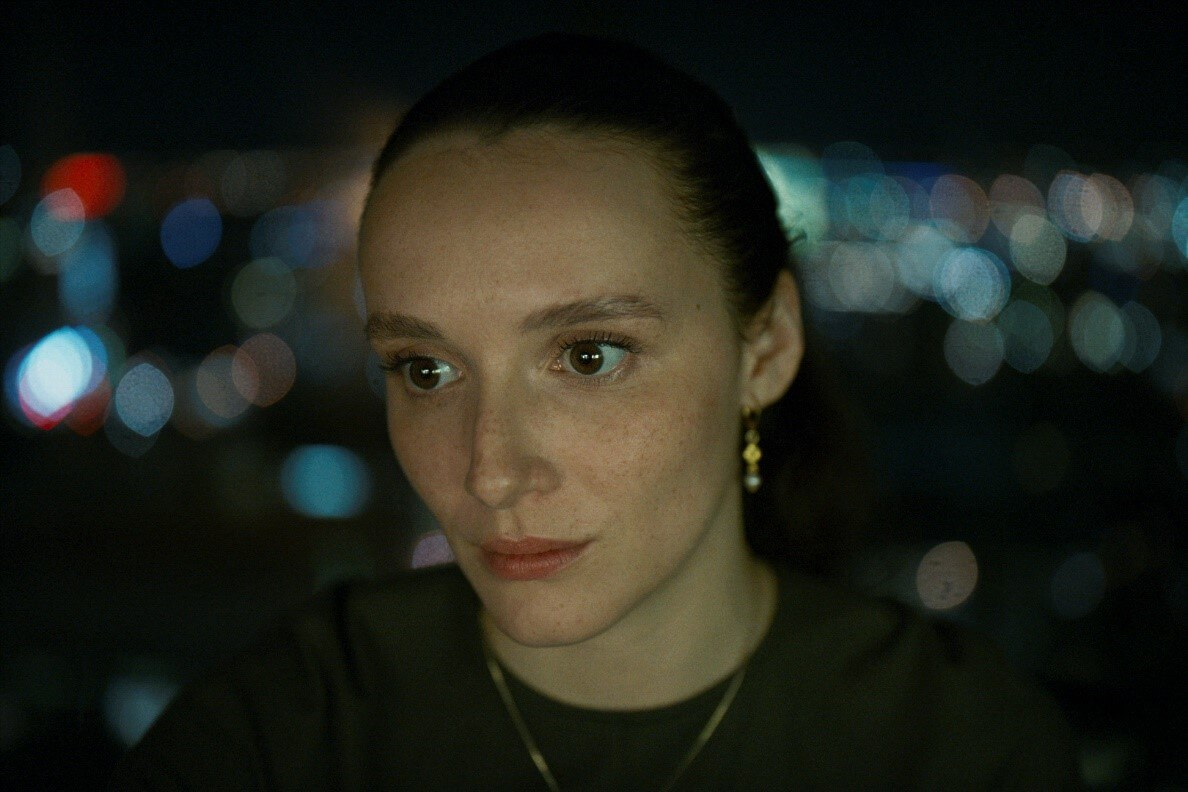
Red Rooms immediately jolts our attention as Dominique Plante’s pulsating music introduces audiences to the protagonist, Kelly-Anne (Juliette Gariépy), sleeping in an alley, waiting for the Palais de Justice to open in Montreal. Why is she there? And why is she waiting this early to be let in? We quickly learn that she is here for the trial of Ludovic Chevalier (Maxwell McCabe-Lokos), accused of savagely murdering three young women in “Red Rooms,” to which he recorded and broadcasted his crimes on the Dark Web.
The movie begins as a typical courtroom drama, in which the prosecutor (Natalie Tannous) lays out her case to the jury as to why Chevalier is guilty while the accused’s defense attorney (Pierre Chagnon), an absolutely detestable figure, explains how reasonable doubt will exonerate his client. All of this is clinically shot through Vincent Biron’s boxed-in lens as Kelly-Anne closely listens to the opening statements made by the defense and the prosecution while Chevalier pleads not guilty to the charges laid against him.
But the courtroom drama quickly becomes irrelevant as Plante cuts to Kelly-Anne returning home inside a lavish apartment complex, fully furnished and equipped with a technologically advanced AI assistant dubbed “Guinivère.” There, she browses on the Dark Web for information pertaining to one of the victims’ parents, Francine Beaulieu (Elisabeth Locas), who is longing for justice to be served for the monster who murdered her daughter Camille. Once the information she is looking for is found, she returns to the alley to sleep, awaiting the trial’s next day.
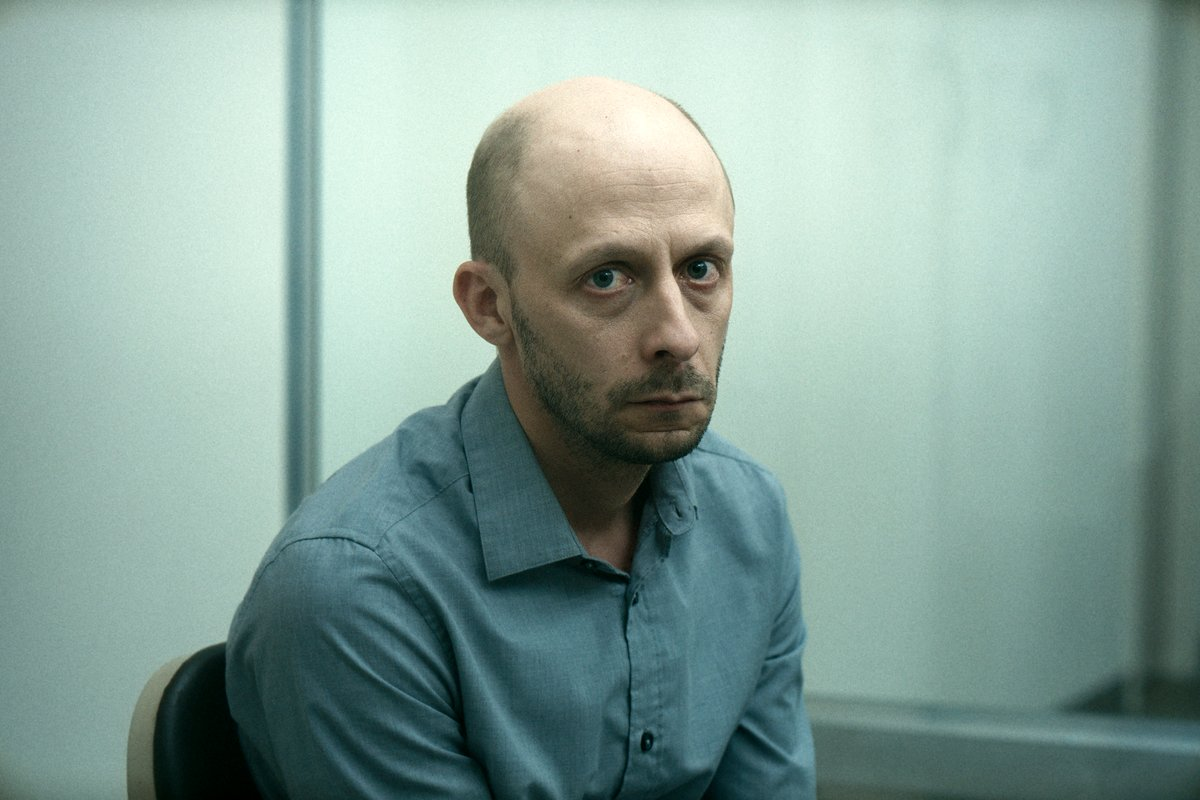
Why is she doing all of this? Does she personally know Ludovic or any of the victims? At least, this is what a fervent Ludovic supporter Clémentine (Laurie Babin) thinks, as Kelly-Anne sits on the murderer’s side in the courtroom. But we quickly learn that there are no personal reasons that encourage her to attend each session: she is simply (and morbidly) obsessed with the trial and personal details involving Ludovic and the victims’ parents. She’s not a journalist (we eventually learn that she models part-time for a fashion agency), nor is she a law student with an interest in true crime cases. No, Kelly-Anne is just really invested in the case, so much so that she eventually bids in a Dark Web auction to find the lost video of Camille’s murder, putting most, if not all, of her Bitcoin currencies for it.
All of this quickly grows more unnerving as Camille begins to befriend Clémentine, whose radicalization in believing in Ludovic’s innocence prompts her to call into “More Catholic than the Pope,” a Y’a Du Monde à Messe parody, where host Richard Turcotte gives his thoughts on the ongoing trial with a panel comprised of radio host Rebecca Makonnen, comedian Maxim Martin, and actress Camille Aubin. After an almost two-minute-long unbroken split-diopter in which Clémentine absorbs the humorous tone in which they discuss the trial and Chevalier’s unequivocal guilt, she calls into the show to tell them what she thinks.
Of course, her arguments make little sense, and she gets immediately confronted by the host and panelists, who bluntly tell her she needs help. Plante never cuts directly into the show’s diegesis. Rather, he films Turcotte talking directly to Clémentine as she watches him on Kelly-Anne’s screen. It’s even more cathartic when we realize that this deepens her into the radical rabbit hole she has been stuck in ever since he was arrested. Some have said this relationship is the movie’s weakest and wobbliest part, never fully delving into an interesting corner. I initially agreed.
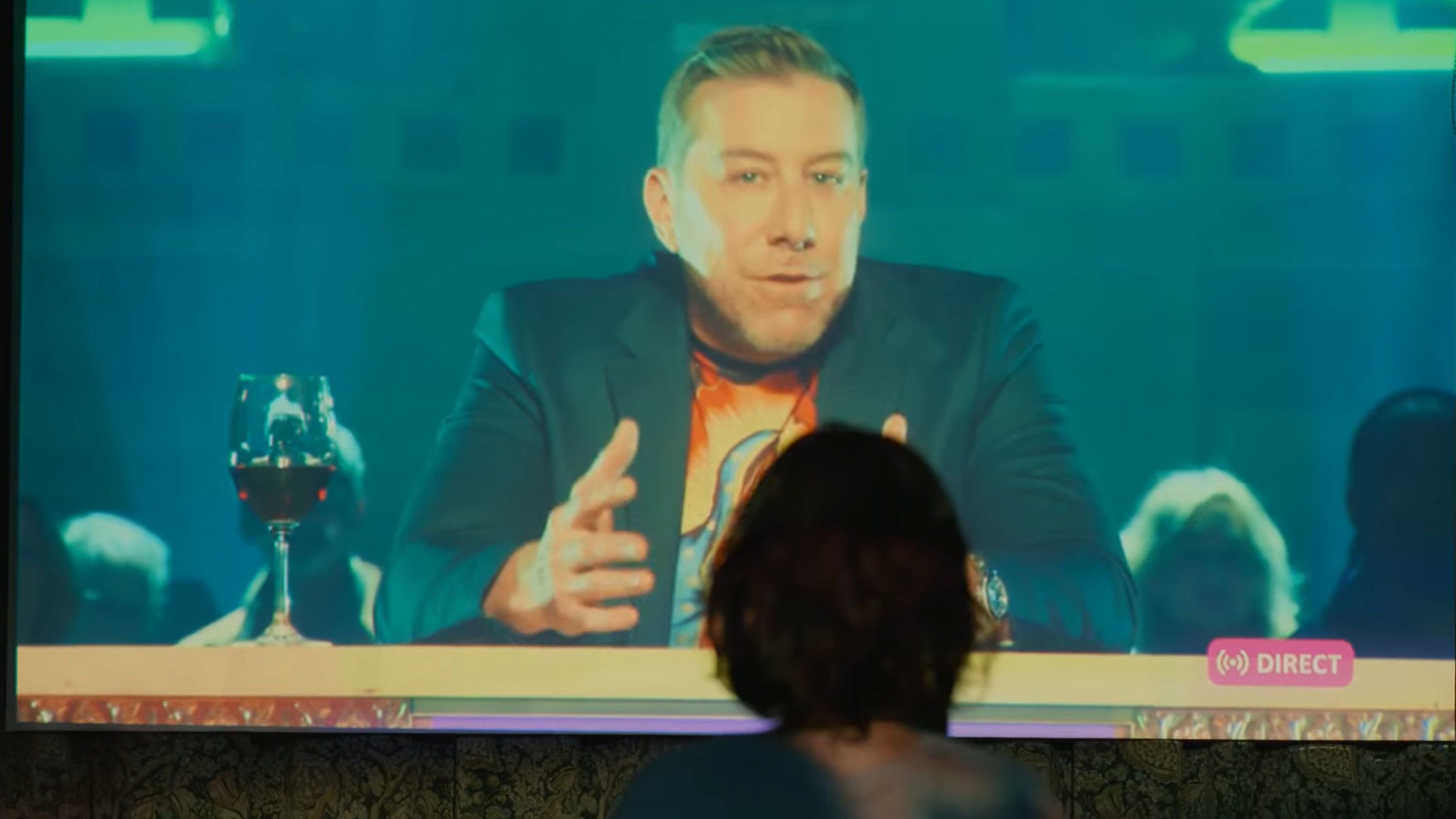
However, when we get to that scene and observe how Plante positions his camera into incredibly specific corners and the spiritual nature of the show’s setting (inside a Church, but no person participating has truly “catholic” thoughts), it’s hard not to become fully invested into the drama, figuring out exactly how this ordeal of obsession for both Kelly-Anne (who is invested into the trial for completely different reasons than her newfound friend) and Clémentine will end. And it definitely won’t be pretty for the two, who get further into places they should not.
When Kelly-Anne and Clémentine eventually watch the “Red Rooms” videos that were seized by the FBI and made one person in the courtroom so deeply disturbed by what they had just watched the paramedics had to show up to resuscitate them, Plante never shows any explicit sequence of violence. Instead, the only shot we see from the video occurs at a distance, after the murders are over, and Chevalier shuts off his camera. But that image is disturbing enough to be etched into our memory, as the rest of its unsettling nature occurs through its destabilizing sound design. The agonizing screams pierce into our ears as one experiences pure horror and progressive trauma while the other is so clinically detached from the actual loss of human life that she coldly observes each minute detail from the videos that prove Chevalier is indeed the perpetrator of these inhumane acts.
This is also where Kelly-Anne experiences a profound psychological shift, disassociating herself completely from the contents of the video and transforming into Camille, showing up in the courtroom dressed exactly like her, with blond hair, a school uniform, and braces. Looking at Chevalier with her blue-eyed contacts, she is escorted out of the room, and the agonizing screams we heard before grow louder as her eyes sharpen and deliver a maniacal grin while the locked-up psychopath waves at her. It’s by far the scariest sequence I’ve seen in any movie this year and contains no ‘disturbing’ image or traditional jumpscare. It’s all treated through the film’s soundscape, which grows more elaborate and frightening as the movie takes even darker turns.

All of this is heightened through a revelatory performance from Juliette Gariépy, who represents Kelly-Anne’s disassociation with pitch-perfect timing. Plante presents her as a calculating individual who’s always one step ahead of what she wants (the way in which she approaches Poker tells us everything we need to know about her). Whenever she experiences anxiety, she sweats it off with HIIT or a game of squash. We’re quickly enraptured by this precise routine and her penetrating, emotionless eyes as her obsession with the case grows morbid, showing little remorse for the victims and their families. It may be the biggest revelation in acting we’ve seen in Québec cinema since Marc-André Grondin in Jean-Marc Vallée’s C.R.A.Z.Y., and one can’t wait to see what she does next.
And yet, after such a rivetingly portrayed thriller that progresses into unforgivably intense and startling territory, Plante makes the cardinal sin of giving Kelly-Anne a redemption arc during its last scene. It may very well be the most significant cop-out of his career after such an incredibly realized movie that breathes new life into Québec cinema, a current of filmmaking that hasn’t been defined by its aesthetics in such a long time. It almost tarnishes the whole thing. But I couldn’t shake off how disturbed I was feeling and was fully destabilized to the point that I was completely unable to sleep at night. If that’s not a ringing endorsement for the movie, I don’t know what will make you want to see this.
SCORE: ★★★1/2


Comments
Loading…