
 Ayla Ruby
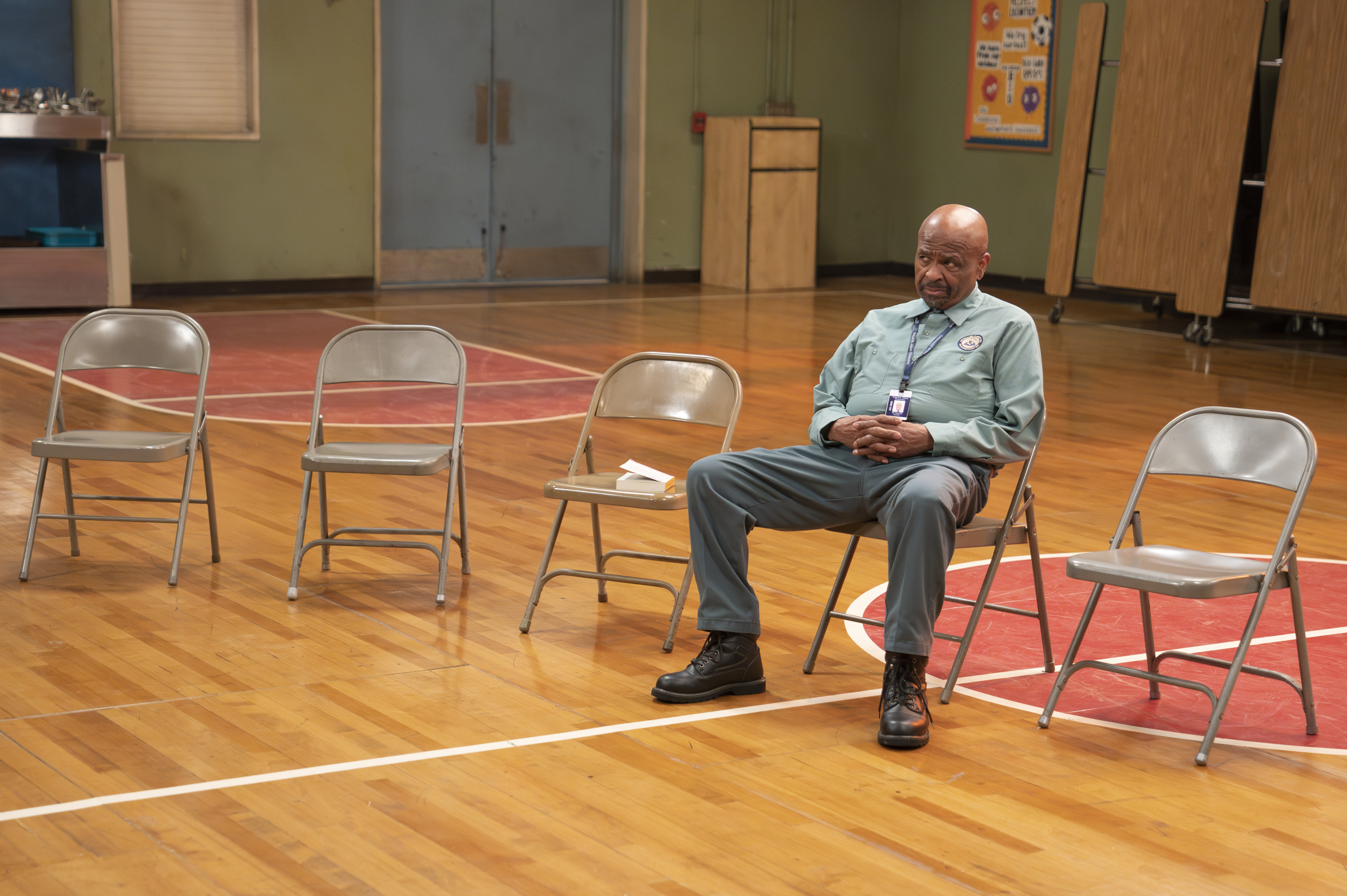
William Stanford ‘Stan’ Davis has inspired many a clip on the internet for his work on Abbott Elementary as Mr. Johnson, the enigmatic and conspiracy theory loving janitor at the Philadelphia elementary school. Johnson doesn’t always have all the answers in the ABC mockumentary, but he does have many questions that have us looking at everything, well, differently. (Illuminati??)
When we spoke a few weeks ago, Davis had just won the award for Outstanding Supporting Actor in a Comedy Series at the 55th NAACP Image Awards. Over Zoom, Davis talked to us about his work on the Quinta Brunson comedy. Davis was quick to praise the sitcom’s writing (and writers!) when asked why his character is such a favorite, and he also talked about how family and friends he’s known have helped him make his portrayal of the character feel lived in. Davis was philosophical about his career and the journey he’s been on until Abbott, including a brief stint in stand-up and a lot of episodic work. It was an interesting conversation, and you can check out the audio above or read the full interview below.
Ayla Ruby: So as I said, I’m very excited to talk. I love Abbott and I love your character, so this is fun.
William Stanford Davis: Oh, thank you so much.
Ayla Ruby: Congratulations. You’ve got a very cool recent award and you had a really amazing essay and time that I was just reading.
William Stanford Davis: Thank you. To be in TIME Magazine, that’s what an honor. And the NAACP award was a triple honor, so it’s been … These last few weeks have been kind of cool.
Ayla Ruby: I can imagine. So can you talk a little bit about how you make your character feel so lived and in real because it feels like a very intentional magic and it’s awesome. And it’s like you still the scene every time you’re there, so.
William Stanford Davis: A lot of it has to do with the writing. We have such an amazing writers room, and even though I’m a lot older than they are, they seem to capture this guy. And I’m sure that some of them base this guy on, some people that they know, relatives, uncles, grandparents or whatever. But I just love the fact that they write such great stuff for Mr. Johnson, and Mr. Johnson doesn’t hold back. He speaks his mind and he doesn’t care where the chips fall, and that’s what I love about him it. But basically, it’s about such great, great writing. We have such great writers.
Ayla Ruby: I love that answer. So you’ve done drama. This is your first really big foray into comedy, I think, right?
William Stanford Davis: Yeah, yeah. Even though I did stand up years ago and I put it on the back burner to really get into my acting… And my career has been basically an episodic television.
Ayla Ruby: How do you switch gears from episodic and that to comedy? Do you channel the skills from stand up or what?
William Stanford Davis: Well, the stand-up helps, but an actor is an actor. The way I look at it and whatever’s in front of you … The word that’s in front of you, you try to bring as much reality to it as you possibly can. You try to make this a real living, breathing, three-dimensional human being and not a caricature or a cartoon. And that’s what I’ve tried to do with Mr. Johnson is just to make him an honest person. I knew people like him. I knew janitors like him. I knew conspiracy theorists like him. I had a few in my family. I think you’ve probably heard my grandmother was a conspiracy theorist. She didn’t believe anything, especially the moon landing. So I tried to bring some reality to it, bring the realism of just who this man is and not make him, like I said, a cartoon or a character.
Ayla Ruby: Do you have advice for people who want to do that, who want to make their characters honest or actors who are trying to not just play [their roles]?
William Stanford Davis: Well, one of my mentors was Martin Landau. May he rest in peace. I loved Marty. He would always say, Stan, I want to share something with you. And one of the things he shared with me, and it was a simple thing that just kind of made sense. He said, “Everything we experience in life is filtered through our five senses. So that’s all we do in life is react to what is fed to us.” And that’s the advice that I would give an actor. We react, we don’t act. And we react and reality and just happens that Johnson’s reality is different from everyone else’s.
So that’s the advice that I would give them in terms of how to approach the character, just to find what your senses are feeding you and then give an honest reaction to that. And I know that’s kind of simple, but that’s helped me a lot along the way to really what’s going on here? What do I see? Who am I talking to? How many people am I talking to? Am I dealing differently with each one? How do they make me feel? Is it cold, is it hot? Am I pissed?
So those are the things that I try to bring to it, whether it’s a comedy or a drama, just try to stand the reality of the situation. Mr. Johnson’s reality is just a little different than everyone else’s.
Ayla Ruby: Is there something like a belief or thought from Mr. Johnson’s reality that you had that’s like your favorite or that you find kind of intriguing or just really fun?
William Stanford Davis: He’s a really enigmatic guy, but what I have the most fun with is his conspiracy theorists. I have a lot of fun with that. When I see them on the page, I’m like, “Oh my God.” So I try to really commit to lizard people being under the airport or the moon being a space surveillance ship and really try to have not as much … I’m having fun all the time, so I don’t want to use that word, but like I said, the reality and really dealing with the other characters, whoever I’m dealing with in the scene really try to get my point across. This is what I believe and that’s what I try to do on the daily.
Ayla Ruby: I think it totally comes across. So in the TIME piece, and I think in other interviews and even a little bit at the beginning of our chat, you talked a little bit about how it’s been kind of an interesting couple of weeks and how you’ve found the success later in your career. What’s that been like for you emotionally, professionally? Has there been anything that’s kind of made you pause or?
William Stanford Davis: Every day. I’m in pinch myself mode right now. I’m talking to you. You know what I’m saying?
Ayla Ruby: Yeah.
William Stanford Davis: To have an article in TIME Magazine based on my own words that come out of my mouth about my life, I never thought that would ever happen in my life. TIME Magazine is one of the most revered magazines in the world. And for them, what an honor to be a part of that history, the history of the show. The show is a history-making show first of all.
And to be in that magazine sharing my life story or my story up until now. What it is it’s that in life, we’re going to have a lot of dead ends and detours and we have to take other roads and things. But the main thing is don’t quit. Don’t forget about the journey. It’s not about the roadblocks or whatever. If it’s a roadblock, I got to take a side road, I got to cut a path through it or whatever. Just don’t quit. See what’s out there that you want to accomplish and keep working toward it.
Ayla Ruby: I love that. That’s such a lovely sentiment. Shifting a little bit into, I guess more into the characters and the show, I would love to … And I know you can’t talk a lot about it, some of it because it’s spoilers, but maybe up to this point, can you talk about the relationship between Mr. Johnson and Jacob? I just keep thinking of the Cat episode. I can’t stop thinking of that.
William Stanford Davis: That was one of my favorites. He has a different relationship with each and every character, and he had a fondness for both Jacob and for Gregory. Gregory Eddie. And if he’s not included with them, he gets a little sultry. He wants to be one of the guys and they look at this old man like, “Yeah, right, okay.” And they listen to what he has to say, but they’re younger. And it’s kind of like in real life. These guys are a lot younger than me and they think about things … Their world is totally different from mine. I come from a world of rotary phones and they’ve never been in the world without one of these things, one of these crazy things. [He holds up his phone.] But with his relationship back to … I see myself in a lot of these characters and all of them, something about them, it’s like looking in the mirror sometimes. And I try to find a way through the writing and through my prep as an actor to create a reality.
And I like them all in a way, but I don’t let them know that I like them, what they’re doing. I like what they’re doing. I like what I like the fact that they’re educating these kids, but I still have to give them a little needle.
Ayla Ruby: So you mentioned something that Mr. Johnson kind of feels like he’s on the outside. And I feel like this season there’s been a lot of hints or maybe allusions to that. Are we going to see more of that?
William Stanford Davis: I think especially toward the end of the season, you’ll see a different side of Mr. Johnson. Not a big difference, but you’re going to see some things that you didn’t expect from him. I mean, you’re going to see some crazy things too, but this is a 21-and-a-half minute show when you really get down there with seven main characters. We kind of get in not where we fit in, the writers write specifically, but they can only write so much for each one. I get a lot of questions. “Well, are they going to show more of Mr. Johnson?” Sure. they are. Each episode has to have a beginning, a middle, and an end, and he has to fit in there somewhere. You know what I’m saying? And I just love what they write for me. I love what they put on the page for me, and I try to make as much out of it as I can.
Ayla Ruby: That’s awesome. Do you think that there’s anything maybe misunderstood or … about your character by the wide world or anything that you want that we haven’t talked about that you want people to know about it?
William Stanford Davis: He loves what he does. He wants to make the school the best place he can for these kids. He went to school similar to that, and if you consider it now, and the reality of who I am and who this character is. The inner city school system hasn’t changed very much since I was in school or since Mr. Johnson was in school in terms of everything from supplies to teacher salaries to the conditions of the premises. And so this character is trying to make this place the best place that he possibly can make it for these kids and for the teachers, but mainly for these kids to get as much of a quality education as possible.
My fervent wish is that in reality, in real life, if they look at this show and see that this is something that needs to happen, that the inner city schools need to be saved and that they need to be … and teachers need to be paid a decent salary, I think teachers should be paid like doctors because doctors save lives and so do teachers.
Ayla Ruby: There was one … I think one line in this season, and Janine … Spoiler is Janine’s going to go work for the district and gets a $2 raise, and she says, that’s like a million dollars in teacher salary, and that’s …
William Stanford Davis: $2. Come on. Teacher’s salaries haven’t changed much in the last 35, 40 years, and that’s ridiculous. It’s ridiculous.
Ayla Ruby: And I think I read that you went to St. Louis for school.
William Stanford Davis: Well, I was born and raised in St. Louis.
Ayla Ruby: Gotcha.
William Stanford Davis: And I went to school, elementary school and high school there. Then I went to an HBCU, Lincoln University, which is in Missouri also.
Ayla Ruby: Awesome. Just from what you’ve seen, are there any … And we talked about it a little bit, are there any parallels between the public schools in St. Louis growing up to the public schools in Philly? And I went to Philly Public Schools. I have lots of questions.
William Stanford Davis: Specifically Abbott … Philadelphia’s probably one of the only east coast cities that I have not visited personally.But Abbott is a lot like the school that I grew up in. The elementary school that I went to. The teachers, they were all very caring. They wanted to make sure that you got the best education that they could possibly give you one of the conditions, and as I said earlier, that hasn’t changed very much. The inner city schools in St. Louis, I got a great education. I didn’t take advantage of it as much at the time. Looking back on it, they presented us with every opportunity possible at that time. And some of it I took advantage of and some of it, I don’t want to do that.
Yeah. But I think that there’s a lot of similarities to both.
Ayla Ruby: Cool.
William Stanford Davis: The crazy thing is what I just said a minute ago, that it hasn’t changed very much. And I don’t know how we can through government funding. Once again, I don’t want to get political about anything, but something has to change. Something has to change. Teaching is a noble profession. I had two of my favorite people on the planet, my mother’s older brother and sister. Her older sister was my third-grade teacher, and they loved what they did. Just two of the most caring, loving people that I’ve ever known. And they showed that in the classrooms too.
Ayla Ruby: To go a little bit back to Philly, you haven’t been to Philly, but Philadelphians are all around. Yeah, has there been any reaction from Philly people to your character or to Abbott that you’ve experienced?
William Stanford Davis: The Philadelphian people that I’ve met here in Los Angeles, they just come up and they shake my hand and tell me how much they love the show and they love the character. I get a lot of social media texts and emails from a lot Philadelphians, and not only do they love the show, they tell me how much they love the character, and that is so heartwarming. And I love the fact that they love this guy, and I hope they keep loving this guy.
Ayla Ruby: I think they will. Hhas there been anything that’s been the most fun, most exciting, most interesting moment just to bring to screen or portray or that’s just been like, this is cool?
William Stanford Davis: For Abbott or in my career?
Ayla Ruby: You could do either one. It’s totally up to you.
William Stanford Davis: I’ve worked a lot, but nothing … And I’ve had recurs on several shows, lots of recurs, but nothing quite as satisfying and enjoyable and meaningful as Abbott Elementary has been. The writing, I get to work with a stellar cast. We all get along, we hang out, and I have a special love for each and every one of them. And so this has been kind of … For a guy who’s going to be 73 in August, this has been a great time in my life. And once again, if for all the younger actors out there who were working square jobs, don’t give up. Just keep doing it, keep doing it, keep doing it. Keep putting everything you can into your art, into your career, and when that roadblock comes, sidestep it, jump over it, whatever, go under it and just keep on keeping on as we say.
Ayla Ruby: Well, that’s awesome. And I think that’s a lovely and inspiring note to kind of finish things on. And thank you so much for talking.
William Stanford Davis: Thank you, Ayla. Thank you for having me.


Comments
Loading…