
 Steven Prusakowski
Whenever I think about the FX series Fargo, I think about how disappointed I was they were turning it into a series. Luckily for me and millions of fans there was a guardian at the gate in Executive Producer Warren Littlefield.
While, if not in the industry, it is possible you don’t know his name, you will certainly know his work after having produced some of the most popular television series over the last few decades including Friends, ER, The West Wing, The Handmaid’s Tale and more.
Littlefield spoke with Awards Radar about the inception of the Fargo series, beginning with an initial pitch based on the film, which he thankfully declined, ultimately paving the way for the six-time Emmy winning anthology series by Noah Hawley.
Our conversation dives deep into season five which tells the story of Dorothy “Dot” Lyon (Juno Temple), a housewife who will do anything to protect her family from those who threaten them. We cover the beginnings of the season and its ties to the original Coen Brothers’ film and the ending which may be one of the best to ever grace TV screens.
Below is our conversation.
Do you remember the original pitch for the show and like how this came to you?
Warren Littlefield: Well, actually, it started back when I was still at NBC. I developed off of the film. Producers came in, Bruce Paltrow, who also did Saint Elsewhere. They came in and pitched Fargo the series. And I said, let’s try it. Iconic film.
I love the film. And we developed a good script. And at the end of the day, I felt, wow, I think we’re going to end up doing a network television version of an iconic film. And I think that’s a mistake. I don’t want to disappoint the audience. And so I passed.
A year later, CBS made a pilot that starred Edie Falco before Sopranos. And Kathy Bates directed it. I’ve never seen it. And it was a failed pilot that CBS did nothing with. So Fargo, the television show, never went into the universe, which is good. But when I developed it, they gave me a snow globe, which was a marketing device from the film.
And it had Marge on the edge of the highway with a flipped over car and there was blood in the snow. And I always loved that snow globe. And then years later, I was just looking at it and just sitting there on a coffee table and thought, maybe it’s time to do Fargo.
Maybe the world has changed and I’m no longer at a network. And so in my discussions with MGM and FX, the only writer I ever talked to was Noah Hawley about it. I’d just done a project with Noah and had fallen in love with his creativity.
And Noah wasn’t afraid to take on Fargo. And in the discussions with MGM and FX, they just said, we’re not sure you need Marge. And so Noah was wonderfully liberated by that thought.
He said, ‘So all new characters, all new story. And I’m just in Fargo as a state of mind. I’m playing in Fargo the tone.
And I said, yeah, I think that’s the freedom you have. And so we came up with an anthology series that always reflected the brilliance of tone and place and the stories that are in Noah’s head. The Coens read the first draft of his first script and they said, we think Noah channeled us.
We would love to put our names on this. And that was a really important embrace for us that they would give us a seal of approval. So from there, it really, it made our lives creatively, professionally.
It took us on a journey. Again, we started it more than a dozen years ago. And we go to Calgary in the winter and we bring a cast together and we tell a dark and also humorous story. And try and reflect part of who America is, where they’ve been. So whether we’re dealing with themes like the Walmart-ization of crime, from family crime to Kansas City crime syndicate, whether we’re playing in season five with power, an examination of power.
Jon Hamm has it. He’s a lawman. Juno Temple also holds onto power because she refuses to be a victim. Many could label her a victim, but she refuses to ever think of herself that way.
She’s formidable and she’s strong. And then of course, Jennifer Jason Leigh, her power is money and she’s really good in the world of money. So that becomes all part of the thematic of season five. They all wield that power in different ways and they all use it for different means and different end results with their different goals, I guess, what they’re looking for.

One of the greatest things about this series since day one has been the impeccable casting. You take these people we know, and you put them in situations that are just awkward, stressful, and uncomfortable for us as viewers who know their work. Most people know Juno from Ted Lasso.
But you create this character who is more relatable. She’s not wearing designer clothes, she is wearing regular folk attire, sweats, and things like that. She’s a housewife.
But then behind that exterior as Ole Munch (Sam Spruell) reveals is that she’s not a woman, she is a tiger. Her character, Dot, within the one episode transforms from what you think you know of her – it’s incredible. It’s amazing writing, amazing acting.
WL: Rachel Tenner actually did local casting on the Fargo movie for the Coens. When we began the journey, they said, ’Hey, Rachel kind of gets us and she’s got good sensibility and I think she’s gone from Chicago where she used to live to L.A. and maybe talk to Rachel.’ So the Coens made a suggestion and Rachel didn’t have a lot of experience in television, but she had a sensibility.
Rachel Tenner has cast all five seasons of Fargo. She is a very essential part of understanding those characters that Noah puts on the page, who can help bring it to life. If there’s a common thread, it’s that none of the actors are enemies of comedy.
They actually all are quite adept at comedy. And many have not given a chance, been given the chance to show their dramatic chops. And so we offer that opportunity and also get to enjoy their rhythm that they hear in their head of how to navigate through a scene.
So Martin Freeman, again, someone who Lester could have been a victim, a wimpy victim. Martin just made that character so delightful. Audiences fell in love with him. Even after multiple murders, he killed two wives, you know, and the audience would go, ‘Oh, Lester, he’s so adorable.’ you know – and that was what Martin did with what that character was that was on the page.
So I think we often say. Who can make us laugh and also play the dramatic chops of the role? And that’s the common thread in each and every Fargo. Yeah, it’s amazing when you look back at the seasons and how each one you go and you don’t really you don’t know what the story is going to be.
It’s not continuing character citizen mythology, but it’s the spirit of the original film and the spirit of the previous season. So, every time you step in, you’re waiting to see where they take you and not knowing who you identify with. And oftentimes that shifts a lot, too, because you’re like, oh, that’s the character that is most like me.
Then by the end, you’re like, oh, that’s I despise that character. I think it’s really great how it really analyzes humanity and what drives us. Well, I love that you’re a super fan and that’s exactly what we’re trying to do.
We’re trying to reflect the world we live in and we need dramatic ballast in that in our stories and character journeys. And yet we also want to entertain in offbeat, unexpected ways. So occasionally we even get a little silly.
So the fun for us is when we’ll be in a screening in a theater and we have hundreds of people and we get to hear the laughter roll through the audience and then and then the next moment they’re gasping because of the situation we put them in. And you’re absolutely right. Look what Dot goes through in that opening hour of season five.
And, in the middle of nowhere, we built that gas station and then we basically shot it up. Right. And who’s the hero in all of that? Dot.
And formidable. She’s no longer PTA mom after she’s been through that sequence. And as you said, Old Munch is like. No, this is not a woman. This is a tiger.
And that admiration for hunting the tiger carries all the way through to the final shot and that final biscuit and smile.
We’ll get to that in just a second. What’s amazing with Juno’s performance and how the character is written is about what’s driving her – with lust for power and selfishness and evil all around her – what drives her is family. How do you not connect with that? She’s a hero you want to be if it comes to it – that’s what I’ll do for my family.
WL: Well, the inspiration for this story really came out of the original movie. And the wife is basically with a very bad scheme. The wife is kidnapped. So we asked the question, when is a kidnapping, not a kidnapping in season five? And what Noah said is, you know, basically you see for a few seconds on camera. On the original movie, you see Bill Macy’s wife and then there’s a bag over her head and she’s gone.
And he said, so maybe there’s a story there. Maybe she is the cornerstone of the story that I can tell. And so in the opening hour, as the first kidnapping attempt starts, there’s some shot for shot homages to the original film.
But then we take off on our own. And of course, Dot is the centerpiece and Dot is formidable in ways we can’t expect with secrets that she’s hidden as deep as her love is. For her husband and daughter, she’s kept a lot of secrets.

Let’s get into that, because there’s that episode which uses puppetry in such a brilliant way to talk about a serious subject without traumatizing, which I thought was brilliant. It’s like you’re being able to address this without making us turn our eyes away.
And I was wondering, you know, if you can talk about that episode a little bit and the trauma that Dot carries.
WL: Noah wrote that episode with April Shih. We always scare ourselves in Fargo. We put ourselves on the edge of the cliff and we jumped off. And this was the episode where we took the biggest leap we had to create.
First of all, those puppets had to all be made. And then we had to create a separate puppet unit. And those puppeteers were drafted from various other locations. They weren’t in Calgary. So we put a puppet unit together, created this world, went through extensive rehearsal. And we really, really analyzed what we were doing.
And then hope that it would work. We hope that when we went into post, what we put together would hold up and be emotional, be powerful, carry the power of this story this season and not be ridiculous or stupid or or inappropriate. And we just didn’t know.
But we thought if we could pull it off that it could have the results that ultimately it did. But we were afraid of the episode. And that was also very exciting to us. It’s an episode that many, many people point to and say, that’s when you nailed it for me. And that’s wildly exciting. And I think that’s part of what we do every year. We challenge ourselves, whether it’s the time periods of the 40s and 50s in season four, a huge canvas of characters and story, the intimacy of season five. But the thematic and and the emotional territory we have to navigate in season five. Does that feel like Fargo? Well, I think we were able to pull it off and say, yes, actually, that is Fargo that expands who we are and where we can go.
So true. I love it. I mean, it’s one of my favorite series out there and every season delivers. I don’t have much time left. I do want to also talk about that closing scene. When that final shot happens, I mean, it was like an epiphany.
Honestly, I think it’s one the best final shots ever. Can you talk about that and your reaction to your first time you saw it?
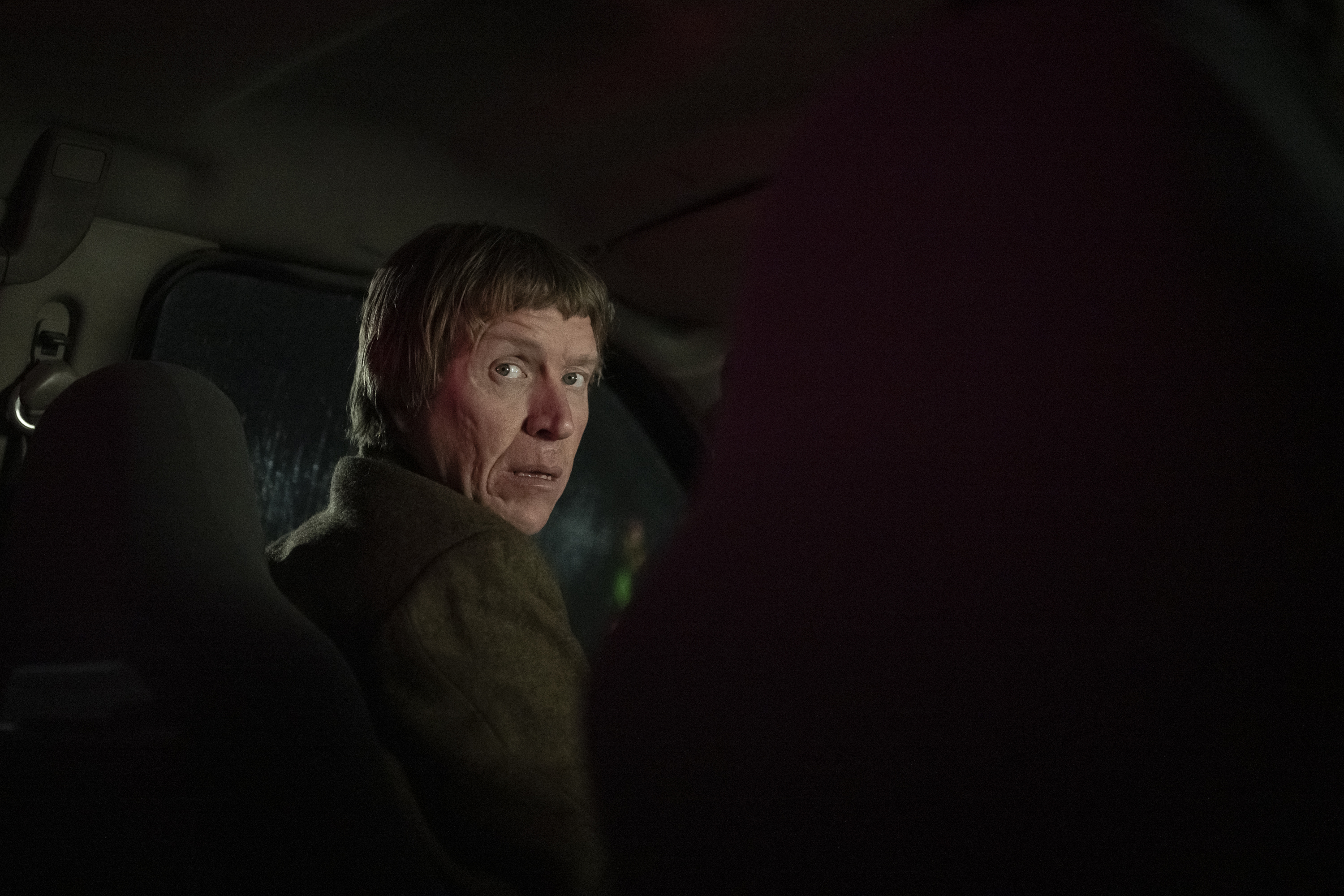
WL: Yeah, Sam Spruell’s Ole Munch is such a brilliant character. He’s five hundred years old. He is a tortured soul and he’s on a mission. And in some ways, he’s a gun for hire, but he’s so much more. And ultimately in the best of America versus the worst of America – and Dot touches him and wins his soul.
That’s what we’re playing with. He comes to hunt her, but then he also comes to really respect her and admire her. Then she sees him as a human being. And I don’t think he’s experienced that in his life.
Munch being a presence in that house and have a soda, sit down for dinner, make biscuits. Then a family gathering. We were sweating bullets. We were getting down to the wire. Do we have it? Get the singles, get the group, the washing of the hands, everything.
And we were literally like, ‘Oh, my God.’ And we left that stage going, ‘I hope we got it.’
We covered it, but we hoped we got it. It was another scary Fargo moment for us as producers. And but that’s it, we had stretched as much time as we possibly could out of the day. It was a wrap.
And we all embraced. We sang. We cried. We laughed. We celebrated. And I think we went to bed that night not knowing but hoping that we had the elements we needed to go into the editing room and deliver the performance that you just spoke about.
And we did. But there was no going back. We couldn’t. If we didn’t have it. It wouldn’t have had the impact that it had. But we got it. everyone. You know, Sam is playing a dark, flawed character. He’s one of the sweetest human beings I’ve ever had the opportunity to work with. And it was such a grueling job for him to be much right and then he was ready to let go – as we all were. And it worked. That final shot was what we hoped it would be the culmination of the story that we told.
You nailed it 100 percent. And I mean, it’s probably good that you did have a tight deadline, maybe you would have overthought it or added something. But it’s perfection. I don’t say that very lightly at all.
WL: You may be right. Maybe if we had had another four hours, maybe we would have missed it. And by the way, every single actor and our director knew we were right there on the edge that we had to get it. Therefore, perhaps everyone brought something in that moment, knowing that there wouldn’t be that many takes in order to pull it off.
Well, thank you for your work on this series. Thank you for saying ‘no’ to the original ideas that came to you and carrying that torch and producing this incredible Fargo series, because like you said, it’s one of the best out there.
WL: Thank you so much. I really appreciate that support.


Comments
Loading…