

 Shane Slater
With films like Boy from Heaven, Holy Spider and Flee being submitted in recent years for Oscar submission, the face of Scandinavian cinema has notably strayed from the traditional White narratives. That trend continues with Malid Alami’s Opponent, this year’s Swedish Oscar contender for Best International Feature Film. In this hard-hitting drama, a man is forced to relocate his family to Sweden, where the secrets of his past threaten to rise to the surface. Those secrets are eventually revealed, and in a recent interview with Awards Radar, Alami discussed the underlying themes surrounding sexuality and the complexities of Sweden’s refugee experiences.
Shane Slater: What was the inspiration for this film?
Milad Alami: I’m originally from Iran and I grew up in Sweden, in the north of Sweden. And I always wanted to do something about the first years when I was in a refugee center in the north of Sweden. It kind of just came back, and I wanted to do something about that experience. And that’s kind of where it started. And then, I grew up with men who were a lot like the main character in the film. I grew up in Iran, and being part of that regime, and then moved to Sweden, where it’s democracy. You can do whatever you want and you can say whatever you want. But still, they’re kind of self-censoring themselves. So I was interested in portraying that. So it kind of came from these two places, to be honest.
SS: It was interesting to see how the refugee system operates in Sweden. Was that similar to your experience?
MA: Parts of it are from my own experiences. I also came to a refugee center in the north of Sweden that was very close to the place where we shot. But it was a different time. It was at the end of the 80s. The view of refugees was different then in Sweden. They were more viewed as someone who is actually going to contribute to the society and it was a more open kind of thinking.
Now, it’s completely different. It’s much more harsh, it’s more difficult. A lot of the people are faced with really difficult circumstances moving around all the time. All of the stuff in the film are based on real things. And all of the extras in the film are real refugees. I wanted to create it as realistic as I could. And it was also inspiring for me to meet all these people who shared an experience, even if it’s over 20 years apart. It’s kind of the same story. You’re faced with anticipation of a new life that’s going to begin but also, the fear that it might not happen, you know? So it was very interesting.
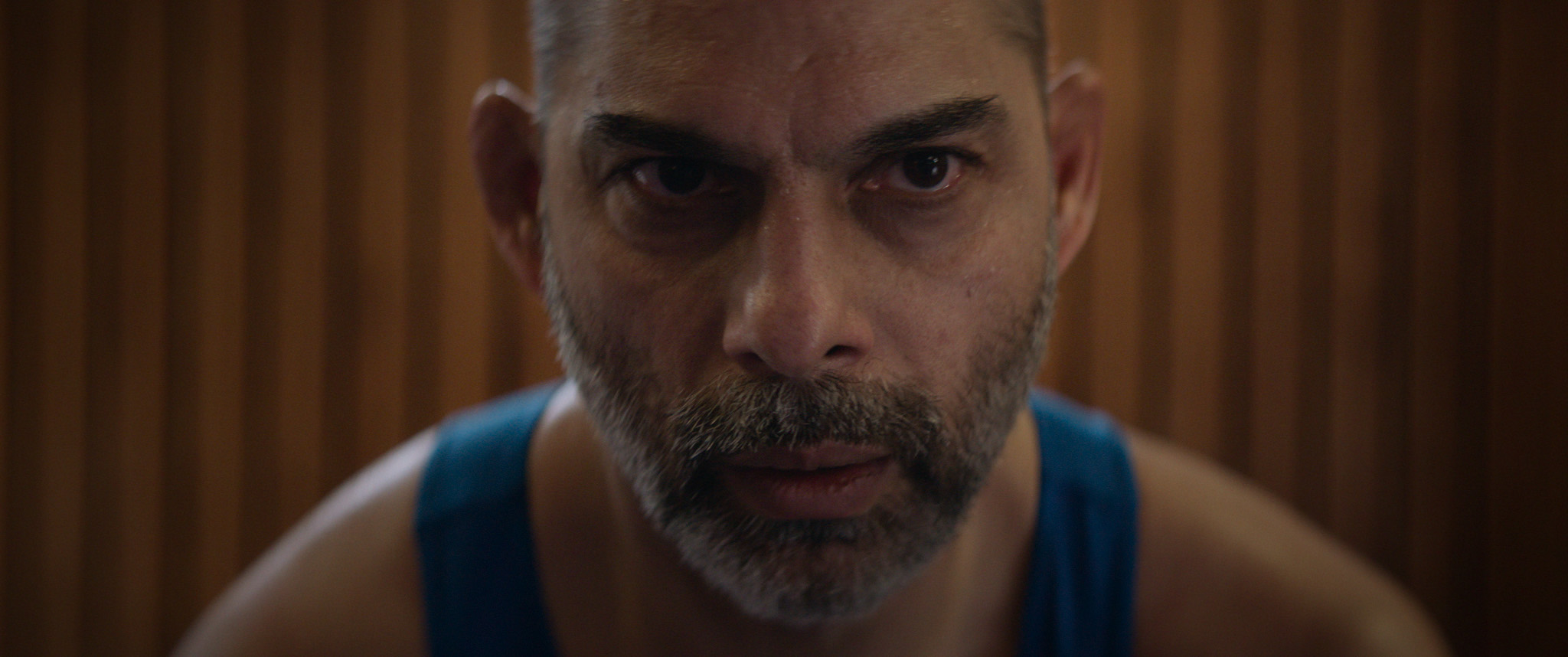
SS: Payman Maadi is so great in the lead role. Was he your first choice?
MA: When I wrote the script, I was afraid of thinking of an actor because I was thinking, if I think of someone, I’m probably not going to get them. But Payman, I’ve seen him in so many films and he’s an actor who both the young generation and the old generation in Iran know of. And I wanted someone who was rooted within the Iranian society. His language was very Iranian. I didn’t want it to feel like I take I’ve taken a European-Iranian actor and he’s trying to portray a guy who’s lived in Iran, because I can hear it in the language directly. Payman is super Iranian.
So the way I contacted him was through the casting director Zar Amir Ebrahimi, she was the main actress in Holy Spider. Zar was casting director for me and for Holy Spider and she had a contact with him. And we sent him the script, and he really liked it.
SS: There’s also a lot of physicality to the role because he’s a wrestler. Did you do a lot of work to find that physicality with him?
MA: I think when he read the script, he knew he had to do a lot of preparations. So I told him, and I told the other actors who had to wrestle, “I was like, “You guys have to do this for real, you know? We can fake it for some parts of it, but you guys have to do it.” So they did a lot of training and a lot of, learning to build muscle. They had private trainers, we got them a trainer from the Swedish national team that really pushed them to the limit.
But also, it was interesting because Payman is a character actor. So I could see that he started to transform the way he walks, the way he started to act while he was in character. Wrestling is such a working class sport in Iran, and it was important that we had that kind of super masculine way of walking, moving into rooms. And Payman really got that.
SS: The winter atmosphere contributes to the tension of the film. Were you always thinking about that environment for the film? How did that play into the tone of the direction?
MA: Yeah, it was always winter. I want it to feel like it’s a long winter that never ends, this kind of cold landscape. I remember it so much, you know? Coming to Sweden from Iran, going to this super cold and isolated landscape that is extremely beautiful but also, you can die there if you don’t have enough clothes. It’s much more about survival than anything else. And I thought that worked quite nicely with the film because he is a character who’s frozen within his feelings, and he has difficulties expressing himself and putting words to how he feels. And I felt that the landscape could kind of almost be his inner landscape.
Also, I’ve seen a lot of Swedish films, I grew up in Sweden. And I’ve never seen anything portraying the north of Sweden like it really is. That it is extremely beautiful but it is also harsh, and can be dangerous. And I liked both these things.
SS: I was really fascinated by their marriage and their backstory. What was it like to craft this relationship and energy between these two characters?
MA: It was really fun, because you just see what’s like, over the eyes, you know? Under the water, there is a lot of stuff that you don’t see. So we talked about how much does she know? How much does he know? How are they pretending to live this life while there are a lot of stuff that they’re not to talk about? Marall Nasiri, who plays the wife, and Payman they’re such good actors. So they completely got that. And the way I kind of thought about it was that, I tried to do some of the more difficult dialogue scenes earlier in the shooting. So those scenes when they are just staring at each other, and we know that she knows and this kind of intensity grows.
We didn’t have that much time to rehearse because we shot it during the pandemic. But we talked a lot about how to create this tension between them. I think that their biggest problem, or his biggest opponent is his silence. He can’t put into words the way he feels and everything that’s happened. And I think that it has to come through in the scenes when they don’t talk. Like one of my favorite scenes is after the wrestling, the last wrestling game. He comes in and says, “Oh, I lost. Did you see?” And she says, “Yeah, I saw everything.” And I think that was a such a strong moment that you could see on Marall.
SS: You mentioned earlier about how the refugee experience has been changing a bit in Sweden. And I’ve also been thinking about how the recent Oscar submissions are moving away from just the traditional White European stories. Is this a trend that reflects changes in Swedish cinema?
MA: I think that cinema is changing, because the generation that I come from, we came to Sweden in the end of the 80s. So when you see films, like Boy from Heaven or Holy Spider, it’s that generation. We grew up there and we educated ourselves. So we share a view or our version of what it is to make a Swedish film, you know? But I think also you can see it in France as well with a film like Les Misérables, Ladj Ly’s film. And because the funding system in Scandinavia is very good, it gives you opportunities.
So it doesn’t really work like we have to have Swedish language and a lot of white people. It’s more about the points of view of the people making it. And if it takes place in Sweden, or even if the people making it are Swedish, we should support it.
I think that’s a big reason why we see a lot of films that are kind of different, you know? I also think that cinema changes all the time. And I think that the cinema 20 years ago, when everyone just spoke one language in a film, that’s not today’s cinema. Today is different languages, different types of people, different backgrounds, you know? And I think it just makes it richer. So I think a lot of it has to do with a good funding system, and that generation of people are grown up now and are demanding to have their stories told.
SS: Do you think this film will be embraced in Iran?
MA: I think it’s probably going to be embraced by the audience. But I know the authorities will hate this movie. It will never be released in any form or shape. My first film also wasn’t released in Iran, because they are afraid of these things. But I know that the people in Iran, these films are downloaded and spread illegally in Iran, but could never be in a cinema. Not even Asghar Farhadi’s movies sometimes, are put in the cinema. In countries that are kind of dictatorships, they know that one of the most powerful weapons against their way of thinking is culture. They’re afraid of how people will react. That’s why they are so harsh against filmmakers.
SS: I’ve noticed a lot of Iranian diaspora films celebrate the culture so much, even despite issues with censorship and restrictions. What is your take on that?
MA: Yeah, I think it’s because it’s natural. I think it’s realistic, you know? Like when I talk to people, we know that I escaped from my country, but everyone I know, the way I talk, my work, everything was there. So it’s just difficult to leave everything behind and come to a place where you’re completely alone and isolated.
And I think that for the wife here, she feels very strongly because she left because of a lie. When she’s like, “What the fuck. What am I even doing?” But it’s also provocative I think, to make these stories for a western audience because they’re like, “Oh, if you left that country that’s a dictatorship, why would you ever go back?” But that’s not how it works in real life. People want to go back. If they have the opportunity, they go back because there are so many things like the food, the shops. Iran has negative sides and positive sides.
[This interview has been edited for length and clarity]


Comments
Loading…