
The first question that popped into my head when hearing that a remake series version of the Stephen King classic novel, Carrie, was being made was: why? We’ve had several versions of the story before, the original ultimately holds up exceptionally well, while the rest had essentially been forgotten over time.
There’s an answer to that question, and that answer is Mike Flanagan. As soon as I learned of his involvement in the series, I stopped researching, I stopped worrying, and I started rabidly anticipating what the series would be. Flanagan has helmed several King properties already, The Life of Chuck, Doctor Sleep, and Gerald’s Game, bringing his vision and respect for King’s work to each. So I knew our beloved Carrie White was in good hands. The wait has ended and my instincts were spot on. Flanagan delivers a modern classic – a take on a timeless tale that will satisfy established fans and new ones, young and old.
As I dug in, my observation was his faith in the story, avoiding Hollywood’s obsession with loading casts with the biggest names or stunt casting trending personas to quickly capture an audience. Instead, Flanagan relies on a cast of talented, experienced, even if lesser known actors and actresses that have the skills to tell the story of Carrie properly. To cut to the chase, from the top down, it works – the series is stacked with stellar performances. At the top of that list is Carrie herself, played by Summer H. Howell. As I started watching, she was completely unknown to me, which is kind of fitting for a story about the new girl in school, the one who no one has any expectations or knowledge about.

My feelings about Carrie have always been unique in contrast with much other horror. While the story has always been intriguing and scary, the emotion that always dominates is the underlying sadness. I remember watching the original decades ago, not knowing what to expect and being horrified, not so much by the supernatural element, but by the human horrors of being an outcast, of being different, of being bullied, especially when all Carrie wanted was to fit in.
It is all just too real. It taps into legitimate fears well beyond anything fantastical or those of your typical slasher. The nerve it strikes runs deep, directly to the heart. It is a shared, personal experience that many of us lived through. Because of how raw it feels, I rarely revisit the De Palma film. Watching this updated take on it is no different, hitting that same nerve dead on. It is a startling reminder that some of those feelings have never gone away.
For those of you who don’t know, Carrie is the story of a young girl who, after living an isolated life, is thrown into a heaping serving of hell, a.k.a. high school. Her household consisted of Carrie, her mother, and her father, whose passing literally opened the doors for her, removing her from the home and forcing her to start school. With her entire existence taking place within the walls of the family home, essentially a time capsule, she has been isolated, with no media and only the religious indoctrination of her parents.
She has never used a computer, knows little about the outside world, and doesn’t even understand her own body. Although her mother has restricted her to reading the Bible, with the help of a kind neighbor, she is exposed to some of life through classic books, snuck to her like contraband. She secretly ingests everything from Anne of Green Gables to Maya Angelou’s I Know Why the Caged Bird Sings.
Flanagan shaped Carrie not as an alien from a different planet, so disconnected from reality, but more as a person from the pages of one of those classic books. Like Sissy Spacek‘s version from the 1970s classic, she exists in a world devoid of the technology and trials of today. She feels like a throwback to a time before technology when the horrors of the world weren’t constantly delivered directly into your hands. Carrie is an innocent anomaly unsuspecting of humanity’s darkness, like Adam and Eve before biting the apple.
Carrie is actually quite smart and very well read, in a time that seems to appreciate the qualities less and less. When she shares with one of her classmates a quote from a J.M. Barrie novel about being kind: “Always try to be a little kinder than is necessary?” The response is not what she expected. Instead of a smile or a nice reaction, they look at her as if she had a third eye. The push for kindness is completely foreign and almost repulsive to the other students. She is like a classic Disney princess thrown to the lions, her naïveté and sweetness only making her more susceptible to the horrors of high school.
Unfortunately for Carrie, the cruelty does not end with in-person bullying, snickers, name calling and insults made behind her back. Flanagan taps into 21st-century bullying that could not have been imagined in the 1970s. Phones are everywhere, and because of them, each moment of awkwardness is not a small stand-alone island of pain, but potentially the tip of the iceberg.
This version of Carrie feels very familiar and lived in, while at the same time taking some chances and expanding on the story to tell one that, while straight out of today’s headlines, also retains the timeless. While phones and social media play a big part in the story, it is strangely easy to forget what year this was made. I’m not saying this is a style choice, but rather because cruelty to those who are different started long before cellphones and will continue long after.
And while the pain of bullying remains all too relevant, the speed and reach of social media take an embarrassing or cringe-worthy moment that once would have been shared among friends or a small group and amplify it beyond the walls of the school and into the boundless expanse of the internet. Kids today have no room for error. Slip up once and that mistake now has a megaphone, broadcasting it to the masses, who can like, comment, remix, and edit it for their own amusement or sadistic use.
It is bad enough if you mess up, but that is multiplied to new levels for a young girl struggling to understand her first period.

When watching this, I decided to do so with my 16-year-old daughter. Not only did I think she would enjoy it, she is a budding Stephen King fan, but I was also curious how the themes would resonate with her. The more things change, the more they stay the same when it comes to people treating people poorly.
As a parent, we have the joy of reliving some of life’s greatest moments through their eyes. What doesn’t get mentioned enough is that we also need to revisit and relive the worst moments as well. As someone who was frequently mistreated and at times bullied, Carrie takes me right back to this time, but luckily for my daughter, her situation seems to be better.
We discussed it, and she reacted as expected, captivated by it all, fascinated to learn of Carrie’s telekinesis, but also reminded that the world is not so kind these days.

None of this would mean a thing if the characters Flanagan so carefully wrote were put into the wrong hands. With a few familiar faces, including Amber Midthunder, most of the cast are relative unknowns, with returning Flanaganverse members such as Samantha Sloyan as Carrie’s mom, Matthew Lillard as Principal Grayle, Kate Siegel, Rahul Kohli, Katee Sackhoff, and Michael Trucco. Flanagan’s decision to go with them rather than a star-studded cast makes the face-in-the-crowd feeling of high school, of being lost in the group, work even more effectively. Midthunder is an island of kindness in a sea of rough waters, Lillard gives one of his best performances as a well-intentioned principal handcuffed by rules and restrictions, and Tim Bagley brings the same affable quality to the guidance counselor that he did in Somebody Somewhere.
As Carrie, Summer H. Howell blew me away, with a performance that grows and evolves and deepens as Carrie becomes more exposed to life outside her home and learns about herself. She starts the series wide-eyed and full of innocence and hope, a delicate indoor potted flower unexposed to weather the challenges and hardships of real life. By the time the series is in its final turn, that girl is all gone, transformed from a delicate flower into a thorny plant that is ready to prick and draw some blood. It is a transformation not of her making, but rather brought upon her like a curse.
In addition, Alison Thornton as Carrie’s nemesis disguised as a friend, Chris Hargensen, is the perfect villain, bringing pure mean girl energy to the role. Flanagan’s avoidance of painting her, or any character, with one stroke is partially what adds the increased depth to the series. This is not a tale of good versus evil. Instead, we have layered people, just like in real life. Thornton’s performance, may always provide the most palatable personality, we see that some of her entitlement and misdirected anger stems from her family life. While that’s never an excuse, we do see glimpses into her soul and at times makes you want to give her a hug as if maybe that is what she really needs to get on the right track.
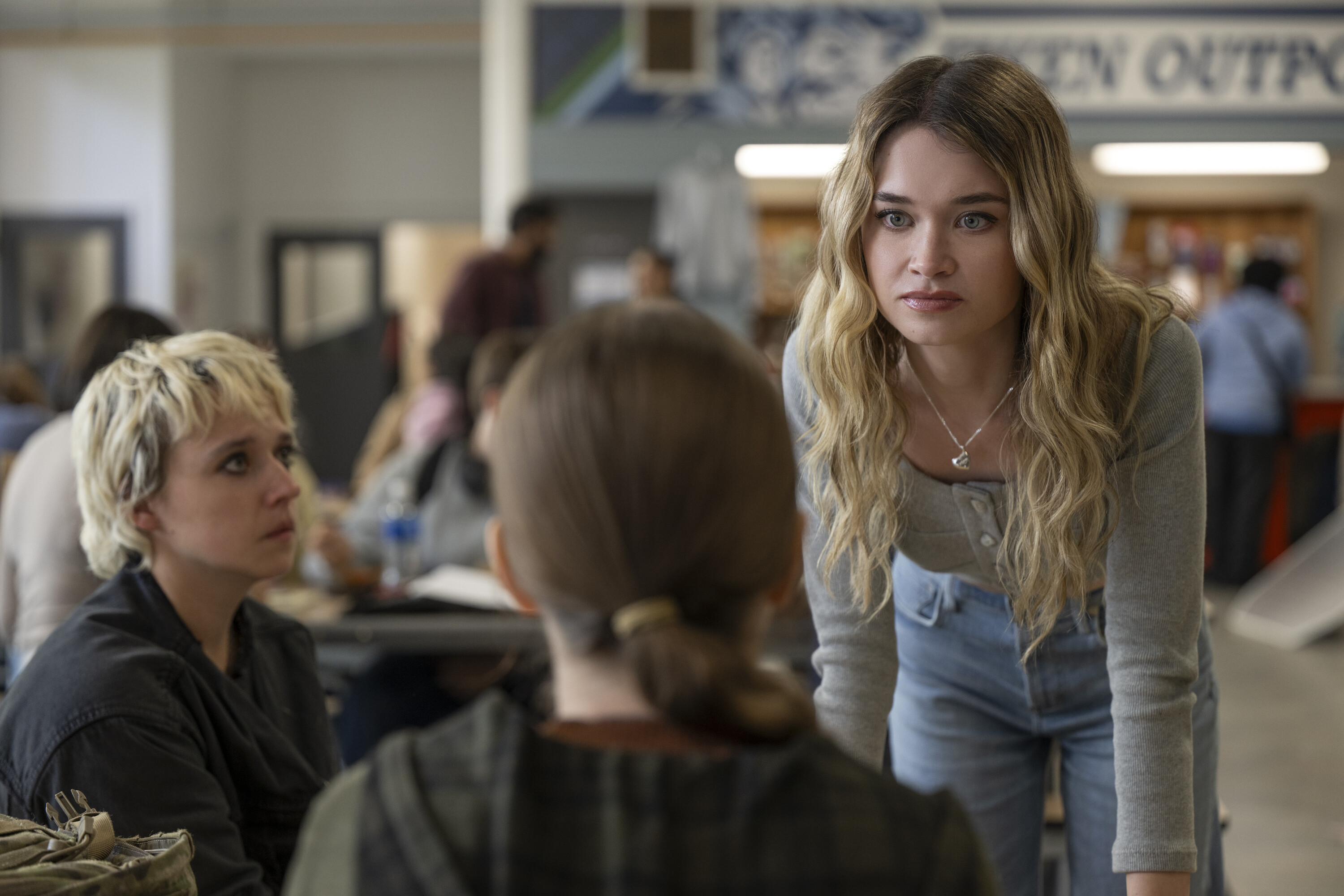
Josie Totah as the flaky Tina Blake, Joel Oulette as good guy Tommy Ross, the town delinquent Billy Nolan is played by Arthur Conti, and Siena Agudong as Sue Snell make up the rest of Carrie’s “friend” group, a colorful cross-section of high school, some that are safer spaces, others not so much. All are great with Agudong being a standout as the compassionate friend that you want so badly for Carrie, even if she does not come through fully.
One note: as I said before, some of these faces were new to me, but my daughter knew most from their earlier work on kids programming. Their work in the series has earned the right for me to know them going forward.
Her mother, Margaret, played by Sloyan, is another casting highlight. Grounded in the overpowering role of a mother bird afraid to let her daughter leave the nest, but also a victim of her own existence, no longer able to shelter her at home or hide her from the real world, she attempts to create barriers around Carrie, driven by her own religious fanaticism and executed via her keyboard and some ambitious helicopter parenting that would make any kid cringe.

There are a few times while watching that I found myself, as a parent who just wants the best for my kid, surprisingly relating to some of the character’s protective instincts. But there is more to her than her words, her actions are abusive as is her toxic use of religion to control Carrie through fear. The more she constricts her daughter’s growth, the more you root for Carrie to find her wings and learn to fly. The shifting tug-of-war for power that the parent/child relationship creates is some of the most captivating parts of the show. One ethical question it proposes that I was not expecting to be presented is one no parent should be faced with.
I found the first seven episodes to be just about perfect. They were thought-provoking and bold, painting a portrait of a high school world that didn’t exist when I was attending, not just the phones but the active shooter safety drills.
The direction is strong, as is the editing, creating an intensity that builds like a simmer to a boil. (The directors list included Flanagan and Kate Siegel, Axelle Carolyn, Kyra Sedgwick, and Hiromi Kamata.) Some of this credit may go to the fact that most people know where this all leads, the iconic prom, which I will avoid discussing for anyone, like my daughter, who was completely new to the story. At the same time, there is this uncertainty of just how bad it will get, even though in my heart and in the foreshadowing opening moments of the series, it was obvious it was going to be a nightmare, I tried to keep a glimmer of hope that all would turn out better. That glimmer of hope is quickly snuffed out.
It is directly related to one of the things that always weighed heavily on me watching, and continued after watching this series, the aforementioned very strong sadness to it. Of course it is horrifying and upsetting and dark, but it’s also just the story of a girl who never had a chance to just be who she was, never had a chance to just be happy. That has lingered with me since I saw the De Palma period scene decades ago and is given no reprieve now.
When the fireworks hit in episode eight, they are a bit meaner and more ruthless from what I recall. It’s a shocking and depressing series of events, especially in a society marred with school shootings and violence. It hits hard and seems like where it should all conclude.
The final episode is also very dark and maybe shades too dark for my liking. Because while the sadness remains, there’s also a shift in Carrie, similar to Chris: the victim now becoming the villain. Perhaps I’m just a softy, a dad who sees these characters and hopes that in a world that’s full of negativity, the imperfect and the broken find a way to survive.
Flanagan even includes some Easter eggs here that fans of King, De Palma and even the Flanaganverse will appreciate, but no prior knowledge of any previous work nor the original film is needed to enjoy this to its fullest. Those coming in looking for classic Carrie will find her. At the same time, as I watched this with my daughter, who didn’t know a thing about the book or the previous film versions, we both came away feeling that Summer’s Carrie was now our Carrie.
Is this a perfect Carrie? Pretty damn close to it, but that’s not completely the case. Without giving away too much, where we end up with Carrie in those last 10 minutes or so is where the series suffers its only misstep. There is one major plot addition that prevents the closure, and while I trust Flanagan to course-correct the issue in seasons two and three, it left me feeling as if Carrie became a passenger in her own story, no longer in the driver’s seat. Instead, we get an epilogue that doesn’t completely feel earned or necessary.
Again, it’s Flanagan, and I trust his vision and will certainly watch, but I do struggle to see where the story goes from here. After such a tight, well-structured story and character study, this tarnishes the natural finish. If I turned the show off five or so minutes early, I think I would’ve walked away completely satisfied.
Still, Flanagan crushes. His update to Carrie is bloody close to perfect. It feels both respectful to the Carrie we all remember and yet a more current tale exploring the many poisons of today’s world. Remove the powers and the blood and the chaos and young adults will relate and eat this up. With them intact, it goes to next-level horror. Flanagan has created a Carrie that feels respectful without being beholden to what came before, and terrifying without losing sight of the tragedy at its center. Biblical and Shakespearean, while still unmistakably Stephen King. I have a feeling viewers will be powerless to Carrie‘s spell.
SCORE: ★★★1/2
All 8 episodes of Carrie are now streaming on Prime Video. Cast interviews will be dropping on Awards Radar in the coming days as well as red carpet interviews and premiere party coverage on my Instagram.
Note from writer:
My biggest disappointment with Carrie is not a creative choice, but I suspect a strategic business decision. The series deserves an episodic release, not a binge drop. There is so much to digest and process that I believe audiences will be craving the next episode, discussing the previous one as they wait instead of binging. This is where social media, instead of being a foe, can be a friend. Not only for the entertainment aspect, but also for the important conversations that could be had in between as we learn again to wait.


Comments
Loading…