

As I spoke with The Lost Boys Tony-nominated Ethan Popp, he frequently used metaphors to explain what he does, which seems fitting for a man whose work is about translation. On paper, Popp has three titles on the production: music supervisor, co-arranger and co-orchestrator. But at his core, he is a storyteller, taking something abstract, emotional and complex and then working with dozens of artists to transforming it into a Broadway experience an audience can see, hear, and feel. If audiences walk away affected by the story without ever thinking about the mechanics of the music, Popp has done his job.
Based on the classic 1987 film, The Lost Boys brings the world of Santa Carla, California, to Broadway, transforming the cult vampire story into a musical, cinematic journey that comes to life (or the undead) across and above the stage. At the Palace Theatre in New York City, audiences are quickly transported into the film, surrounded by a thrilling, immersive world about family, belonging and blood.
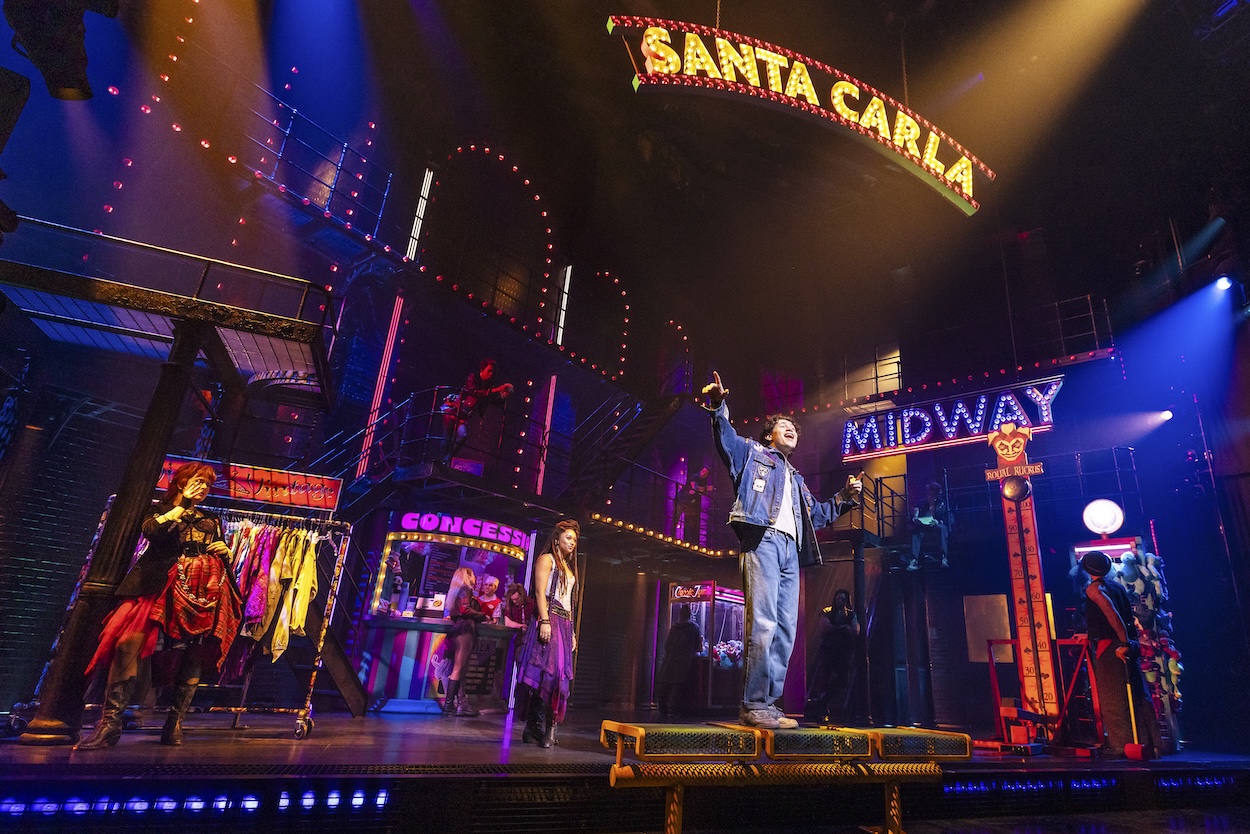
The Lost Boys gets into your veins. It has been weeks since I have seen it and still I find it flying through my head at random points throughout the day. Part of it is surely the spectacle of it all. What they bring to the stage is impressive, to say the least, transporting you back in time to the larger-than-life vibe of the 80s through a rockin’ musical sensation that erupts live before your eyes, but there are also the powerhouse performances. Shoshana Bean and Ali Louis Bourzgui, who both won Tonys for their work, along with Broadway newcomers LJ Benet, Benjamin Pajak and Maria Wirries, elevate this vampire story to full-on Broadway event. One of the biggest secrets in a musical about a town with some very dark secrets is how the sound pulls you in and heightens the world playing out on stage and all around you.
For Popp, that ability for music to do more than simply accompany a story began long before The Lost Boys, or even his career in theater. It started with a movie, E.T. the Extra-Terrestrial, where the music of John Williams made him realize that sound could change the way people experience a story.
“I remember having this epiphany at that time that music could completely deepen the emotional meaning of a story, that it wasn’t just accompanying an image, that it was telling you and informing you how to feel, how to hope, how to ache,” Popp recalls. “And that really started the journey for me because I remember going home after that and looking at the out-of-tune piano in our living room that hadn’t been touched by anyone and begging my parents to allow me to take piano lessons.”
It was the beginning of a lifelong fascination with what he calls the “architecture of music and storytelling,” an interest in understanding “why something lands, why something lifts, why something can devastate you.”
“And over time that expanded into theater, film, arranging, music supervision, production, all of it,” Popp says. “But for me, at the center of it has always been the same impulse, and that’s using music to create emotional context and narrative life.”
Popp often describes that process through the language of food. The technique can be taught, he says, but the real artistry comes from understanding the ingredients.
“You can learn the sort of technique of the craft. All of the techniques, those are your recipes, but what makes a really great chef is not knowing recipes, but knowing ingredients,” Popp explained. “If you know the individual ingredients and know what flavors pair well together, you know how to drive an end result that may be slightly out of the box, but more delicious than something someone has ever tried.”
During Popp’s childhood in Massachusetts, his Catholic school would make monthly trips to Boston Symphony Hall. At the time, Maestro John Williams was still conducting, and he would break down the function of each section for the students, demonstrating how each contributed to the larger composition. “He would talk about the functionality of every section of the orchestra, and have the woodwind section play a passage. And this is how the woodwinds function. This is how the strings function.”
“I found that incredibly interesting and informative in terms of texture,” Popp said, “and just sort of reinforced to me, even at a very young formative age, the sort of power that music can have in informing emotion.”
Decades later, that same mindset influenced the way he approached The Lost Boys, where his job would be to take an existing musical idea, understand its emotional DNA and determine how to build it into something larger.
This is when Popp shifted to the metaphor of a painter, and it worked perfectly to describe the extraordinarily complex and involved process in a way a less musically educated person (such as myself) could wrap their head around.
On The Lost Boys, his three official titles, music supervisor, co-arranger and co-orchestrator, come with distinct responsibilities, something that was lost on me before our conversation. There is so much more to bringing this story to the stage than performing the original songs. The music has to emerge organically from the story, support the performers and respond to the physical world of the production.
“I often describe the role of musical arranging sort of as a painter or an artist, seeing something for the first time and creating a pencil sketch in a notebook,” Popp says. “Well, from what perspective am I going to see this? How is this piece going to flow?”
That sketch begins with the composition itself, but Popp’s job is to determine how it enters the story.
“Oftentimes, arranging is saying, okay, we have this composition. Obviously, we need to start the composition somewhere. The songs don’t just start, it needs to feel like it’s organic and coming out of the scene,” he explains. “So there may be some light underscoring that takes us in. Other times, it may be a decision just to start the music out of nowhere, potentially for shock value or to underscore an emotional moment.”
The sketch also has to account for the people bringing it to life, “collaborating very closely with our amazing cast in terms of, obviously, The Rescues (the American rock band consisting of Kyler England, Adrianne “AG” Gonzalez, Gabriel Mann) have their own incredible voices. But as we put these compositions onto new performers, that may inform differences in what key they’re singing in, or the flow of the song, or needing to take a break from singing to get back into dialogue. It’s sort of sketching all of that out.”
“And then the orchestration is then taking that sort of pencil sketch, and applying color to it, much as a painter would to that original pencil sketch,” Popp says. “What sort of textures are going to be there? How deep are the colors? What sort of feeling are we trying to evoke out of this moment?”
Popp goes beyond deciding what instruments should play which notes. He is considering perspective, texture, timing, emotion and the physical demands of performance, all while keeping the larger story in view.
When the process works, the audience should never see the sketch, or even notice the brushstrokes. That may be the ultimate goal of Popp’s work: to make something extraordinarily complicated feel completely natural to the audience experiencing it. So much so, you Lose Yourself.
“For the latter two, for arranging and orchestration, when it’s done, when it’s at its best, almost goes unnoticed,” Popp says. “You never actually feel like a song is starting, but it’s a natural extension of the emotion of the dialogue of the greater story.”
That idea of music emerging organically from the story is at the heart of Popp’s approach to The Lost Boys. His work is not about imposing a musical identity onto the production, but discovering what the story needs and finding the right language to express it. The music has to move with the characters, riding the same emotional peaks and valleys, while expanding something that began as a composition into a living piece of theater.
“It’s developing something from sort of a static demo into something that can live and breathe within the story that rides the same peaks and valleys as the emotions that they’re portraying on stage,” Popp explains. “And of course, that work as a whole between all three of my positions, it’s a tremendous amount of collaboration not only with the composers but with the director, with performers and the rest of the creative team and sort of shaping how the music functions not just musically but dramatically.”
The score is only part of the storytelling architecture, one element in the larger theatrical language that includes performance, movement, sound, design and the audience itself. “And for me, it’s never about what a score sounds like in isolation,” he says. “It’s really about how the music moves in the room and how it supports the storytelling, how it sort of interfaces with our audience.”
On The Lost Boys, that meant pushing the idea even further. The music does not simply come from the stage. It surrounds the audience, move through the theater and become part of the environment itself thanks to the approximately 300 speakers placed around the theater. Popp and the creative team were not simply creating a score for a Broadway musical, they were using the sound to create a world for the audience to enter and explore.
The next question was where that world began. The answer came in the form of a phone call, a handful of demos from The Rescues and a decision that took less than a minute to make.
Four years before The Lost Boys would open on Broadway, Popp was simply walking down a street in Midtown when a longtime friend called with a proposition. The friend was producer James Carpinello, who Popp had known since working together on the original Broadway production of Rock of Ages in 2008. Carpinello had been talking with a group of friends (including co-producers Marcus Chait, and Patrick Wilson) about bringing The Lost Boys to the stage, with attached to direct and The Rescues creating the score. He wanted Popp to listen to a handful of demos and consider joining the project.
“And I don’t even think I made it 45 seconds into the first demo when I called him back and said, I’m in,” Popp recalls. “I was just so sonically rich, so influenced by my upbringing and so much sort of in my world of music that turns me on and excites me, that I didn’t need to listen to anymore. I knew it was going to be equally as compelling.”
While it took Popp about 45 seconds to say yes, that was just the beginning of the four years of work and extensive collaboration required to develop what that hasty “yes” would become. At the center of it all were The Rescues, the Los Angeles-based indie rock trio whose demos were the foundation for the production.
“They really laid the sort of sonic foundation and the DNA of what this score was going to become through these fully produced demos that they made,” Popp says. “They were very imaginative and very forthright with synthesizer sounds that they wanted to hear, guitar sounds that they wanted to hear, drum grooves, string lines, and that’s where I sort of came in, within that translation and helping craft it for our live orchestra and the stage.”
Popp’s role was not to replace what The Rescues had already created, but to understand it, preserve its emotional core and find a way for it to live in an entirely different form on stage.
“My job was really to take that and preserve the emotional core while expanding it into something that could function theatrically at full scale, with our 15-piece orchestra, various playback elements, the immersive sound design,” he explains. “And so my work really became about translation and expansion, taking what was so potent in their original demos and finding the theatrical language by which this material could live on stage in a way that felt muscular, emotional and dramatically clear.”
But the translation did not stop with the orchestra. For The Lost Boys, Popp wanted the sound itself to become part of the world the audience was entering, working with Tony-nominated sound designer Adam Fisher to make the theater feel less like a place where the story was being presented and more like a place where the story was happening.
“Adam, from day one of him coming on to the production, we were in an ongoing conversation about what this piece could be and how we could push the bar forward in terms of what the audience experience became and how I particularly wanted to use spatial design and immersive sound design not just as a way to present music but as an actual orchestrational tool within the music,” Popp says.
“We mixed the show in 7.1 surround sound and it really opened up a ton of dramatic possibilities for us,” Popp explains. “Movement, atmosphere, dread, scale, and a sense that the environment itself was alive and around the audience.”
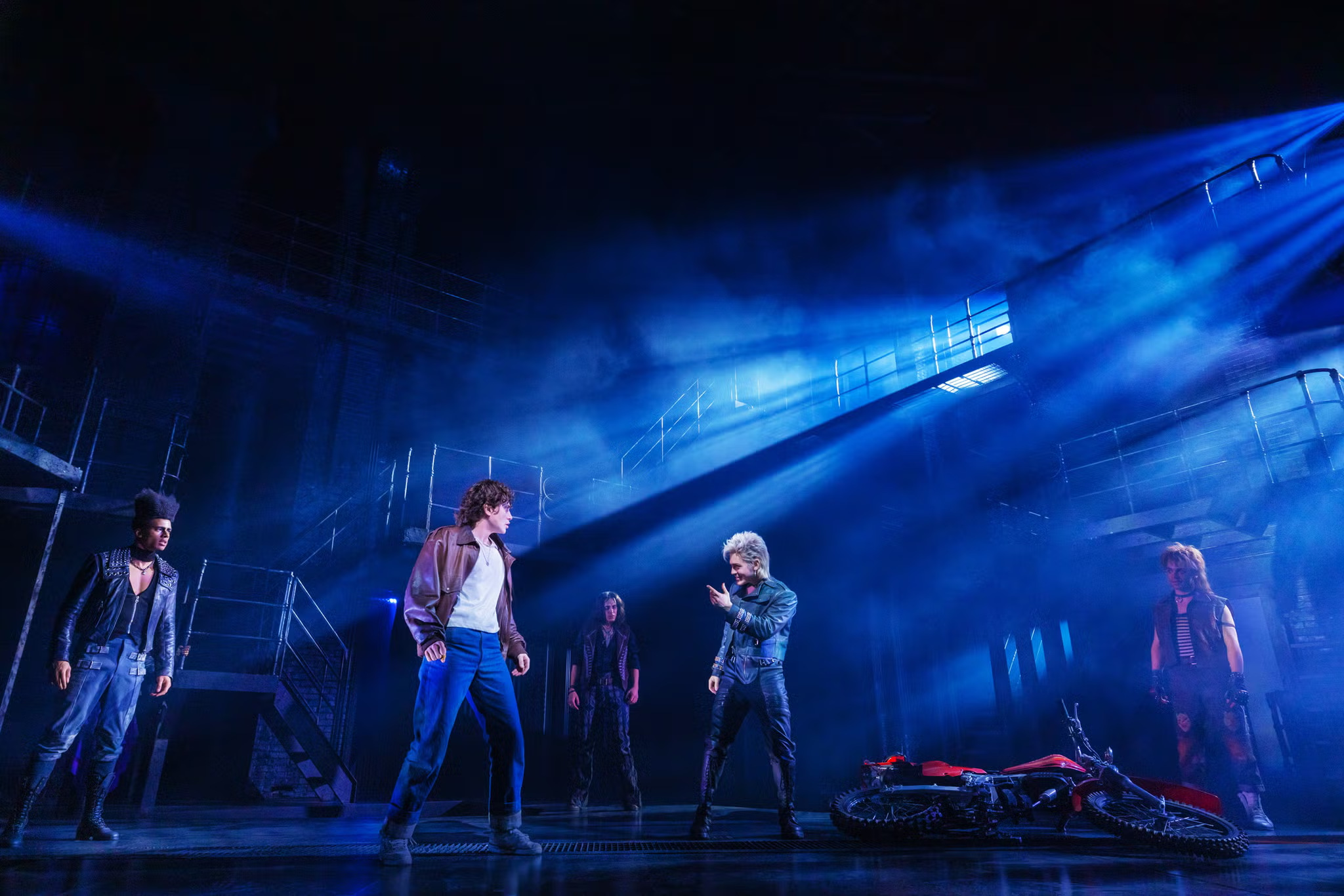
One of Popp’s favorite examples comes at the first entrance into the Coronado Ironworks, the vampire lair at the center of the story (just part of the incredible Tony-winning scenic design of Dane Laffrey.) The music begins quietly, then gradually surrounds the audience, creating the sensation that something is moving through the theater itself.
“We began with a sort of very low synth pad that starts at the stage and then sort of wraps its way around the audience as a way to build tension,” he says. “And then this sort of swirling ostinato synth pattern arises out of that and then we have these very short vocal gestures that first appear on your left and then your right and then behind you, from one side behind you, from the other side, almost like the spirits of vampires sort of encircling the audience.”
“To me, that sort of spatial storytelling was really important to the craft, fully supported by the story and fully paying that back by being fully supportive of the story,” Popp says.
The result is a production in which the line between music, sound and storytelling not only blurs, it disappears. When sitting in the theatre, you quickly forget where you are. Every element is designed to serve the same purpose: to pull the audience deeper into Santa Carla and make the world of The Lost Boys feel as though it exists not only on the stage, but all around them. Ghoulish laughs, sizzling cooking bacon, chilling echoes of an empty basement and the pounding beats of a live concert that have you wanting to stand up and cheer all work seamlessly to help you forget you are in a theater.(There is plenty more to the sound to share, but I will keep it vague to allow those seeing it for the first time to experience it unspoiled.)
One of the unorthodox aspects of the production, especially one of The Lost Boys‘ scale, was that there was no out-of-town tryout, meaning the team had to build and refine the show largely within the Palace Theatre itself. There were readings and workshops, but nothing that could truly replicate what the audience would eventually experience inside the massive three-story world created for the production.
“We did something incredibly rare in this industry, which was we didn’t have an out-of-town tryout,” Popp explains. “A lot of shows, a year before they open on Broadway, they’ll go to Denver, Chicago or LA or Boston, and they’ll do a three-month run of a show to work on it, to hone it. Then the show will close there, they’ll do eight months of rewrites and then they’ll go into a Broadway rehearsal room a few months before opening. We did none of that.”
Instead, the creative team had to imagine much of what they were building before they could actually see it. “We did, I think, three or four table readings with a piano, actors learning music, sitting at tables with scripts, reading through the material. We did two workshops where we played around with staging,” Popp says. “But of course there was only so much that we could do in that because we have Dane Laffrey’s amazing 60-foot-tall, three-story set, which you can’t do in an environment such as a stage reading.”
Popp describes the collaborative process as one of the great joys of his career, a massive challenge that had the creative team continually pushing one another to go further. A healthy dose of blood, sweat and tears… with a hefty dose of blood.
“A lot of it we had to use our imaginations, so many creative conversations about what we were dreaming to do, but we put this all together just in the Palace Theatre,” he says. “And the incredible part, the most incredible part to me, was how we sort of drove one another. That we would see one another work, see the incredible things each of us were creating, and that would drive ourselves as individuals to want to bring more and go further.”
Once the production entered its final stretch, imagination gave way to an exhausting reality of deadlines, revisions and the relentless demands of opening a Broadway show. Did Popp and Co. bite off more than they could chew?
“I think between January 4th and our opening at the end of April, there wasn’t a week where I worked less than a hundred hours,” Popp says. “So by the time we got to that first audience, all objectivity had gone out the window. You were just sort of going by those very early instincts, brain stem, and just sort of saying, ‘I think this is right,’ but anxiously awaiting that first audience to actually give you the answer.”
After four years of imagining what The Lost Boys could become, the audience finally got to decide. The results were bloody magical. The Lost Boys earned 12 Tony Award nominations, including Best Orchestrations for Popp alongside Kyler England, Adrianne “AG” Gonzalez and Gabriel Mann. The show also received nominations for Best Musical, Best Original Score, Best Book, Best Direction, Best Choreography, Best Scenic Design, Best Costume Design, Best Lighting Design, Best Sound Design and Featured Actor and Actress in a Musical. Popp’s nomination recognized his role in helping turn The Rescues’ compositions into the fully realized theatrical sound he had spent four years building.
Critics noticed the scale of the experience. The Washington Post wrote that when Michael finally takes flight, “the sound soothes,” while Time Out New York called the production “spectacular” and said no other new musical that season had come close to its scope. Variety praised Adam Fisher’s sound design for creating “a world of foreboding and creepiness.”
While I attended the theatre, it was packed, and the post-show crowd awaiting the cast meetups was the largest I recall seeing, surrounded by anxious fans who were sharing how they had seen the production numerous times already.

The Lost Boys walked away with four Tonys: Best Performance by an Actor in a Featured Role in a Musical for Ali Louis Bourzgui, Best Performance by an Actress in a Featured Role in a Musical for Shoshana Bean, Best Scenic Design of a Musical for Dane Laffrey, and Best Lighting Design of a Musical for Jen Schriever and Michael Arden.
But the long hours were not simply about getting The Lost Boys open or the accolades. For Popp, it was part of a larger artistic goal, to push Broadway sound toward the future while remaining firmly rooted in the fundamentals of theatrical storytelling. Go get tickets, and after the show takes you to the top of the world, listen closely to everything happening around you.
“We all grew up in the eighties. We all grew up being informed by John Williams scores and Steven Spielberg movies and the sort of scale and breadth of those, but as well, within the theatrical realm, these huge spectacle shows that were coming out at the time, like Les Mis and Phantom of the Opera, and sort of wanting to pay tribute to, as I was talking about before, specifically with orchestration and the future of Broadway sound, paying tribute to what came before, but also very much looking towards the future of what Broadway can be.
“So giving people that Broadway experience of spectacle, not just visually, but acoustically, while also hopefully pushing the bar forward with where Broadway will be in 10, 20 years as well. Much of the process was driven by the future of Broadway sound and where it can go.”
Popp never stops moving. Now, even long after The Lost Boys opened on Broadway and was showered with awards, he continues to extend the reach of the musical beyond the stage. He recently co-produced the Original Broadway Cast Recording, which is now digitally streaming and will be released on CD and vinyl on a very fitting Halloween Eve, October 30.
When it comes to Popp’s heart, no metaphor is needed. He is also finding a way to squeeze in another role to play, this time turning the miles he runs into something bigger than himself. Through Ethan Runs for Good, Popp is using running and fundraising to support causes that matter to him. On September 13, he ran the NYRR Fifth Avenue Mile in support of Broadway Cares/Equity Fights AIDS, and on November 1, he will take on the 2026 TCS New York City Marathon, running 26.2 miles through all five boroughs in support of Make-A-Wish Metro New York, with a $10,000 fundraising goal. He is also planning to continue the journey with the 2027 TCS London Marathon in support of Make-A-Wish UK.
It is oddly fitting that the man who enjoys being invisible in his professional life, translating music into emotion, would find another way to make big noise and an impact beyond the stage.
Follow Ethan’s charity efforts and consider contributing. And be sure to support Broadway as well by seeing The Lost Boys. It is a show that will sink its teeth into you.
And it won’t Hurt a Little, I promise.


Comments
Loading…