
 Jeff Heller
Peacock’s The Paper returns for its second season this week, bringing viewers back to the offices of the Toledo Truth Teller. After finding some unexpected success in its first season, the newspaper staff returns with new challenges, evolving relationships and a growing sense of what it means to be journalists.
The Paper may take place in the same universe as The Office, but creators Greg Daniels and Michael Koman weren’t interested in simply recreating the formula of the original series. Instead, they found a new workplace, and a new reason for the documentary crew to start filming again.
The Peacock series follows the staff of a struggling newspaper, with Domhnall Gleeson starring as Ned Sampson, an idealistic editor determined to breathe new life into the publication. According to Daniels, the idea for the series actually began with the documentary crew.
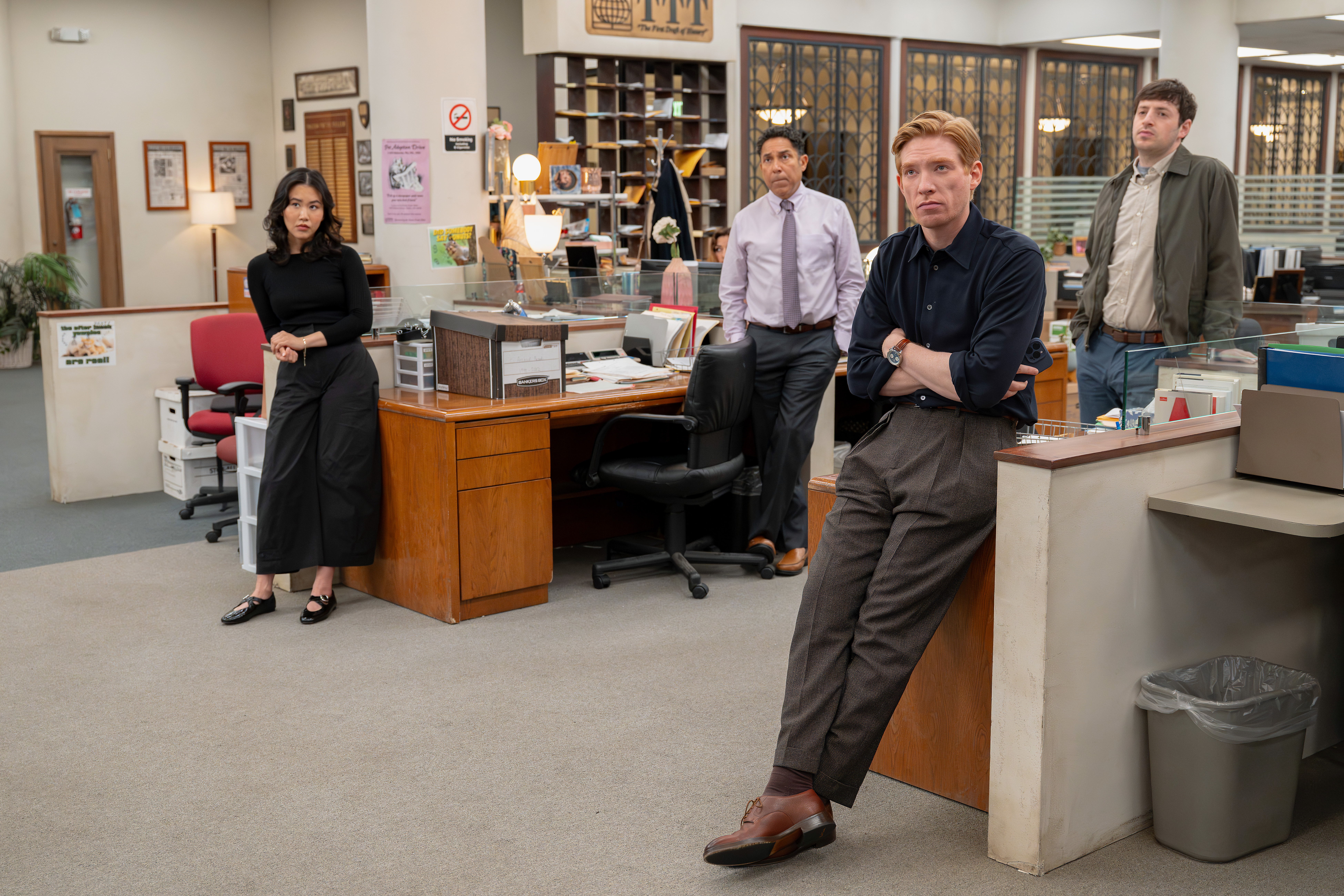
“We approached it from the standpoint of the documentary crew,” says Daniels. “We felt like the mockumentary format has kind of gone far field, but in the process became kind of stylized. And there would be scenes where the camera crew would be in someone’s bedroom, for instance, and we’d be like, ‘What are they doing?’”
Daniels and Koman wanted The Paper to return to a more traditional approach to the format, where there was a reason for the documentary crew to be following these people. “We wanted to go back to more of a strict mockumentary where we know the cameramen are in the room,” says Daniels. “And part of that was, ‘What would be a topic that they’d be excited about?’ Because we don’t want to repeat anything from the original show.”
The answer came from the changing landscape of local journalism. “There is a lot in the news about regional journalism and the decline and assault on the economics of it, and how communities are left without newspapers,” says Daniels. “It seemed like a good topic that the documentarians would be interested in, and also one that could be connected to a paper company from a business standpoint.”
That connection provided a simple way to tie the new series to The Office. Daniels reasoned that someone researching what had happened to the original paper company might discover it was now part of a conglomerate that also dealt in newspapers, toilet paper and other paper products. “So, it was a bit of a joke,” says Daniels. “But then it led to this interesting show about journalism.”
Koman didn’t necessarily see journalism itself as the source of the comedy. Instead, he saw the potential in characters who once aspired of working in the industry, only to discover that the reality was far different from what they had imagined. “It was very easy to me to picture Mare being a young woman who wanted to work at a newspaper and had some kind of dream of journalism, only to find it kind of hollowed out, and that they turned into this place where nothing that she anticipated is what they’re actually doing,” says Koman.
That begins to change when Ned arrives with the ambition and energy to transform the newspaper. “Her thinking that, ‘Oh, this thing that I thought I wanted to do, that I kind of gave up on, I might get to do it,’” says Koman. “From there, it felt comedy will come from that. They’re changing what this place is. There’s going to be people who don’t want to change. There’s going to be people who see an opportunity in that. To me, the comedy seems like it would all follow from these people meeting.”
It also gave Daniels an opportunity to explore a workplace from a different perspective than he did with The Office. “The Office was very much that they were in these boring, pointless jobs, but there were moments of human decency in the connections between people,” says Daniels. “But sometimes you’re not in that situation. Sometimes you’re in a situation where the job is inspiring, and you’re actually excited to do it, and it matters to you.”
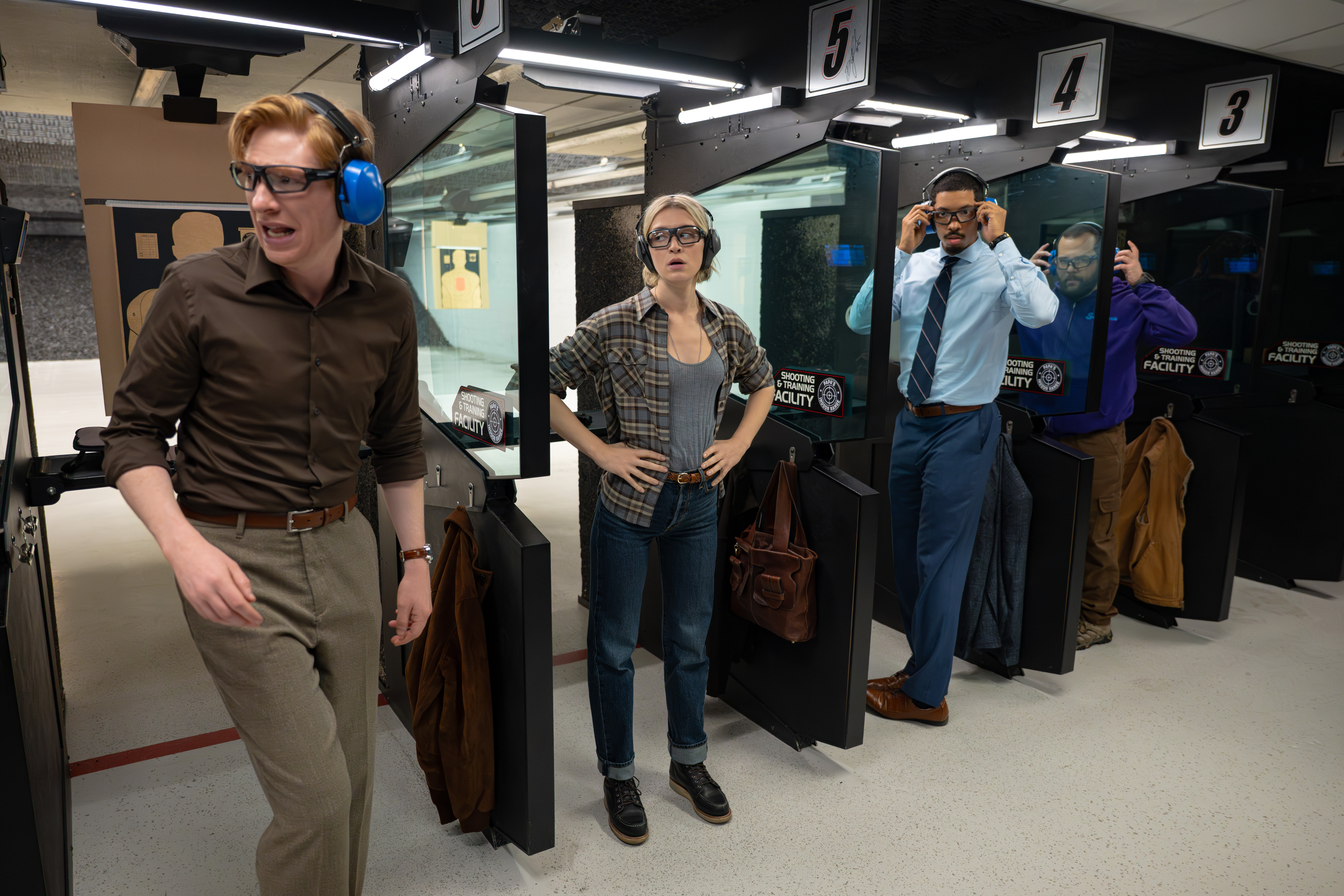
That distinction can especially be seen in Ned. “Ned is very unlike Michael Scott,” says Daniels. “He’s a person who is inspirational. And then you wonder, ‘Can he pull it off? Or is he just destroying his career?’”
For Gleeson, finding the right balance with Ned means making sure his optimism doesn’t prevent the character from having enough flaws to create comedy. “I think that’s the big struggle in the show, is he has to have enough character defects to allow him to fail and have blind spots that can be comedic,” says Gleeson. “And yet he needs to maintain the center a little bit in terms of being somebody that can inspire the people around him and hopefully inspire the audience to want just the whole endeavor to succeed, because I do think the show cares about journalism.”
Gleeson says finding that balance continues throughout the production process. “That is the big balance to try to find in the scripts, on the day when we shoot. And I’m sure in post [production], it’s the same thing,” says Gleeson. “That’s the constant thing, and then I guess my job is to try to remember who he really is without putting blinkers on that he can’t surprise us.”
Chelsea Frei has also seen changes in Mare as the character has become more established in both her career and personal life. “I think as she’s gained momentum in her career and her personal life, there’s a confidence to her that’s been kind of fun to play this season,” says Frei. “I think we’re seeing her kind of take risks and enjoy herself maybe in a way that we didn’t always see in season one. And also, the stakes are a bit higher for her as things get more real, not only in her personal life, but at the paper.”
While the documentary format gives The Paper its connection to The Office, it also creates an unusual relationship between the characters and the people supposedly filming them. Melvin Gregg, who plays Detrick Moore, sees the camera almost as another member of the cast. “There’s this other character that is the camera, and it’s like, how do we interact with this?” says Gregg. “I think for me, it’s trying to figure out who he is, and then from there, it’s like, how would he feel about this situation? How would he feel about the cameras?”
Gregg decided that Detrick is aware of the cameras without necessarily performing for them. “He’ll look to the camera when he’s confused and unsure to see if they get it too,” says Gregg. “‘Are you witnessing the same thing that I’m witnessing, the absurdity of the situation?’”
The talking-head interviews also allow Gregg to reveal more of a character who might otherwise remain quiet when surrounded by his coworkers. “Amongst everybody else, a lot of times, he’ll just kind of sit in the backseat and let things play out,” says Gregg. “But once he’s able to do a talking head, you can kind of get his opinion on things, because there’s no one but him to give it.”
Ramona Young had a different experience developing Nicole Lee’s relationship with the documentary crew. The Paper was her first experience playing a character who regularly acknowledges the camera. “Originally, it was very awkward and uncomfortable, and I felt kind of shy and intimidated by it, which I feel like is very relatable for Nicole, because she’s probably not used to doing that herself,” says Young.
As Nicole’s relationships with her coworkers change, however, Young says the documentary crew has become someone for the character to confide in. “I think in season two, with pretty much all of her relationships at her workspace failing, she doesn’t really have anyone to confide in,” says Young. “I think now she finds that she has someone to share her inner thoughts or her inner theories with, and that is the documentary crew.”

Sabrina Impacciatore faced a different challenge with Esmeralda Grand, a character whose actions could easily make audiences dislike her. Impacciatore says that was something she was concerned about when she first took the role. “I was very scared that Esmeralda could not be loved because this show is everything to me, to my life,” says Impacciatore. “When I was chosen to play this role, I thought this is probably one of the biggest things that happened in my life, so I was very concerned that it could also be the last one.”
Her unlikely inspiration for finding Esmeralda’s humanity was Tweety Bird. “How can I make her lovable when she’s doing the most nasty things?” says Impacciatore. “And it appeared to my mind, the image of Tweety Bird. Tweety Bird does the most horrible things, but just because he needs to survive. And Esmeralda is doing the same.”
Impacciatore doesn’t view Esmeralda’s behavior as coming from a desire to hurt the people around her. “She’s not attacking because she feels entitled or she wants to have supremacy or control,” says Impacciatore. “To me, she’s just trying to survive in a lifestyle that she loves, in a country that she loves as a single mom. She feels that everybody could be threatening her. And I think she just fights for life.”
Eric Rahill and Alex Edelman have an additional level of influence over their characters, Travis Bienlien and Adam Cooper, since both actors are also writers on the series. That doesn’t mean they’re spending their time in the writers’ room lobbying for better material for themselves. “We have input, but I think at the end of the day, it’s still Greg and Michael’s final call as to what happened,” says Rahill. “Not everything that we say is accepted. And I think neither of us really pitched for our characters that much because it can be kind of embarrassing to be like, ‘I think that Travis should….’”
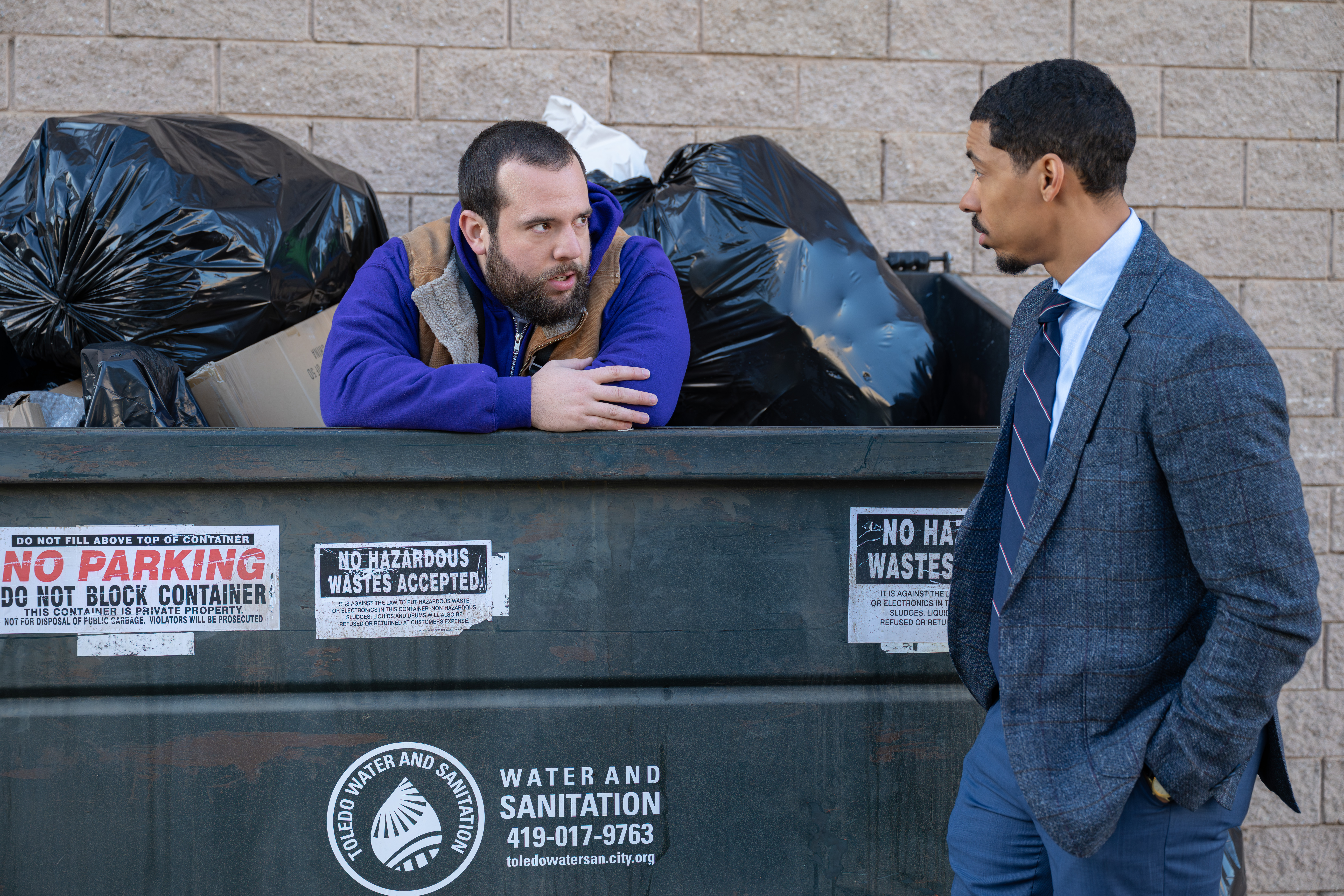
Edelman jokingly demonstrated how quickly that could become awkward “‘I think Alex should save the day. Oh, I mean, Adam,’” says Edelman. “I think we tend to sort of stay back when we can, but it is a really beautiful thing to be able to occasionally get a joke in for your guy or get a joke in for somebody else,” he adds. “That’s a really cool moment, particularly for the talking heads segments, which is your best shot at putting something in your character’s mouth. It’s so much fun.”
With The Paper, Daniels and Koman have taken a familiar mockumentary format and applied it to a workplace where the employees aren’t simply trying to make it through another day. For Ned and the rest of the staff, there’s something at stake in whether the newspaper succeeds. “Sometimes you’re in a situation where the job is inspiring, and you’re actually excited to do it, and it matters to you,” says Daniels.
You can watch our full interviews with cast members Domhnall Gleeson, Chelsea Frei, Sabrina Impacciatore, Ramona Young, Melvin Gregg, Eric Rahill, Duane Shepard Sr., and Alex Edelman, as well as executive producers Greg Daniels and Michael Koman, below.
Season Two of The Paper is currently streaming on Peacock.


Comments
Loading…