

 Adam Patla
It’s a big undertaking to jump into an established environment as the new kid on the block. There’s a rhythm and the dynamics have fallen into a sense of familiarity. Sepideh Moafi experienced this in tandem with her character, Dr. Baran Al-Hashimi, as she jumped aboard HBO Max’s hit series The Pitt for its second season.
“It was a little bit intimidating, I’m not gonna lie,” Moafi admits, “but very cool to join something that it’s like, you know it’s working, it’s this living ecosystem….”
Al-Hashimi is brought in to take over as attending during Dr. Robby’s (Noah Wyle) upcoming sabbatical. However, her presence is immediately met with hesitation and skepticism as she attempts to integrate herself into the workings of the hospital and try and implement some changes.

“It’s got such an intense rhythm, everything is kind of always at Level Ten and for Baran she’s immediately thrust into this,” Moafi explains. “Some people read her and welcome her with open arms like Dr. King and Dr. Mohan and then to others they’re skeptical and she’s read as maybe a disruptor because she’s brought in to change the status quo and make things work a little bit better and more accessible to more people and safer and more sustainable. She’s intensely purpose-driven and sees for positive transformation of the Pitt.”
While there was definitely a parallel between Moafi’s own experience jumping into the hit series and Al-Hashimi’s, the actress entered the machine with open arms.
“…[F]or me I certainly wasn’t trying to transform anything, I was like, ‘I hope I don’t disrupt anything,'” she quips before adding, “There’s such a deep sense of authorship on the show. They hired you to do your job and they’re not going to get in the way of you doing your job. I work really well with that kind of confidence and trust so it felt really good.”
That confidence in Moafi is rightfully placed as she so fiercely advocates for Al-Hashimi as a character. Though she was prepared for her character to be misunderstood initially, Moafi presents a nuanced character brimming with empathy and warmth who wants to offer the best care to her patients as possible.
“As an actor you’re not trying to be loved or liked, you’re trying to fight for the integrity and dignity of your character,” Moafi explains. “And for her it’s easy…. With her, while we are so different, she is so inspiring to me. She’s such a person of excellence.”
Moafi particularly excels with the details she infuses into Al-Hashimi. Not only do these specifics enrich the character, but they also allow the culmination of her arc to land more powerfully. It signals a performer who thoroughly knows and understands the character she’s been tasked with portraying.
“I felt her immediately,” Moafi says brightly. “The more I got to know her through the scripts and through my work and through conversations and all of that other homework, the more I fell in love with her. But with every character the specifics matter. The specifics of who they are, their stories, how they came to be, the details of their lives. That’s our work. And then through these specifics we come to realize how universal these baseline human emotions and feelings and fears are. And with her, I think because she withheld so much for such a long time, you see her revealing herself through little gestures…. These things revealed so much to me. I knew where she would end up…and what was happening with this condition from the audition process, so I knew how much I could cover….”
That condition is a seizure disorder that flares up for the first time in years during Al-Hashimi’s work day. Throughout the shift, she contends with what this means for her in this new position surrounded by new colleagues who don’t know her at all.
“There’s something really interesting about the resistance and the friction that is building throughout the season and that’s something that I was actually playing against because actors as actors we love to express, that’s why we do what we do,” says Moafi. “But having to cover that and hide that…there was always this volcanic energy underneath but she had to blend in but she had to be invisible in ways and she had to be like that throughout her life. That, I think, also informed her physicality and her way of speaking. It’s incredibly measured…and intentional.”
Al-Hashimi decides to share her condition with Dr. Robby as a sign of trust. Of course, the revelation results in a major clash between the two, showing a side of Al-Hashimi that jarringly contrasts between the demeanor we’ve grown accustomed to all season.
“It was honestly a relief to be able to unmask for a bit because it’s painful,” she says. “It felt really good to open up a bit and she opened up with the intention of getting closer to Robby. It was such an earned contrast to the way she’s been zipped up all season.”
The confrontation and immediate aftermath stood out as a major a moment for Al-Hashimi’s character and the season thanks to Moafi’s devastating performance. The precise and put-together doctor unravels completely in the most vulnerable display we’ve seen from her. Moafi makes us feel years of pain and disappointment and frustration all in this small moment through our screens as if it were our own emotions to carry.
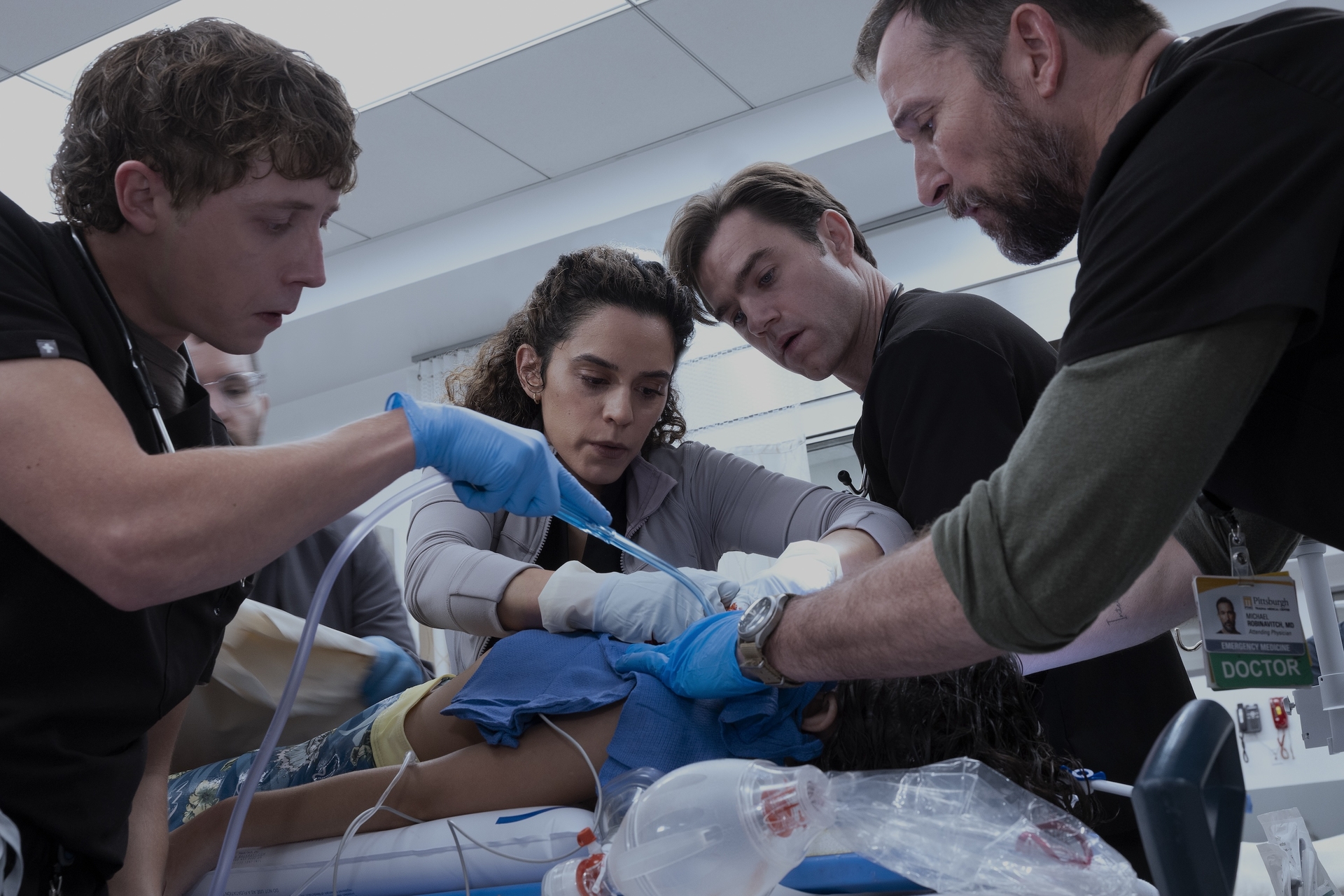
Al-Hashimi’s major moments aren’t all steeped in tragedy, though. One major victory for her comes in episode ten when she performs a slash tracheostomy on a patient.
“That was a huge moment,” she says. “[I]n episode seven we saw this moment where she goes to the bathroom and she thinks she’s having another seizure and it’s the first time in years that she’s had seizures so she feels like the ground is sort of cracking from underneath her. Her world is falling apart in front of her eyes at such a high stakes situation.”
Despite all of this, she successfully performs the procedure, earning her some rare praise from Robby. Moafi says, “That was so gratifying as an actor and as a character to earn that…. Even though she shouldn’t have to do that in order to earn respect, but it felt really good for him to see her in that way.”
The season finale leaves Al-Hashimi in a bit of a precarious position with a lot of questions in the air. In terms of what she personally hopes for Al-Hashimi, Moafi says, “I hope she’s delivered the dignity she deserves. I love that the show stirs conversation, it’s what I love about art…. Everybody has their own interpretation and their life experiences…so everybody has their idea of what this character is, who this character is…. The only point at which I was concerned I guess is when people started throwing out some ableist language and tropes around it. That to me is so important to dismantle…. I hope we’re able to explore what the normalization of having a health condition [looks like].”
While she claims that she doesn’t want to transform anything, Moafi’s work this season has left an indelible mark on the series for good. She brings an exciting and oppositional energy to the chaos we’ve grown accustomed to as well as a fresh pair of eyes to examine it. With her precise and detailed work, we get a character that seems to liven up a show that’s already alive and well. But, at the end of the day, it’s all about the work for Moafi.
“…[M]y theatre background has instilled this obsession and rigor and addiction really to the work. That’s where it started…in opera first, then in theatre. If I had to guess, it absolutely informed how I approach any set.”
Her surrender to the work delivers staggering results. Moafi is completely in service of the overall vision of the series but also in complete command of her performance. It’s exhilarating to watch a new character hold her own without pulling away from the rest of the ensemble. Every choice is backed by intention and there’s a clear sense of her work building this character from the ground up. Moafi is a genuine force and The Pitt is better for it.
You can watch all of Sepideh Moafi‘s work on the second season of The Pitt. Season 2 of The Pitt is now available to stream entirely on HBO Max. Make sure to check out Awards Radar’s full interview with Sepideh below!


Comments
Loading…