

 Joey Magidson

A John Carney movie follows a certain melody. Whether it’s his smallest film in breakthrough Once, his most star studded in follow up Begin Again, or his most recent work with Sing Street and Flora and Son, music plays an absolutely integral role. It’s not just to the plot, either. Carney does far more than fill his flicks with memorable original songs. No, he also imbues the love of music, of making music, into his characters. To them, songs are saviors (Begin Again was even originally titled Can a Song Save Your Life?). Now, he’s back with Power Ballad, which feels like a mix of everything he’s done before, albeit with a very enjoyable little twist. I was completely charmed by this one, which is as good as anything he’s done yet, as well as ranking amongst the best work of the year so far.
Power Ballad has all the charm of Carney’s work, though this time there’s more conflict in the story. That slight prickliness gives it a distinct flavor amongst his filmography. At the start, you’re pretty sure you know where the film is going to go. Then, the end of the first act has a real pivot point for Carney. From there on, the movie does kind of follow the path you’d expect, albeit a road he’s never quite gone down before. By the end, not only has he wrapped up another feel good gem, but he’s tugged at your heartstrings in just the right way.

Rick Power (Paul Rudd) once fronted a rock band with some promise. They had a record deal, went on tour, and his ambitions of playing Madison Square Garden didn’t seem outlandish. Then, he got married to a woman he met while playing in Ireland and had a daughter, with the resulting desire to take a year off from the band leading to his dreams going unfulfilled. Now, Rick is certainly happy, still in love with his wife Rachel (Marcella Plunkett) and raising a strong willed daughter in Aja (Beth Fallon), even still playing music. The thing is, it’s a wedding band called The Bride & Groove. When they play the hits, the crowd digs it. Sometimes though, Rick needs to play his own stuff, and while he imagines the life he could have had, the wedding party tends to die down. Then, while playing a swanky wedding, he’s asked to let a friend of the groom sit in. That friend turns out to be Danny Wilson (Nick Jonas), a former boy band superstar. They take a liking to each other and end up spending the night drinking, smoking, and noodling around with their instruments. Rick even fixes a tune Danny is working on. Danny is so impressed by a song Rick has been tinkering with for years that, when parting ways, he gifts him a classic guitar. That would be the whole film for Carney once upon a time, but that’s merely the first act, as when Danny returns back to Los Angeles, his desire to have a second act to his career leads to him passing Rick’s song, How to Write a Song (Without You), off as his own.
In short order, the song is a massive hit, shocking Danny, but also shocking Rick, who overhears it at the mall. What begins as a thought that his ship has come in eventually turns into a realization that Danny stole from him. Rachel and Aja don’t remember his writing of it, nor does his band, and it was so long ago that he doesn’t appear to have recorded any evidence. So, he’s screwed. As this takes a toll on Rick, Danny thrives, protected from Rick’s attempts to contact him by his manager Mac (Jack Reynor). At a breaking point, Rick and bandmate Sandy (Peter McDonald) fly to America to confront Danny.
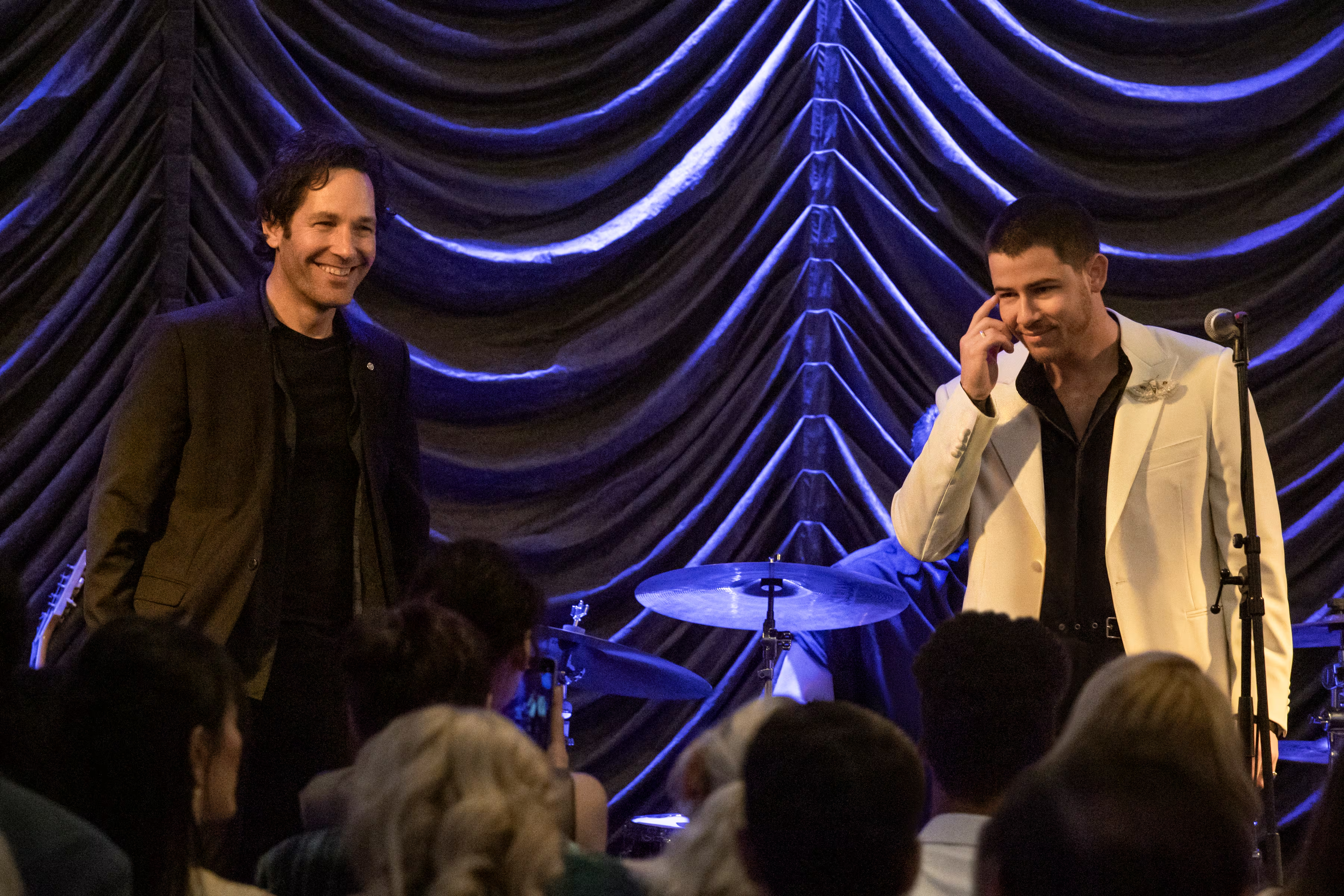
Nick Jonas and especially Paul Rudd are very good here, with the latter turning in some of his most complete work to date. Jonas gets to play off of his real life musical career, with charming results. He never makes Danny a villain, and you always understand his desperation, no matter how well things are going for him. Rudd goes above and beyond in giving us a layered portrait of a happy man who can’t help but also think about what might have been. When he lays his cards on the table in the third act and reveals something the audience might already know but another character doesn’t, it’s the best bit of acting he’s ever done. Peter McDonald is a riot as the comic relief, allowing for some silly moments when things threaten to get heavy. Beth Fallon has one moment at the end where her eyes do some wonderful acting, but overall it’s a solid teenaged portrayal, while Marcella Plunkett helps make her role more than just that of a concerned wife. Jack Reynor is a Carney good luck charm at this point, so it’s nice to see him here in a small part. Supporting players include Rory Keenan, Havana Rose Liu, Keith McErlean, Paul Reid, and more, but this is Jonas and Rudd’s show.
John Carney directs a screenplay he co-wrote with Peter McDonald, once again crafting a feel good winner. His big new song, How to Write a Song (Without You), is believable as a smash hit, which helps the narrative. Visually, it’s what Carney has always done, which is ground his work with an unfussy feel. Carney and McDonald have a lovely script on their hands, which is the real filmmaking highlight. Even if you see the third act reveal coming, there’s a moment that so purely hits you in your feels that you just want to applaud them for pulling it off. Carney has always been aces at showing the joy playing music can bring to his characters. In Power Ballad, he shows you the other side of the coin a bit, with tremendous results.
Power Ballad deserves to be the hit that How to Write a Song (Without You) is in the film. This is the sort of movie that deserves to be treasured, as the industry continues to squeeze out this sort of work from the theatrical experience. It’s a 2026 highlight so far and the kind of work everyone can enjoy. It’s a chart topper, plain and simple.
SCORE: ★★★1/2


Comments
Loading…