

 Maxance Vincent
If you thought a film like Bad Luck Banging or Loony Porn, which is one hell of a provocative object for a Golden Bear-winning film, was a bit too intense, perhaps you’ll enjoy a more subdued effort from Radu Jude in Kontinental ‘25. Shot in ten days with an iPhone after production on his Dracula film wrapped, the movie is far more minimalist in its aesthetic and structure than what audiences have been accustomed to seeing from the Romanian filmmaker since the incredible I Do Not Care If We Go Down in History as Barbarians.
Of course, after the sensational reception of Do Not Expect Too Much from the End of the World (his titles are certainly a mouthful, though that’s not necessarily a bad thing), expectations are sky high to see what Jude would do next. And Kontinental ‘25 is exactly the type of movie someone would do after making their ultimate masterpiece, meaning not at all what audiences think the filmmaker will do. The form of Kontinental ‘25 doesn’t blur as much as Do Not Expect too Much from the End of the World, which consistently communicates its present-day story with a past, almost forgotten Romanian film (Lucian Bratu’s Angela merge mai departe), and the aesthetics of this heavy-handed drama are far more subdued than anything Jude made in recent memory. It’s a film stripped at its most basic elements – fixed shots that carry long conversations, as the words of its characters are more important than the images themselves.
Most of this 109-minute feature consists of long, static takes, where Jude and cinematographer Marius Panduru position the iPhone in the middle of the frame, and let the drawn-out exchanges speak for themselves. To the uninitiated, this introduction in Jude’s filmmaking corpus may prove alienating, though there isn’t a picture in his filmography that seems accessible for a layperson. You either vibe with his ever-evolving, experimental style or quickly realize he’s not for you. That said, Kontinental ‘25 is definitely less outlandish than the films that put him on the map as a force to be reckoned with in world cinema, and seems to be shot with the “five dollars and a dream” energy of a yearly (or twice-yearly, if we’re lucky) Hong Sang-soo production.
One may think that, because of this, Kontinental ‘25 may not be as visually interesting as something like Aferim!, but the iPhone cinematography has a keen eye for deep focus and compositions that feel three-dimensional in nature. It doesn’t take long for anyone who enjoys Jude’s work to feel immersed in the simple story of Orsolya (Eszter Tompa), a bailiff, who, after the man (played by Gabriel Spahiu) she threatens to evict from a building kills himself, is stricken with the guilt of having seemingly pushed this person to suicide. Their co-workers (one is played by Do Not Expect Too Much from the End of the World’s Ilinca Manolache, who predictably steals the show) tell Orsolya it was not her fault, and that she applied the law by the book. Yet, it somehow makes her guilt much worse than it already was.

She doesn’t want to see any radiators, since this is how the man hung himself, and is reckoned by culpability that goes far deeper than “abiding by the rules.” Corporate (in this case, legal) guilt becomes catholic guilt, which are expressed through many sequences, one where she recites “Our Father” in front of an animatronic dinosaur (don’t ask). The other involves a long conversation with a priest (Șerban Pavlu), which doesn’t amount to much in changing the protagonist’s mind. In fact, most of the movie’s extended exchanges don’t result in more than small talk in the hands of Jude, who writes some of the angriest dialogues of his directorial career within the mouths of Orsolya or her colleagues.
Everyone – and everything – goes through the wringer in this absurdist dark comedy, with humor that not even a satirist like Quentin Dupieux would touch. But Jude isn’t afraid of pushing buttons, and he does so not with crude imagery (although one slightly explicit sex scene near the end of the picture does confirm that the man behind Bad Luck Banging or Loony Porn is behind the camera), but with his words. Frustrations he carries at the world’s lack of moral support in relation to what is currently occurring in Ukraine and Gaza are distilled through Orsolya’s “activism” (her Vodafone donations), while the hell she is stuck in is not the cause of her own actions, but due to corporate greed.
We laugh at the protagonist’s stupidity, yes, but the situation depicted here is no laughing matter. When one finds out why Orsolya had to evict the individual who ultimately chose to end his life, one asks if all of this is worth it. Jude gives no easy answers to this question, and instead confronts the viewers with the harsh consequences of urban development, which, at face value, seems to be a solution to the housing crisis, but instead exacerbates a problem already present. Doing so with such acerbic sociopolitical cogency is even more daring, because audiences aren’t necessarily receptive to such ponderous material unless it’s somewhat entertaining. It’s a risky gambit that ultimately pays off.
You’ll laugh a lot, sure, but underneath the layers of comedy is a real sense of urgency that hasn’t been felt from Jude like this before. One can say Kontinental ‘25 is his angriest piece of work, and you may be correct, but aren’t all of his recent political satires filled with rage? The concluding segment of Do Not Expect Too Much from the End of the World, an almost 45-minute-long unbroken take, seeks to expose a culture that has sadly worsened by the time Jude released his film to the world. Kontinental ‘25 responds to this plight by showing us how the world hasn’t gotten any better – it has actually regressed.
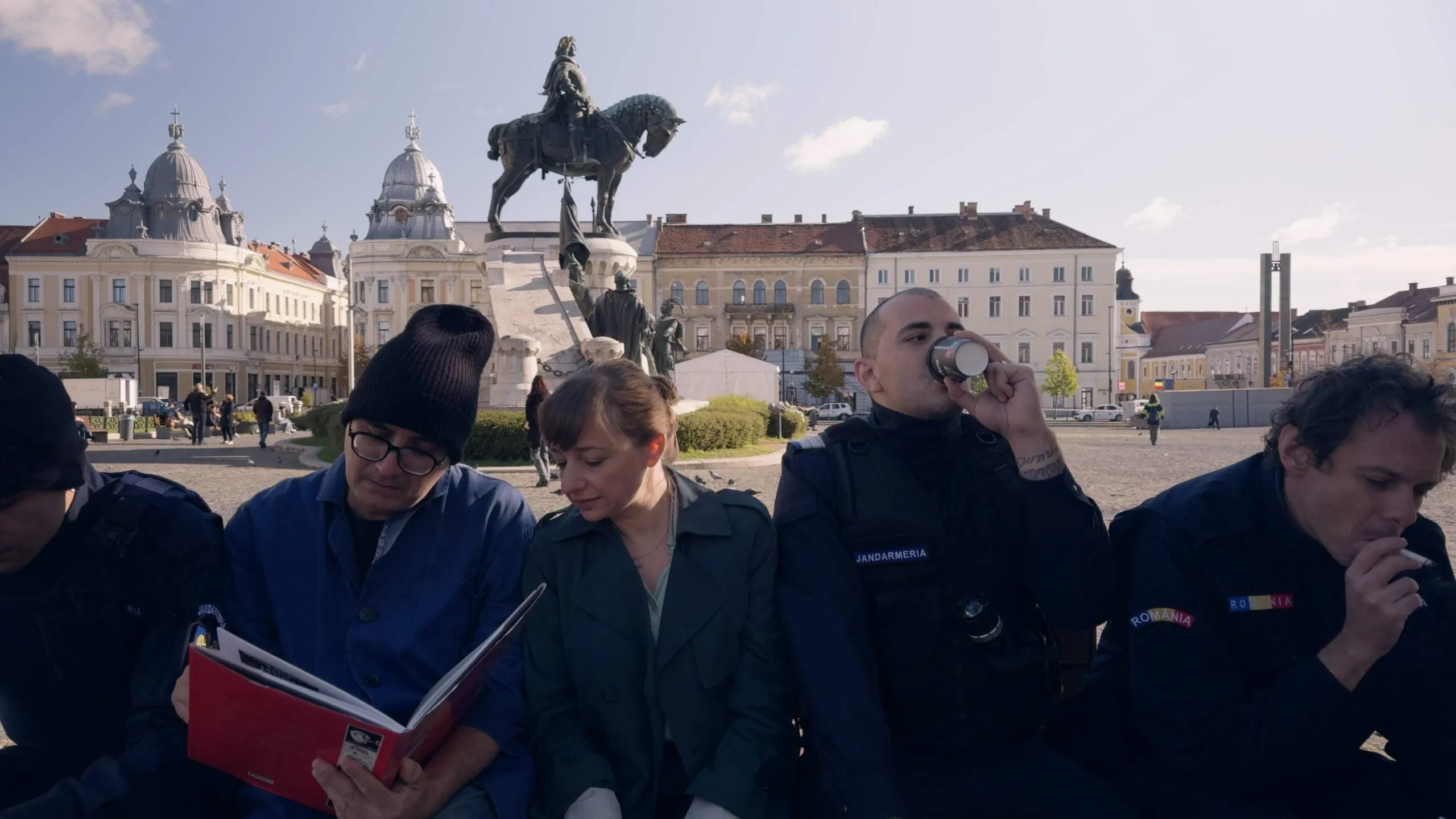
At the center of it all is a revelatory turn from Eszter Tompa, whose guilt is so sullen that it could move you to tears on the few occasions Jude lingers on her face and makes us sit with the protagonist’s sense of sin. It cuts much deeper than the legal, catholic, and, ultimately human guilt, which makes the final few scenes we spend with Orsolya all the more devastating, before Jude culminates his picture with more static images that speak louder than any line of mordant humor we’ve been hearing for the past one hundred minutes or so. Sometimes, it’s best to let the images speak for themselves, and the resulting – stunned – silence from the Festival du Nouveau Cinéma crowd was enough to convey what the filmmaker wanted to say.
Kontinental ‘25 may not be Jude’s best – or most audacious – movie, but the subdued nature of the project makes it more personal and intimate as he prepares to do something genuinely crazy with his Dracula “adaptation.” There was a screening of the film right after Kontinental ‘25, but I felt it best to wait a bit later during the week and process the rage felt by the filmmaker before bathing into 170 minutes of madness. I’ll be ready, but one can’t miss his “calmest” movie yet either.
SCORE: ★★★1/2


Comments
Loading…