

 Jeff Heller
Giancarlo Esposito has been a steady presence in film and television for nearly five decades, but in recent years, he has become one of the most recognizable actors on screen. From his Emmy-nominated turn as Gus Fring in Breaking Bad and Better Call Saul, to roles in The Usual Suspects, The Mandalorian, and The Gentlemen, Esposito has built a reputation for portraying powerful figures with an understated presence. His performance as Stan Edgar in Prime Video’s The Boys continues that trend, portraying a character who can stand toe-to-toe with ‘supes’ without needing to raise his voice.
Season four of The Boys pushed Stan into unfamiliar territory, stripped of his corporate throne and navigating betrayal from those closest to him, and earned Esposito an Emmy nomination for Outstanding Guest Actor in a Drama Series for his performance.
We chatted with the actor about Stan’s shifting mindset, his complex dynamic with Homelander, and the personal experiences that inform his portrayal of power.
First of all, congratulations on the Emmy nomination. It was well-deserved.
Thank you very much. Thank you.
It’s been a real pleasure to watch you on this series, so I was really happy to see that you got nominated.
I appreciate that. It’s a great show to be on. We have great collaborators on the show and great actors to work with, scene partners to be with, so it’s a fun show to do.
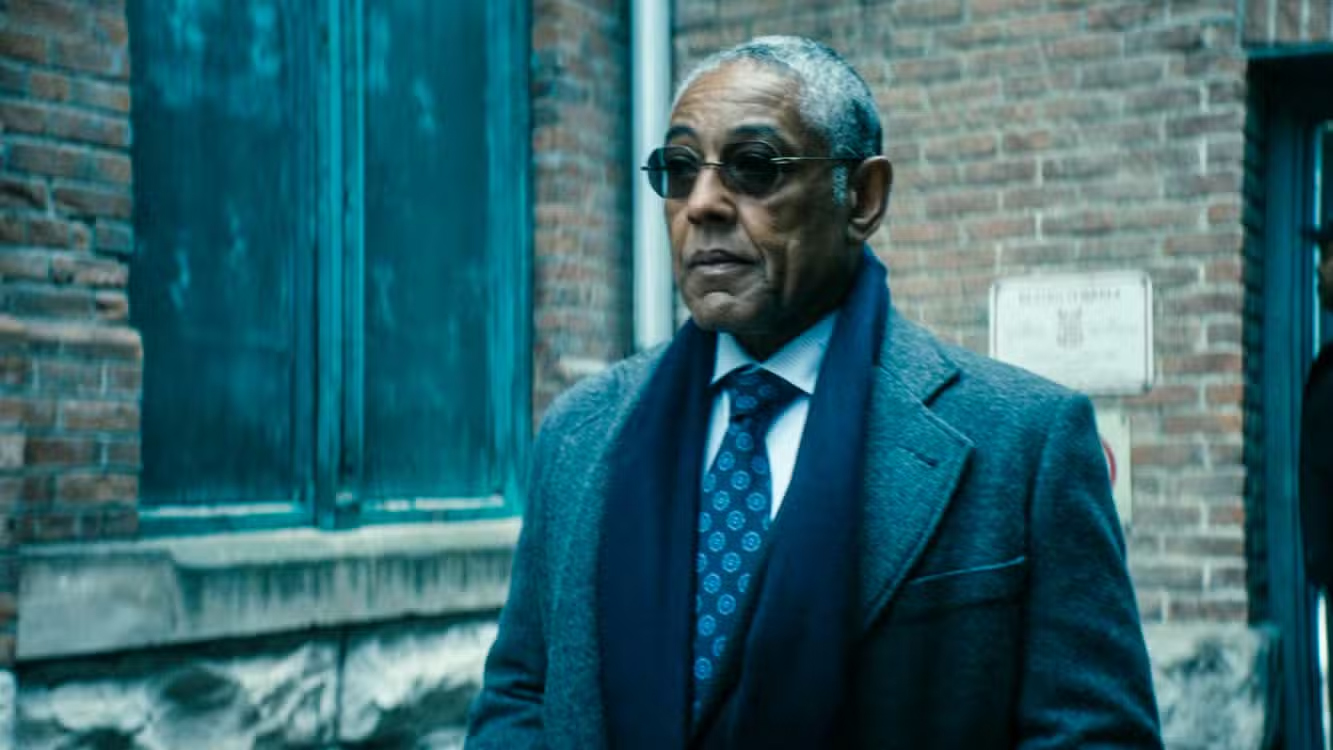
Going into to last season, season four, Stan was obviously at a very different place, both figuratively and literally, being imprisoned. How would you describe his mindset going into the season compared to the previous seasons?
Going back to season three, when he was deceived by Victoria, he’s still stung by that. His mindset was that of surrendering. He’s raised someone to basically be him in many ways, but he’s had to impress upon her that she’s had to hide her identity to get somewhere. So, she takes that as being that he’s ashamed of her, but he’s actually very proud of her. He finds out a lot of things in this season and in this particular episode that are disturbing to him. Obviously, Victoria has a little power grab of her own going on and wants to move up the ladder, but certainly, Stan Edgar, having raised her from a child, expected a little more loyalty from her. So, he’s very vulnerable. And I feel like Stan is at the place where he says to Butcher, “Make it quick. I got pottery class in 10 minutes.” He’s not going anywhere. He’s like, “I’m done with this whole world, and it’s a good place for him to be because he’s safe.
His relationship with Supes, especially Homelander, is very interesting. There’s a level of confidence, almost arrogance, that Stan has that no one else in the series possesses. Can you talk about where that comes from?
Yeah, I had a very peculiar relationship with my father. My father is an Italian man from Naples. He was a worker, a laborer who worked with his hands in the opera house in the San Carlo Opera House in Napoli. But yet he was very literate, very well read. He spoke more than one language. He wore good clothes when he could. Yet he was good at one thing. He was good at being a carpenter, but he wanted to be something else. I always wanted his approval.
It came out of me, looking at my relationship with him, that I started to really understand that Homelander is really searching for that. He’s looking for a father figure that he never had, one that he didn’t have the way he wanted his father figure to be. Stan, I believe, is a bit of that for Homelander. And so, when I started to think about that and I started to look at the writing, I wanted to inspire them through my acting that they could write to that. That this is someone who had no fear of Homelander killing him because he knew how to hold back at the right moment, what Homelander needed and wanted. And he would just crave it more if Stan didn’t give it to him.
That’s the major part of it. The other part of it is, if you go back when Stan is explaining to Homelander what this business, what Vaught really is, that also kept resounding for me. He has this whole speech, I think it’s in season two, where he’s explaining who Frederick Vaught is, and that our company is not a superhero company at all. It’s a pharmaceutical company. Then I started to think about the company man who has the bigger picture in his brain, who is cultivating big business. And so, to make Homelander feel like, “This is way above you. You have no clue. It’s not just about money, in certain ways. It’s about control and power. And it’s about getting people into the loop in regard to the pharmaceutical company. The entertainment company is just an offshoot of that to control people and control you.”
You have an amazing ability as an actor, which we see in The Boys, to demonstrate power and authority with seemingly little effort. Is there a secret to playing that kind of power?
I think my secret is to just keep telling myself that I belong. Somewhere inside of me, I think many of us human beings and actors, maybe specifically and especially, are also a little bit of Homelander. We’re waiting to be told that we did well. We’re waiting to be told that was good. “You’re great. You’re the best actor I’ve ever seen. That was a great take.” That makes us feel good. So, I found a way to validate myself. It’s a lot of what I’ve told my four daughters at one time or another: don’t look for your validation outside of yourself. You have to look for it inside yourself. And if there’s any character that I’ve played that has that particular confidence, it’s Stan Edgar. He’s not a know-it-all. It’s a different kind of confidence that he is able to ride the edge of in this particular show.

Stan Edgar is not the first morally grey character that you’ve played. I’m curious if you need to find something personally to relate to or to find some redeeming qualities in the character, to help in your performance.
So, Jeff, what I try to do is think about all the positive parts of this man that are the antithesis of what you see. When I’m in a scene, I’m thinking of that antithetical feeling. If we go back to season one and we go back to a scene that I had with Victoria and my granddaughter at the house, he’s really loving grandpa. I don’t ever want to forget those moments, because every moment builds upon the building block that you see today. I think the superpower for me is to try to figure out how he can be all of those things. Yeah, he’s the guy who’s controlling the chaos, and he seems to be the bad boy of the show. I create the feeling that he’s taking care of you while he’s taking advantage of you. I also try to create the feeling that there’s a bad guy above him that he works for, so you can’t take it all out on me. I’m just doing my job, Jeff. It’s a big job, and certainly there are a lot of elements and pieces to it that have been entrusted to me. But without me, you wouldn’t have your job, and then they wouldn’t have their jobs.
Has your interpretation of that character changed since season one?
It has because I’ve always wanted to be empowered to be able to have the courage enough to take the V because there’s something in me, Giancarlo, that just wants to be that supe and wants to use that physical power, whatever would be given, that would be less manipulative and more direct, more present, more right now, more instant. Like all these other supes have this instant, ‘boosh,’ you’re done.’ Your head’s blown off and you’re gone.
When I watch the show, I think that’s really quite brutal. It’s one of the things I kind of key into, the brutality of it. But when I think about it, speaking to you now, there’s something more subtle and more enduring about how Stan Edgar handles his business.
Have you been given any backstory to Stan that we, the audience, don’t know that has helped you inform your performance?
I wish I could say yes, but I have to tell you no. I come from a school where if it’s not there, make it up, figure it out, but make it there. So, I’m very mindful and thoughtful to give myself ideas that allow me to have the character be fuller, without a doubt. I mean, look, the episode that I referred to earlier, giving the whole history of Vought, was an eye opener for me because it allowed me more depth. It allowed me to draw on knowledge that I didn’t have before that and fill in the gaps from there.
I’d like to talk about your career as a whole a little bit. It’s been more than 40 years now, and you’ve had quite a bit of success over that time, but I think it’s safe to say that you hit another level of notoriety in recent years. How have you navigated that fame? And do you think you would have handled it differently had that fame come earlier in your career?
Jeff, it’s been 57 years as a professional since I stepped on the Broadway stage at seven and a half, eight years old, and we want to be seen. I can qualify for myself as an actor, as a human being. I think many human beings want to be acknowledged, recognized and seen, especially when you’re an artist, whether it’s a painting artist, a dancing artist, a singing artist or an acting artist. But then, behind that, you kind of get tickled by the idea that you could be famous. And yes, I would have dealt with it completely differently had it happened 40 years ago, 50 years ago, when I wanted it to happen; when I thought maybe I deserved it to happen.
The truth is that we get seasoned by life and become more mature. The truth is, if you have the time to be matured and seasoned by events that happened to you in our business, you’re better for it. And so, for me, my life would have been completely different had it happened a long time ago. I think I would not have known how to keep creating in an original, fresh, and new way. For me, I know what the juice is. The juice is for me to switch to all these different characters and have people go, “Oh, but you’re always playing the bad guy. Oh, but that bad guy’s a little bit different every time.” That’s a different person. That’s a different person. That’s a different person. So, to me, to cultivate that kind of skill is to create a way of doing it and allow it to inspire me. My life has inspired my work, and my work has inspired my life, and had it happened a long time ago, I don’t know if it would feel the same or if I’d have the same commitment to the love of what I do as I do now.
Has your approach to the craft of acting changed over the years?
It has. I build my own set of foundations and building blocks, and when they work, you want to use them again and again. And I think it was Breaking Bad that sort of changed the template for me. I started to leave some more space. I started to look over there a little more. I started to not feel like I had to fill up all the space and time once they called action. I could wait to call my own action. And I developed a more relaxed way in, and it served me to do that. So, my style has evolved. Things have changed the way I speak, the way I take in the set, the way I take in others. The time that I allow myself to breathe and be present has certainly changed. I feel like my timing has evolved. Although the basic principles of the foundation are there, I’ve allowed it to change.
I’ll give you a great example. In the last five years, I’ve decided that with each role, I want to give myself an assignment about what I want to get from it. Not what I want to give you as a director and you as a producer and you as the audience. It’ only one thing. What’s the one thing I’d like to cultivate during this run of this character in this show? How can I satisfy that creative urge of mine to figure out something new and different and see if it works?
Because what I do is called play. It’s play acting. And what, you know, I think maybe you’re lucky enough with that twinkling in your eye and smile on your face to know that there’s a four-letter word called work, W-O-R-K, and there’s one called P-L-A-Y. And if you’re in the P-L-A-Y region, then you’re in the L-O-V-E region. And it changes the game about how you do things. Everyone will be different in their rhythm. The director, the producer, your other actors, they’re going to surprise you and stun you, but if you can stay within the ring to be present, then you’re going to fall in love once again with all the elements that are inspiring you.
I know that you’ve said that you wish Stan would get some temporary V. I’m curious what power you would like if you were ever to get temporary V.
I think it’s an odd one in actuality. I think, because the show deals so much with snuffing people, taking lives, so immediately, I go to some formidable way of instantly frying someone’s brain. But to me, I think it would be, have to do with time. It would have to do with stopping time between the moment that the supe is trying to blow my head off.
You know, it would be with time and mirrors to reverse an action so that the action you took actually takes place on you. But it’s stopping that time and reversing it. It’s more of an alchemic, natural kind of way to change the power dynamic, literally.
I like that answer a lot. I know you’re busy. I don’t want to take too much of your time, but season five just wrapped. I know you can’t talk about it, but can we assume that we have not seen the last of Stan?
I don’t like to affirm or deny any spoilers. I love working with Eric Kripke and Amazon’s been so great to support this show. This is a crazy show. A quick story. During season three, I was watching a very, very profoundly graphic episode. You know which one. And I’m sitting in the living room with my daughter, and she had to pause it for a minute to go to the bathroom. So she goes to the bathroom, she comes back out, and I’m sitting here with the phone and I’m furiously texting. She says, “Papa, what are you doing?” I said, “I’m texting Kripke.” She said, “What are you texting him?” I’m telling him I want in. I want into the next season. “That’s how you do it?” I said, “Yeah, that’s how I do it.” We’re sitting there, and Kripke texted me right back. He said, ‘What, would you?” I said, “Of course I would!” I like to think that I’ve created a character that is, in a way, Machiavelli. That he’s going to go on. That he’s going to survive the world that’s been created here because he has an equanimity and a reasonable nature enough that we would definitely want to see him again.
Well, thank you for taking the time. And congratulations again on the Emmy nomination. Good luck.
Thank you so much. I appreciate it. Take care.
You can watch our full conversation with Giancarlo Esposito below.
The Boys is currently streaming on Prime Video.


Comments
Loading…