
 Shane Slater
In what director Amel Guellaty describes as “a dream come true,” her debut feature Where the Wind Comes From makes its world premiere at this year’s Sundance Film Festival. And it’s a sentiment that would surely be shared by the film’s protagonists – a pair of Tunisian best friends who embark on a road trip to enter a potentially life-changing art competition. Indeed, the artistic expression of Mehdi and the rebellious spirit of Alyssa offer a fresh take on Arab life. In anticipation of the film’s premiere, Awards Radar talked with Guellaty about the inspirations behind the film’s narrative and its artistic flourishes.
Shane Slater: What was the inspiration for the story, especially seeing a male-female friendship on screen in this specific society?
Amel Guellaty: I really wanted to talk about a friendship between a woman and a man, both straight and both Arab. I feel like this relationship is so common, at least in my life. I always have been surrounded by guys and I always had really deep, emotional connections with them. And I could really talk about private things with them. And that was always the kind of friendship that I could lean on. It was an important friendship in my life, especially in my teenage years and early 20s, before the kids and before nobody has friends anymore. [Laughs]. It was a really important relationship in my life and I felt like this kind of relationship is not represented enough in cinema.
Most of the time when we talk about friendship in cinema, it’s between two girls or two boys, or one of them is LGBTQ. Or it starts with a friendship and then it becomes a rom-com. So I felt a bit frustrated by this and I wanted to really talk about this kind of relationship where a woman and a man share a really deep connection without ever involving sexuality.
And especially in the Arab world – even though it’s the same everywhere on the planet – but especially in the Arab world, we like to separate the genders. And I like to show that there is not always a sexual tension between men and women, even if they are both straight. Sometimes it’s really complicated. Sometimes you even question whether you should date this guy because you’re so close. But sometimes the answer is no. We shouldn’t, because it couldn’t work. So it’s complex friendship, but it’s really interesting. And this is why I wanted to talk about it.
SS: The film references the revolution and the impact of that. And I could see it expressed in the art, through Mehdi’s art, through the graffiti. Can you speak more to the significance of art in this story?
AG: I feel like Tunisian youth are really interesting, because they are really rooted in African and Arab roots, and some conservative roots. But at the same time, they are definitely one of the most open-minded youth, at least in the Arab world, but probably in Africa too. And this is why I wanted to create this movie about what they have to face, because I feel at least the government and a lot of people underestimate their ability to create.And there are so many artists. For example, Tunisian cinema is really on top. In the last few years, you will always find Tunisian movies in Berlin, Venice, Cannes, and this year in Sundance. So I’m so proud to be part of this new generation who, after the revolution, felt this hope and also despair, but felt like they always want to create.
SS: Class also plays a big part in this narrative, especially that segment where the protagonists go to stay with a wealthy family. Could you speak to the context behind that?
AG: Yeah, Tunisia is a complex country. It’s a mix of conservative and open-minded. There is a lot of conflict. And there is definitely a bourgeoisie. The richest people are definitely disconnected from the reality of Tunisia. They always think that the youth in Tunisia don’t want to work and are lazy people. So they have like a paternalist way of seeing them. And it’s really common. And there is such a big gap between the richest and even the middle class. Especially after the crisis, the gap became even bigger.
So they’re disconnected. Also, it’s not only about money. It’s also about culture, because most of the people in Tunisia have an Arab culture. And the richest ones, they’re going to have way more Western culture. They’re going to speak way more in French, more than in Arabic, in fact. They’re going to say, I’m not Arab, I’m a Berber. Or I’m a Phoenician. They reject the Arab identity and the Arab culture.
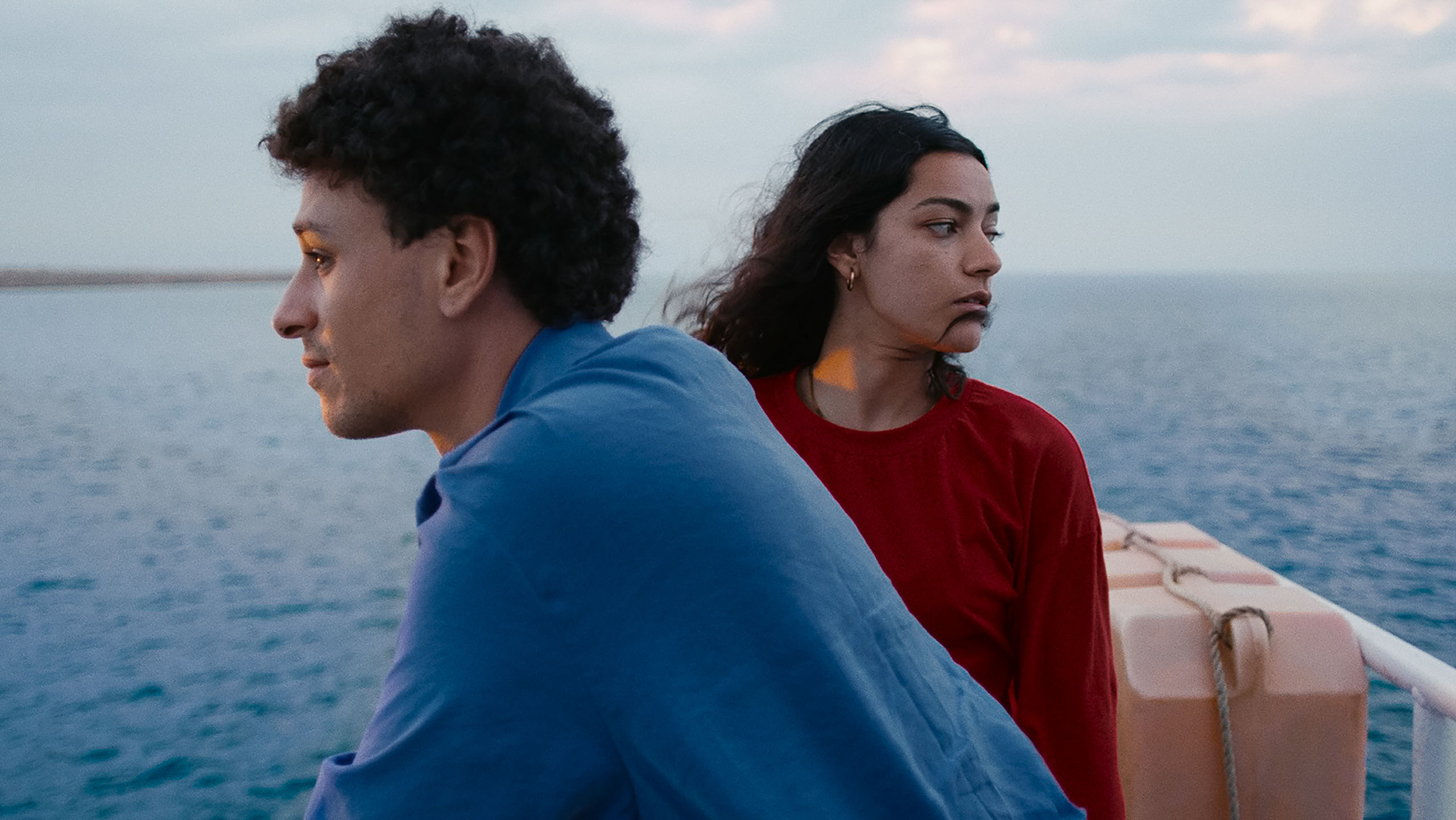
SS: Could you speak to some of your visual choices? You have these surreal daydream sequences and some striking drone shots that showcase the Tunisian landscape.
AG: Because I’m also a photographer, I love images. It’s really an important part of my job. It’s something I take a lot of time to create. This is a movie that doesn’t take the rules of the road trip movie as a genre, because most of the time, road trip movies use hand-handled camera and you follow the characters and you have natural light. What I wanted to do is follow the surrealistic part of the movie. So most of the shots are still and don’t move and are wide shots. Then I can play with the composition. And that was important for me because I also wanted to emphasize the imagination. Even though there are not a lot of imaginative or surrealistic scenes, I wanted this effect, just a little bit. But I thought, it’s what makes the movie the movie.
And I thought it was important to to do these kind of scenes, because I was inspired by my own imagination. Even though I don’t have this really creative imagination that my characters have, I wanted to create something more poetic and imagination is always something that I admire. People who have imagination, because it’s an escape.
And it’s also something that everybody has. Like, all kids have imagination, then you decide to explore it or develop it or not. But everybody has it, whether you are born in Australia, or Brazil, or Congo, you’re going to have imagination. And so I think it’s a wonderful human element that everybody uses and Alyssa uses in the movie to escape every time she’s uncomfortable. And I like the fact that it’s mixed with her tough reality and that it also adds a layer to their friendship, because they are also connected through the imagination because she’s inspired by Mehdi’s drawings.
SS: What are you most looking forward to with your Sundance experience?
AG: First of all, it’s a dream come true. So I can’t wait to be there to see all the other movies. I really love Sundance movies. Like, when I see Sundance on a poster, it’s usually a movie that I like. So I really can’t wait to meet all of the other directors, the other actors, the other producers too, because I know that we’re going to have the same taste.
And because Sundance is still like, a kind of movie, you know? They have their own genre, even though they don’t say that. Even when I was doing my movie, I was like, “This is a Sundance movie. I really do hope they take me because for me, this is a Sundance movie.” So I can’t wait to be there, to meet all of those incredible people. I can’t wait to go with the actors. They haven’t seen the movie. So they’re going to sit at the premiere with everybody. They’re not used to travel, they never saw snow. So like sharing this experience with them.
[This interview has been edited for length and clarity]


Comments
Loading…