
 Joey Magidson
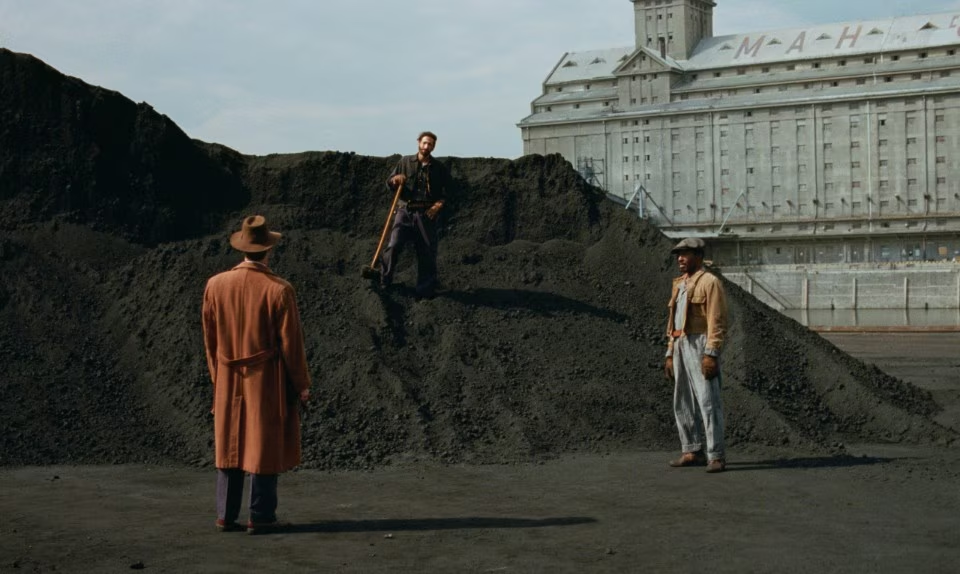
Ambition runs rampant throughout the veins of The Brutalist. Not just in the protagonist’s vision for his work, but also in that of filmmaker Brady Corbet. For his third feature, the actor turned director has opted to make a big old American epic, the kind we almost never see anymore. Expansive and sprawling in narrative and scope, it’s the sort of big swing that usually is reserved for a veteran A-lister. Corbet may well be that now, director-wise, in some eyes, as this movie has been winning people over left and right. Here at the Toronto International Film Festival, I can’t quite match that enthusiasm, but boy do I respect the hell out of this work.
The Brutalist asks a lot of you. The over three and a half hour running time alone is evidence of that. Now, there’s an intermission, but still, This is not for the feint of cinematic heart. Hell, I’d been vocal on the Awards Radar Podcast that I thought I was out on something this long. Then, the raves out of Venice began, prompting me to give it a shot at TIFF. Lo and behold, I’m actually glad I did. Is the film way too long? Yes. Was I ever bored, though? Shockingly, no. The canvas being painted on ultimately turns into something I need to ponder more, but am glad to have experienced.
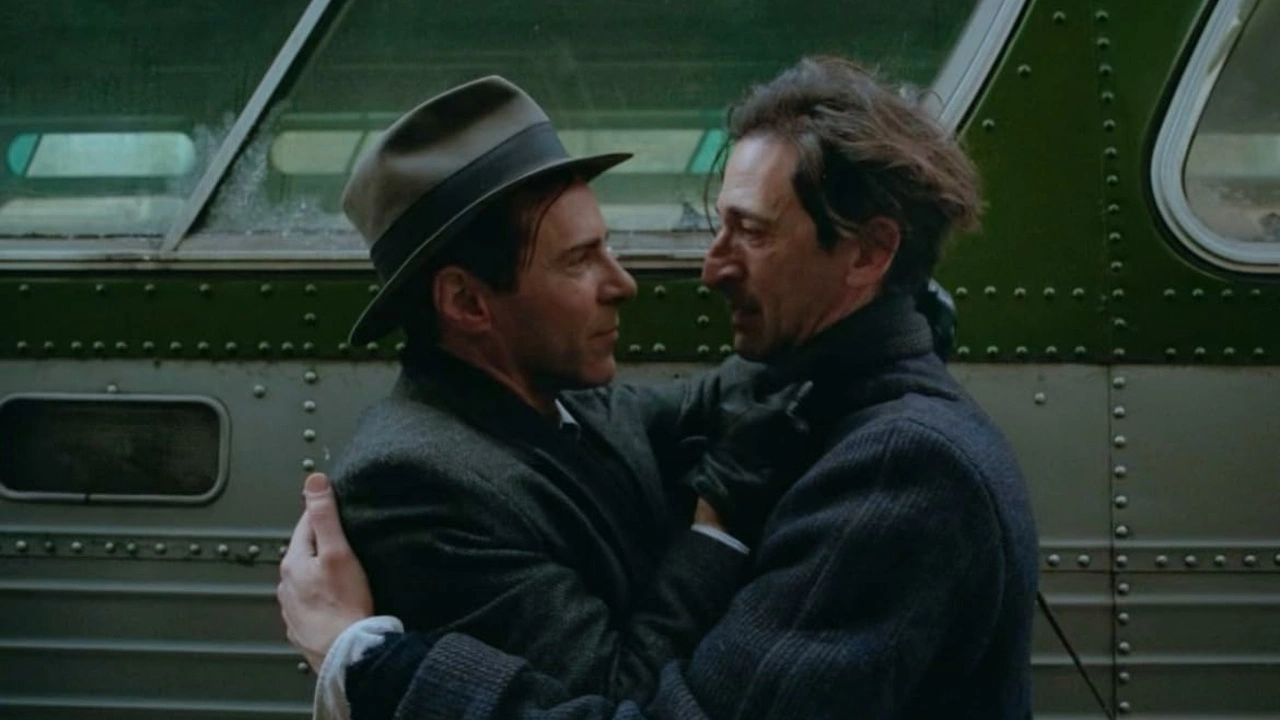
Taking place from 1947 all the way to 1980, the first section introduces us to the man we’ll be following: László Tóth (Adrien Brody), a Jewish refugee from Hungary. A respected architect, he’s come to America in the aftermath of World War II, arriving at Ellis Island and then in Pennsylvania, where his cousin Attila (Alessandro Nivola) lives. László stays with Attila and his wife, working with them, though that harmony is short lived. Around that same time, the cousins meet Harry Lee Van Buren (Joe Alwyn), the son of local business maven Harrison Lee Van Buren (Guy Pearce). Hired to redo the latter’s reading room, Harrison is none too pleased, until he realizes the work of art that László has crafted. Then, he’s a fan and not only wants to meet the man, but hire him to help design buildings of great ambition. Around now, we learn of just how well-regarded he was back home, which brings us to the end of the first half and a welcome intermssion.
The second half moves us from success to conflict, starting when László’s wife Erzsébet (Felicity Jones) finally arrives in America. She’s bound to a wheelchair and brings with her the silent niece Zsofia (Raffey Cassidy). Not only is he unsure of how to act around the woman he’s missed, he’s also having trouble with the latest brutalist design he and the Van Buren family have been working on. László and Harrison’s relationship will take a turn for the violent, a drug addiction will come into play, and ultimately, a finale that suggests even more has been going on than meets the eye. Is it a lot? You better believe it.

Adrien Brody, Felicity Jones, and Guy Pearce all do some of their best work here, painting on an expansive canvas. Brody portrays the evolution, or perhaps de-evolution, of a man with the commitment of a biopic. He’s intense and every bit the brutalist that his work is, but there’s hints of tenderness. It’s easily one of his most complex parts to date, and he nails it. Jones doesn’t show up until the second half, but is a force of nature from back in Eastern Europe. At times, the script almost makes her a co-lead, though on occasion her narrative arc feels a bit stock by comparison. Then, there’s Pearce, who is best in show as a man who you’re always leery of. An ultimate act of betray is shocking, but also really does hammer home the power imbalance in the relationship Pearce’s Harrison has with Brody’s László. In addition to the solid but less utilized Joe Alwyn, Rafey Cassidy, and Alessandro Nivola, supporting players include Isaach De Bankolé, Emma Laird, Stacy Martin, and more.
Brady Corbet directs his third feature from a screenplay he co-wrote with wife Mona Fastvold. They’re peppering in a lot for over 200 minutes. The first half has a surprising amount of sexual material, as well as information about Pennsylvania steel. The second half isn’t quite as compelling, but that’s because there’s more destruction and less construction. Regardless of the bloated running time, Corbet’s filmmaking is incredibly confident. The visuals are often stunning from cinematographer Lol Crawley, with so much added meaning coming at the tail end. There are plenty of times where I wasn’t sure where Corbet and Fastvold were taking us, and I’d be lying if I said I was sure of what everything meant, but there’s an emotional core to the conclusion that is undeniably effective.
The Brutalist quickly became the talk of TIFF and while I don’t know that this is a film worth the hype, it’s truly one of a kind. Movies just don’t get made like this one anymore. Kudos to Corbet for pulling it off and not making it the brutal experience it seemed for all the world to be like. This is, most likely, a flick that will be discussed for years to come. Maybe by then I’ll fully get it, but for now, I’m content to have just liked something that most everyone loved.
SCORE: ★★★


Based on how the reviews have been describing this film out of Venice, and the members of the main competition jury, I actually think this is the likely winner of the Golden Lion. In fact, here’s how my (broken but hopefully repaired by now) crystal ball is seeing how the awards are gonna shake out:
Golden Lion: The Brutalist
Grand Jury Prize: The Room Next Door
Special Jury Prize: The Order
Silver Lion: Wang Bing – Youth (Homecoming)
Actress: Fernanda Torres – I’m Still Here
Actor: Daniel Craig – Queer
Golden Osella: Three Friends – Emmanuel Mouret and Carmen Leroi
Well, you pulled a Cannes, prediction wise…
Good thing I slipped it in as a comment instead of a full article LOL!
True story!
An outstanding article! You really captured my attention from start to finish.