
 Steven Prusakowski
When telling a modern age detective story, is a tech whiz who, Brit Marling, the co-creator of A Murder at the End of the World aimed to make it feel both familiar and unfamiliar. Her lead character, Darby (Emma Corrin), is a twenty-something woman, the type who would typically be cast as the victim, instead here she is the one solving the crime. Darby has been invited to attend a reclusive billionaire’s secret retreat, but once the bodies start piling up she the tech whiz puts her sleuthing skills to work.
Marling spoke with Awards Radar about her work on the series, it is a fun and very intriguing conversation that covers not only a look into developing the character and the series, but also the growing impact of AI on the world and her concerns and hopes for the tech development – a development which was mostly the things of sci-fi as Marling and co-creator Zal Batmanglij were building the concept for the series. We also cover the auto-biographical nature of the main character duo, where they would have ended up without each other and her foodie like qualities. It was a delightful conversation.
Watch our conversation in its entirety or read some excerpts below.
What was your goal when creating this series?
Brit Marling: I think our goal always when making something is, can we make something that feels familiar in some ways and then really unfamiliar in other ways? And I think in making a murder at the end of the world, sort of whodunit murder mystery, a part of making it unfamiliar was just taking the person that is normally in the story, the victim, the age and the gender of the victim of the murder, the woman that dies at the end of 10 minute opener teaser, and instead make that person the detective.
And I think we found in doing that and doing it not in a tongue in cheek way, but in a credible way that you really believe this young person in her twenties is going toe to toe with some of these figures and managing to hold her own. I think doing that turned out to be a pretty serious inversion of the genre and hopefully, yeah, hopefully makes it for some surprising viewing or shows you something you haven’t seen before.
When it comes to the AI aspects of the series, you certainly feel ahead of your time. How were you able to predict where this was all heading?
Brit Marling: It’s interesting that you say that because I’ve never, nobody really brings that up, but it’s true that when Zal and I were first talking about this, the bare bone that we had is this idea of an amateur sleuth and it being a young woman and her being invited by a technology billionaire to a mysterious retreat somewhere. When we said we wanted to make him an AI designer, people in that (tech) space were like, ‘Nah, that’s so far away. Maybe you want to have them be focused on space or some other thing.’
We really persisted on the AI thing, because the more we were reading about it the more we were like, this is terrifying and interesting. Also mind blowing, like there’s something about AI that is connected to all. We played with an early version of ChatGPT before it went public. In the earliest version we input a scene and it sort of spat something out. It was mostly funny, because it didn’t understand.
But by the time I was playing with the later versions of it, it was not funny anymore. It was like, you felt like you were having an encounter with an alien intelligence that had been given some of the basic parameters of human discourse, and we’re giving you an alien narrative. And that is exhilarating and terrifying in equal measure.
We felt that coming and were interested in writing about it. Then we did a lot of work back then in the screenwriting to explain what AI was to people, because we would turn the scripts in and people would be like, ‘I don’t know what this is, explain it to me.’ So we would write a scene about where a large language model functions.
It’s not a genie in a bottle, it’s a statistical model that’s, you know, ingesting a lot of information and giving you the most probable next word, you know, much like autocomplete. Then by the time we were editing it and putting it out in the world, people were like, ‘Cut that scene, we know what this is now.’ So that was all a little uncanny because it felt we were so delayed from COVID and so delayed from the strikes, that we ended up coming out after ChatGPT.’
Where do you stand on AI?
Brit Marling: I think what scares me about the system we’re in is that everything is being built inside a system that can only really measure and value profit and can only really be interested in profit quarter to quarter. It’s the short term thinking and it’s the obsession with just the monetary gain that I think, as a result, it almost feels impossible for us to create something that isn’t a little dangerous and like limited in its conceit.
So I think that’s I think that’s what Zal and I were thinking a lot about, as we were writing A Murder at the End of the World is just the question of like, how Andy Ronson as a singular person sort of designing this thing, how his own fears and anxieties if we come from a non judgmental place, everybody’s got fear, everyone’s got anxiety, everybody’s worried about their family, everybody wants to protect their children. But what happens when you’re in a place of sort of unusual power and resources to design things towards those fears and anxieties? And then what happens when that’s just like unleashed on the rest of the world? And we’re all playing catch up.”
I think about this a lot with social media. There’s just a piece that was published recently that a lot of people have been talking about mental unwellness in the generation that came of age with the smartphone and with social media as their primary social engagement. I think we can all say pretty unequivocally at this point, many of us could have said a long time ago that that isn’t feeling good to people, but we’re the guinea pigs, all this stuff is being tried out on us in real time. All of it is about an attention economy, which is a profit economy.
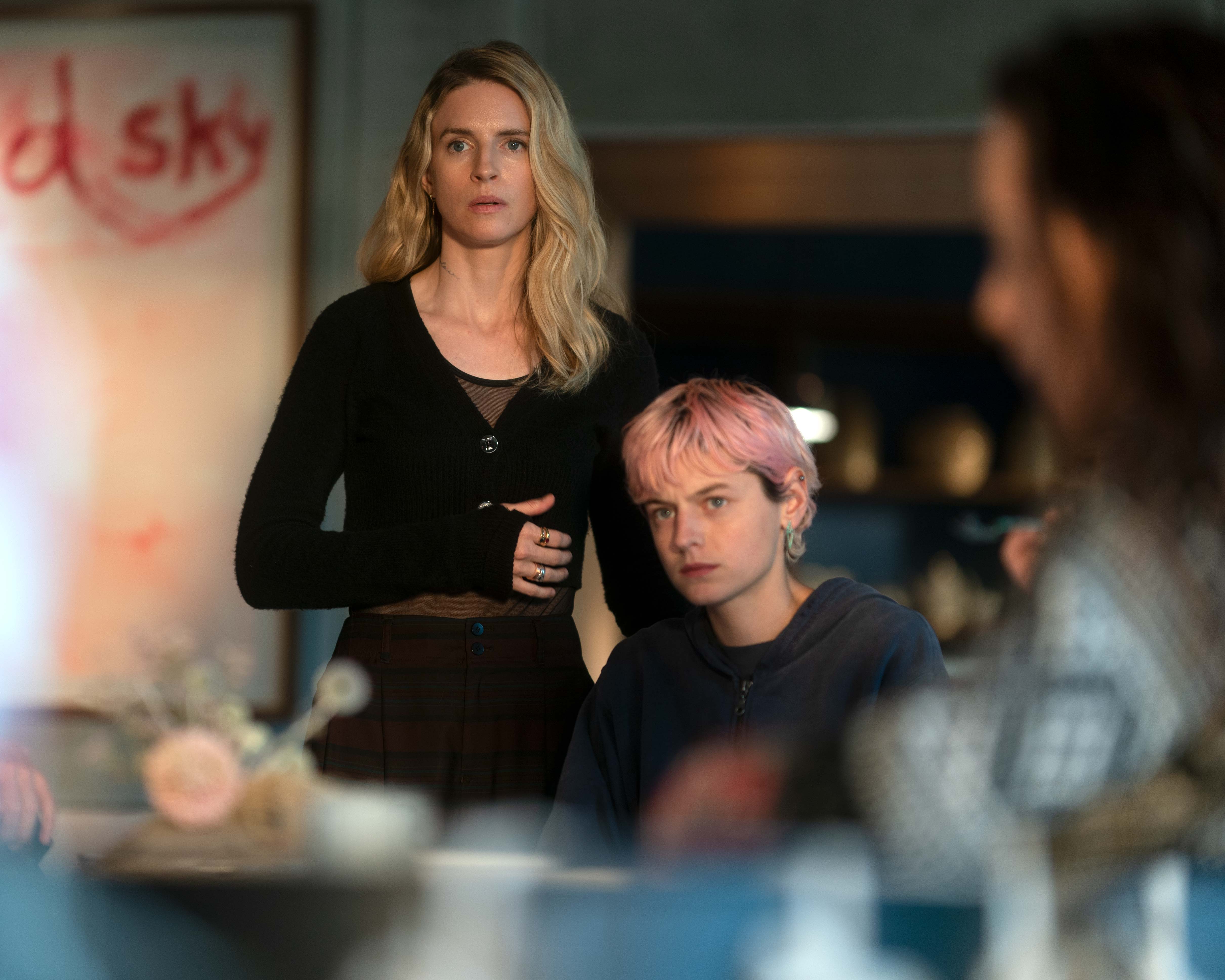
You did kind of touch upon some of your goals and when the character originated. But I was also curious, are Darby and Bill in any way autobiographical?
Brit Marling: Oh my God, that’s dope. You’re really shrewdly getting to the heart of everything. Who did you talk to for this?
It’s interesting. Yeah, I think that there are definitely some aspects of myself, I think, that I put into Darby. I think one of the things that I figured out a long way in my life is that I often used work and a kind of obsessiveness about work as a way of keeping everything else at arm’s length, especially intimacy with other people.
And I think Darby has that arc in the story. And talking about your broader question, what does it mean to take the detective that is traditionally played by a man, an older man, and sometimes maybe swapped out for an older woman, but with a gun and with a badge, acting with all the authority of the male gun and the badge. What happens if you strip those things away and it’s just a young woman, she doesn’t have a gun, she doesn’t have a badge, she’s authorizing herself to do all of this.
What kind of journey does she have to go on to solve something? And I think, Zal and I talked about this a lot, that we felt that that’s not a linear journey, that has to have some sort of arc. She has to have some realizations about herself that are required to solve the greater mysteries of life. And I think part of what she figures out in the love story with Bill is that she thinks that he broke her heart and that he left her in a cruel way.
And then as she goes back and revisits all those moments, I think she comes to understand that she had actually left him many times emotionally before he physically left her and that she struggles to meet people in that kind of vulnerability of just being in a room with somebody and holding their feelings with them. It’s a lot easier to instead go to set and write a part and act that part in the safety of narrative than it is to live real life. It’s messy and complicated.

Darby and Bill are both kind of lost and they find each other. Did you ever think about where they would be if they didn’t find each other?
Brit Marling: Oh wow, that is such an interesting question. Yeah, I thought a lot about the first time I fell in love with somebody when I was writing the scenes between Bill and Darby. And I thought that one of the things that’s kind of uncanny about first love is that it’s also like the first time a mirror is held up for you so you can see yourself. Like often the person you fall in love with first is someone who helps you see who you are because at that age, you’re still just trying to figure it out.
And so you’re looking for qualities that mirror you back to you in another person. And I think that Darby and Bill have that. I mean, they have it even down to like their haircuts even ended up being kind of similar, you know, and they have an almost sibling kind of quality when they’re around each other. It’s a twinship, you know. And I do think that Bill helps Darby figure a lot of herself out and vice versa. I think they’re two.
Watch Brit Marling’s work on A Murder at the End of the World, including her role as Lee Anderson – all episodes are now streaming on Hulu .


Comments
Loading…