

 Ayla Ruby
The miniseries Lessons in Chemistry is Brie Larson‘s latest venture into the past. The prestige miniseries from Lee Eisenberg and Apple TV+ takes the audience back to the 1960s, where Larson plays chemist Elizabeth Zott, who has an unlikely path to cooking show superstardom through science-based gastronomy. Also starring Lewis Pullman, Aja Noemi King, and Stephanie Koenig, the show is full of jazz and lasagne (sometimes burnt!) but also with deep looks at society, sexism, and the core beliefs held by those in power. The filmmakers do an excellent job of putting us in the world of that time, and a ton of that comes down to the show’s cinematography. Jason Oldak shot several episodes of the miniseries and, through e-mail, gave us an inside look at all the work that went into making it look so beautiful on screen.
If you’ve ever been curious about just how things work on a period show or even just a streaming show, this is the interview to read. Oldak spent a ton of time extensively breaking down the visual language of his four episodes of Lessons in Chemistry, including a deep dive into the heartbreaking episode Living Dead Things and the Book of Calvin. From talking about how his grief influenced how it is shown on screen to specifics about choices for cameras and lighting, and why as the father of a young daughter, this show is so relevant, it was an interesting chat.
Read on for the full e-mail discussion, but as always, be mindful if you haven’t seen the series yet. There’s one very large spoiler that if you’re not prepared, will shock you.
Ayla Ruby: How did you get onto the project? What was your journey to Lessons in Chemistry? And what really interested you and made you want to be in this world?
Jason Oldak: I was hired onto the Lessons in Chemistry team in early spring 2022. I had a previous working relationship with one of our producers, and she brought me into the mix to interview for the show. At the time, I knew it was based on a best-selling novel, but not much more than that. I read the scripts presented to me. I immediately understood the world and how I wanted to capture it. I had photographed a period show called Minx for HBO MAX about a year prior, which was set in the 1970s. I absolutely loved my experience working on that set, with all of the vintage colors, the clothes, the set design, and the vehicles of that era. I was very excited at the possibility of being able to photograph the 1950s. I loved that the narrative chronicled Elizabeth Zott’s life, and with it being a limited series, there was a beginning and an end to our story. This was very enticing to me.
Ayla Ruby: Can you talk about building the visual language for the show as far as cinematography goes? What was that like?
Jason Oldak: It’s always beneficial to join the team early and talk about the origins of the project. It was quite helpful to discuss the process with my co-DP, Zach Galler, and our production designer, Cat Smith. Cat had a plethora of images she found and colors she pulled to discuss her intentions and how the world would be built on the stages. That helped us to think about lighting and the design of the LUT. Zach and I shared our lookbooks from our respective interviews and found shared images. Moving forward, I knew we were on the same page with our visual intentions for the show.
This show didn’t necessarily have a pilot in the traditional sense, as each episode portrayed a different emotional and physical stage in Elizabeth’s life, giving the filmmakers the liberty to change the tone and the visual language accordingly.
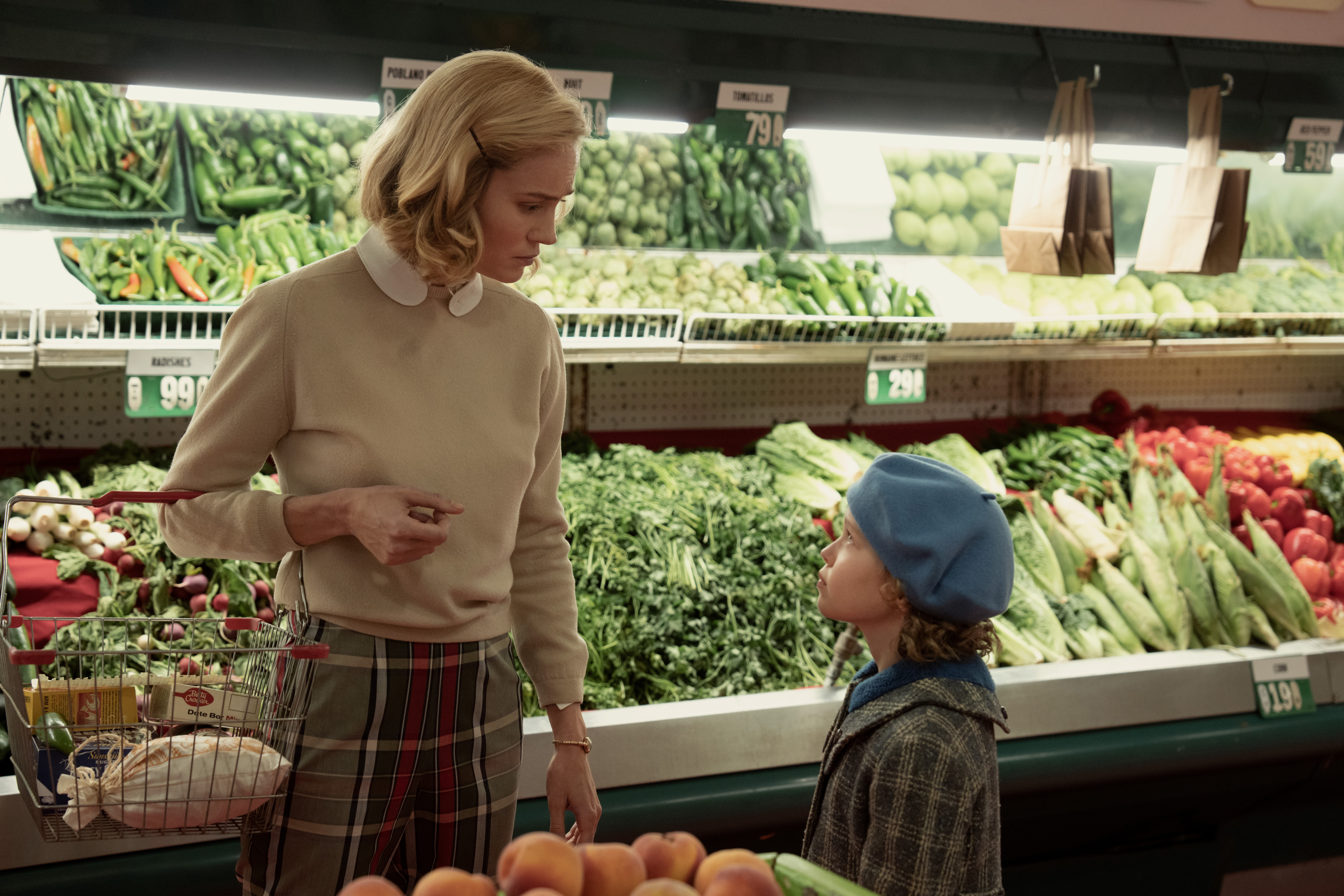
Our costume designer (Mirren Gordon-Crozier) and production designer (Catherine Smith) and their teams created a world in front of our lenses that was so definitive of the 50s that we were more than halfway there photographically. Our approach through the camera was all about being subtle with our choices. We found vintage lenses that worked strongly with our LUT. We added a level of atmosphere to soften the image when needed.
The term naturalistic lighting comes up a lot in contemporary cinematography, yet it doesn’t always seem successful in its final execution. I truly feel like this was one of the first shows where I got there. We really strived to feel like the light was coming from our window sources or from a fixture that you can see on camera in the interior sets. We definitely augmented these frames with our own lighting, but just enough exposure to feel as if that practical was creating that luminance on the subject’s face. At times, it was about finding a source that may be more of a ¾ back angle to the subject, and we would wrap that light subtly with atmospheric smoke and grip attire so the lighting never felt heavy on the face.
With the camera, our consistent challenge was how to take, for example, three shots needed in a scene and make them work as one. We would try to design the blocking so that the camera moves from one piece to the next and tells our story in a non-cutty aesthetic. I love subtle camera moves and equally enjoy staying completely static and letting the actors perform within the space. We incorporated both ways of storytelling throughout.
Ayla Ruby: How about choosing what cameras to use? How did they help build this retro world of the show?
Jason Oldak: We photographed the series on the Arri Mini LF camera system along with TLS Canon K35 lenses. We shot in ARRIRAW framing for 2.2:1 inside of 4.5K, 3:2 full sensor. I love the Arri camera, and its color science does seem to react slightly better to skin tones and has a softness to the image. The camera is small enough that it never was an issue when mounting to cranes, remote heads, or steadicam. However, I really feel that your lens choice is your paintbrush when it comes to designing your visual language for your show (as well as the period your story is placed in). The TLS Canon K35 lenses, supported by our friends at Keslow Camera, are rehoused vintage glass that really accentuated the period we were after. We added a mix of atmosphere, and it was exactly the right recipe for the series.
Ayla Ruby: Your first episode is the third one, Living Dead Things, and it picks up right after Calvin’s surprise death in the series. And also it’s told via 6:30. You don’t normally have a dog’s perspective in things. What was it like shooting that and how did you approach all of that? Not only are you dealing with animals, but it’s very emotionally heavy.
Jason Oldak: In episode 103, we deal with an immense amount of grief and sadness. It’s quite the departure from the first two episodes, where our love story began. Losing someone close to you creates a sensation that the world has stopped moving. The silence feels vast and overwhelming. I lost my father tragically many years ago and had a very similar experience to how Elizabeth receives the news. It only made sense to bring my own knowledge to our visual language.
At the beginning of the episode, Elizabeth learns of the news of Calvin’s passing. The directors and I wanted a somber balletic tone to the way the camera moved. A slow and steady approach, like time, has come to a halt. Bert & Bertie (directors of ep 103 & 104) and I devised a series of shots that play over-cranked and blended together in the edit to create the passage of time in a new foreign environment (funeral homes and cemeteries). There were a lot of scenes in the episode that needed the stillness to process the pain.
It felt like a necessary visual departure from the light and to embrace the darkness and the stillness. Our lighting needed to encompass a different level of darkness from the rest of the show. Creating less wrap in our lighting, we would place Elizabeth in frames within frames to feel confinement. At different times, we would move with her aggression. Brie Larson performed so much of episode 103 with little to no dialogue. It was all in her face and her movements. There were times when the camera just needed to be still so we could process her performances that much better.

In addition, we learn the origin of 6:30, our dog in the show, at the beginning of 103. Throughout ep 103 and 104, we tend to view a lot of perspective through the dog’s eyes. It was imperative that we were very honest with where the camera was placed to feel as though we were with the POV of the dog. The dog shares its own grief for what it wasn’t able to do (protect its owner), and it was important to make sure 630 felt like one of our castmates, not just the dog of the house. One of our consistent camera tools on the show was a stabilized remote head called an ARRI SRH 360.
Our A camera would live on this head when we did any studio work. Cat Smith, our production designer, worked with us and built the sets with smooth flooring in mind to help if we needed a move without track. The stabilized 360 head, underslung, allowed us to get low enough to feel the perspective of the dog. With the stabilization and the smooth floors this allowed us to not rely on the dolly track to move through the sets with our dog in the frame. This also meant the dog didn’t have to walk over any film-related objects. We could dolly towards the dog or place the camera over its shoulder and move with him. We also utilized this type of work with cranes when out in the world.
6:30’s team of wranglers were pros and helped us get the dog to land on the right marks and look where we needed the eye line to be delivered to. It took a village! However, sometimes, that dog amazed me with its own intuition. In episode 103, Elizabeth conducts a scientific experiment with frogs to figure out if she is pregnant or not. The camera moves past the jars of frogs and lands in a loose medium of Elizabeth at the kitchen table. 6:30 walks into the frame and places his head on Elizabeth’s lap as if the dog knows there is a baby in her belly. I remember that being an unprovoked performance that the dog executed, and it just worked so well in the moment!
Ayla Ruby: Can you talk about the episode the Book of Calvin? Because this is a little different point of view than the rest of the series. We finally learn about Calvin’s history. And not only that, but it’s a different time. What does that mean from a cinematography standpoint?
Jason Oldak: While the show as a whole is structured around Elizabeth’s life in a linear fashion, the penultimate episode of the series (107) takes us back to the origin of Calvin Evans and continues to shed light on his side of the love story. The storyline was not found in the novel and proved to have a plethora of visual opportunities. Tara Miele, our director of episodes 107 and 108, and I teamed up to conceptualize and design the final chapters of our story.
In the beginning of episode 107, our story starts in the 1930s. There is a distinction between where Calvin (Evans) starts in his life (1930s) and where he ends up in our present-day story (1950s). As a young man, he was stripped of a family and a home, but he had drive and perseverance. Because of the boys’ home environment and how little they had to their names, we felt inspired to strip the color away and create a cooler palette with blooming highlights. Our original LUT is based off of the old AGFA film stock, with warmer tones and cooler pops. This look would be quite the contrast. We referenced a handful of images from classic films and shared this with our onset DIT, Scott Resnick, and our final colorist at LIGHTIRON, Ian Vertovec, to craft a specific LUT, which allowed the sets and costumes to be designed with this same aesthetic in mind.
Once we reach the end of our 1930s story, we compose young Calvin in the same framing present-day Calvin is in, as a camera flash bulb dissolves the two shots. That jump cut and the change in looks of the two men from one time period to the next accentuate the passage of time.
Once we arrive at 1948 Calvin Evans, we get our first glance at Rev. Wakely a.k.a. the man of God as he attends Calvin’s lecture at Harvard. Wakely felt so inspired and courageous enough to question Calvin’s scientific theories with his own ideas of God and how they might fit into Calvin’s world. So, he felt compelled to share his thoughts with Calvin. Intrigued, Calvin reciprocated leading to the interactions that we see and hear through VO.
It was such a poignant display of respect and affection that they gained for one another. Tara and I were both moved by this bond between the two men. The correspondence was so poetic and their descriptive language to each other felt so cinematic. We had to give these vignettes the photographic direction they deserved.
However, the letters that are penned in the script in voice over had very little scene direction to match. Tara and I then created a cohesion of imagery that flowed back and forth, sometimes metaphorically, to the spoken word being said. We romanticized the influence each of them had on their worlds through the way of camera movement and composition.
In addition, what I love about the culmination of episode 107 is the breakthrough. At this point in our story, Mad becomes quite the detective, trying to solve the origin of her dad. Before her investigative work gets rewarded at the end of the episode, the audience is taken back in time to connect the dots with how it all began. Mad’s discovery at the end of the episode feels even more rewarding after we learn about all of the connective tissue!
Ayla Ruby: In the Book of Calvin, there’s also a really technically interesting opening scene. Can you talk about how that worked and how you brought that to life?
Jason Oldak: In general, our approach to the camera was to take, for example, three shots needed in a scene and make them work as one. Designing blocking so that the camera moves from one piece to the next and tells our story in a non-cutty aesthetic.
When Tara and I discussed the opening sequence, we wanted to show off how Calvin had always been so curious about the world, which took his attention away from his schooling. The opening was not one shot but intended to feel like one. Because of the geography in front of the boy’s home location, we used a 35′ move bird crane to tell our story. The camera starts angled up on the facade of the building of the boy’s home and tilts down, finding Calvin in a dark corner examining a pipe and its functions. As our first nun calls out Calvin’s name, we telescope back, leading him to run towards us. As the boy rounded the corner, we shifted our crane on the dolly track down the line with him, and as he ran up the stairs, the crane telescoped forward, feeling as if we were running with him to class! The location was built on a pretty steep hillside. Making it a game of measurements to see if it could be achieved, but thanks to our Key Grip, Adam Kolegas, and his team, it was a success. I also wanted to limit the ambient sunlight surrounding us and build on the contrast, so Adam constructed a cluster of large black solids to take away the unwanted light in the scene.
Once upstairs, we actually did the whole shot as one move on Steadicam (Operator Mikael Levin). The intention was to tie the boy’s name, Calvin Evans, to his face at the very end of the sequence. We start on his feet as he enters the hallway and pulls back, leading him. As he rounds the corner, we wrap around the back of Calvin and are now in follow mode as he approaches the class door. As he opens the door, we creep in behind to get to the seat before the nun turns around, feeling as if we are also sneaking into class. As she says his name, we wrap around and reveal Calvin in the light, sitting in his chair, presenting to the audience the man we’ve come to know now as a young boy. This was all done on stage. As the camera comes around to find Calvin at his desk, we pan across four to five large windows, so we had to flood them with a handful of T12’s and Q10’s to feel the sunlight hitting in at the right angle but not see the units. I loved the orchestration and the timing of these shots. It told the story in the most effective way possible. This was truly a collaborative effort with our G&E team, AC & operator, our director, and myself.
Ayla Ruby: Can you talk about the Supper at Six scenes? What was involved in that process and how did it evolve?
Jason Oldak: Our production designer (Cat Smith) and her exceptional team built a full-scale television set with three sections for an audience, a TV control room, and all of the hallways and offices off-stage that ran the studio. It was an impressive build, to say the least, and incredibly photographic to shoot! Our gaffer (Len Levine), working alongside the art team, installed practical units throughout the office area to help with our walk and talks and the minimal light needed in addition to. On stage, we wanted to be able to photograph the set in its entirety, which meant seeing the lights above Elizabeth’s set while she was working. This meant seeing units from the 1950s. However, if we had that many tungsten units hung up above, the set would become very hot very quickly. Especially the units that would be hung right over Brie’s (Larson) main setup. Len worked hand in hand with our props team and our electrical rental company to find lighting units from the era that were hollowed out. We then placed modern LED lights in those units to make it appear as if our set was lit with period-era lighting. Cat (Smith) even designed green beds around the lights, like the old television sets would have appeared of the time period. It was perfection!
Lastly, when shooting anything wide enough to see the whole stage, the audience would also see three ped cameras of the period (which didn’t work). The team placed lipstick cameras inside the rented PED cameras so that the monitors on the back of the PED cameras would have a B&W image if we needed to photograph from that perspective. We could also run this image up to the TV control room if we ever needed a shot, looking over the TV control room’s operator and seeing the Supper at Six set in the background. Lastly, we brought in Ikegami cameras, which were popular in the 80s, to photograph a more downgraded B&W image if we ever needed to place footage of Elizabeth (talking to the camera) on one of our retro TVs on a different set. In my opinion, it’s always better to have more control over the image then, to shoot it with a high-end camera and hope the post team delivers an image that feels of the period.
Most of my work for Supper at Six revolved around episode 108, which is the climax of our story. A big arc to the final episode is Elizabeth’s decision with her future at Supper at Six. She comes full circle, finds focus, and moves forward with a clear path ahead.
This was always written with a lot of pieces happening over a large part of the Supper at Six set with a lot of dialogue for our lead to memorize. To top it off, the schedule had us completing it all in one day. We brought in a 3rd camera team. We did a heavy amount of prep, days prior to the shoot day, with shot diagrams to figure out how to best tackle this within the hours allotted to the crew and the talent. We devised fluid camera moves, and our lighting felt clear and controlled. The number of shots we devised and how we introduced the show was important, as this will be the last time we step foot in the Supper at Six studio. We made our day with strategic planning and execution!
Ayla Ruby: Overall how do you match the cinematography to the scripts? How do you help convey the story, the emotion, through your choices?
Jason Oldak: It all starts with the story you are telling. As a cinematographer, you have to be truthful to the pages you’re given. My process with the cinematography and how I approached each stage in Elizabeth’s life was a simple one…I would strip each episode down and ask myself, what is the emotionality, and what story are we telling? What are the tools we need to tell this scene? Does the scene need one shot? Is it simple in form? Is it a complex montage that needs to feel like one sequence? I was lucky to have a solid amount of prep alongside my directors and discuss the visual language we wanted to tell. I would look for visual references to add to my lookbook for that episode.
In episode 104, we deal with birth and new beginnings. The episode narrates an initial discomfort with Elizabeth giving birth to her daughter. Calvin appears as her angel and helps her through the pain. The directors and I were in search of a tool that could create this vision from the page. I spoke to my friends over at Otto Nemenz and told them what I was in search of. We ended up heavily testing a lens system created by Roger Deakins called the Dekanizer, which was the perfect tool. It created a stretched, morphed image around the edges which can be changed and distorted to your liking, but had a dreamlike presence of Calvin in the center of the frame. This is one of those examples of the script leading us to the right cinematic tool to tell our story appropriately.
However, no matter how many choices, variables and tonal shifts you make in a TV series, there needs to be an importance put on the cinematographer to make sure we keep consistency and a unified image throughout. I tried to be honest to our overall feel while photographing my scripts the best way I could.
Ayla Ruby: On this show you also have amazing actors and actresses. Can you talk about how you balance the camera work with Brie Larson’s performance? And what that process is like?
Jason Oldak: I was unbelievably blessed to work with Brie, Lewis (Pullman), Aja (Naomi King), Alice (Hadley), and so many others. Our cast were true professionals who were always prepared and, throughout the process, delivered tremendous performances to the screen.
We had a communal understanding of what both parties were trying to achieve. There were many moments when we would move the camera and every actor worked with us to get the shot we needed. There were also many times when we had to just let the camera sit and give the floor to the actor to perform. It was a true partnership, and I believe it shows on screen.
Ayla Ruby: Can you talk about working with and collaborating with Zachary Galler?
Jason Oldak: This was the first time I worked on a show alongside another cinematographer and the first-time meeting Zach. It was a wonderful experience. Our communication was strong from the beginning and there was no ego on either of our parts. We shared similar approaches on the intentions for how we wanted the show to feel and knew that each of our episodes had enough to allow us to have our own voice come through! It couldn’t have been a better experience.
Ayla Ruby: Was there anything especially challenging or gratifying to bring to life professionally?
Jason Oldak: Every cinematographer will tell you that their biggest fear is watching that sunset and knowing they did not complete the daylight work for the day. Throughout episode 107, Calvin and Rev. Wakely form a friendship through letter correspondence. A lot of this voice-over imagery was found in the water, filming Calvin rowing. Our day on the water, shooting all of our row work for multiple episodes, was an extremely tight schedule. The plan was to shoot the row work on a lake in San Dimas, CA, in the early part of December, when the sun sets at 4:30 pm if you’re lucky. We arrived way before the sun came up and had everything pre-rigged to get out on the water just as the sun was rising. We had a large pontoon boat that carried the crew and a 35′ movie bird crane with a camera on the end of it. We treated the row work as you would with a car-to-car sequence, trying to keep the team placed on the right side of the sun.
The director, myself, and our AD worked out a very specific timetable. With little room for error, we had our work cut out for us. In the end, the light was always in the right place at the right time, and our team was on their A-game, resulting in a stunning final result!
Being on the open water and filming the actors crewing was one of the highlights of the show. When I first interviewed for the job, I remember reading a scene involving Calvin at dawn on the open water and immediately envisioning what that would look like in my head. I wanted to photograph it right then and there. In episode 107, I was able to do just that!
A different and unique challenge occurred at the beginning of episode 103 when the directors and I were faced with bringing to life an entire origin story of our dog 630. From a story standpoint, this sequence was so important. The audience learns where 630 came from and why he fell so madly for Elizabeth after she rescued him from that alley. The montage grows with his love for Calvin and it builds and builds until the devastating accident, leaving him breathless on the corner of that sidewalk. Most of that opening sequence was also penned in voiceover with little screen direction. We were tasked with creating different scenes leading up to the escape by 630. In addition to the regular collaborators we would have on set, we now had a stunt team, multiple animal wranglers, and military advisors. We had to be very planned in our approach. In the end, the results were so rewarding. At the end of the day on the military base, the camera lifts up and into a wide over a setting sun as our dog runs through the fence and off into the distance. And we all took a huge sigh of relief! We nailed it.
Ayla Ruby: Is there anything else you want people to know?
Jason Oldak: I truly had the best of both worlds on this show. I worked with three talented and artistically driven directors who worked alongside me and prepped the heck out of these shows, pushing me to make great work for the screen!
As closely as I worked with our directors in prep, I was in full communication with my camera, grip, and lighting team to make images that we were all so proud of. Half the battle is hiring a talented team behind you that you can communicate your vision with and it’s executed with ease. This team was a sensational bunch that understood the story and knew how to tell it in a compelling way.
I was in awe of our cast’s performances throughout the series. They brought their all on set, each and every day. They were so powerful and brought such talent to the frame. I am truly honored to be a part of the Lessons in Chemistry team! Lastly, since the show’s premier I’ve heard of so many people touched by the series and how it’s lived up to their expectations in regards to the novel. As the father of a 7-year-old girl, and thinking about her future, this story could not be more topical. I hope what we created inspires more Elizabeth Zotts to be the best versions of themselves.


Comments
Loading…