

 Steven Prusakowski
If you have been wanting to see more of Emma Corrin then the FX series A Murder at the End of the World is where you should be looking. The actor is in every scene of the murder mystery playing Darby, a Gen Z amateur sleuth with a knack for technology who is invited to participate in a clandestine retreat hosted by a reclusive billionaire. The series, created by Brit Marling and Zal Batmanglij, combines the latest AI technology, capitalism and past trauma which make for a tale of intrigue and human connection.
Corrin spoke with Awards Radar about the challenges of navigating the character across several timelines and mysteries. They reflect on Darby’s growth and vulnerability in solving mysteries in contrast with traditional detective portrayals. For those who know Corrin from their Emmy-nominated work on The Crown this role offered them the challenge of creating a lead character without extensive source material.
Watch our conversation in its entirety or read some select excerpts from our conversation, below.
What made you want to be part of this series?
Emma Corrin: I think Brit and Zal have this way of creating a world that is so rich, both fantastically and breaking the boundaries of what you think would be possible in terms of worlds.
I know everyone loves what they did with that and the OA. Just, yeah, breaking all those boundaries of what would be thought of as possible in creative worlds. And then with this, I guess they did it with tech and AI.
And but they have this very strong human element at the center of all their stories, which is really tender and really… Brit and I were talking about it earlier today, about the sense of earnestness that it really appreciates and holds close. And I think that that’s a rare thing these days. And I think I really enjoyed that element of it.
Those two different things, to be able to tell a really beautiful human story, but in context of this crazy sort of retreat and this sort of warning tale about AI and technology as well.
The series has multiple mysteries and characters who we learn about slowly little by little. With this narrative that kind of burns at both ends and in the middle was it very challenging to kind of go between all those different elements?
Emma Corrin: It was wild because Darby’s in every single frame. And I think it was a real sort of lesson in hubris for an actor to sort of read the script. And initially, I was like, ‘Oh my God, this is fantastic. I’m on every single page. This is great!’ And then the practicality of shooting and being in every single frame is insane for the best part of a year. And it takes its toll in a very real way. And so it was a masterclass in learning how to use stamina in your work.
And I think I was able to draw on my experience in theatre for that, which is also incredibly physically demanding. But it was helped by the fact that we sort of shot in Iceland to begin with, which was an incredible environment and is such a strong character in itself, that environment in the show. And that was fun.

There are several different versions of Darby. What is it like playing three different variations of the same character who’s experienced so many different things? How do you prep for that?
Emma Corrin: It was actually amazing. I found that the two different Darby and those two different stages, those two different versions of her, if you will, they sort of inform each other. Present Darby has a lot to learn from the person she was in that moment with Bill.
She hasn’t allowed herself to properly process what happened then. And the fact that she is partly responsible for why Bill left her because she wasn’t able to be open and available to him emotionally like he needed to be. And because of that, she has to access the vulnerability in the present tense to sort of be able to find out who the murderer is.
And it’s a kind of a really original idea that Brit and ons are working with this idea of a detective, especially a female detective, who has to become vulnerable in order to solve a mystery, not become hardened. And I think that’s quite rare to see on screen. And they really did that.
What do you think Bill and Darby see in each other?
Emma Corrin: I think they both found this way of connecting with people, which is this like community that is online. And yeah, this sort of shared language that they very much have, which is through the computer. But then I think that it’s also sort of a shared mission that they don’t want to leave anyone behind.
And I think maybe I think they’re both searching for meaning in a world that is sort of quickly losing its meaning. And where technology is ultimately taking over and replacing human life in many ways, I think that they are trying to not leave any person behind and, you know, that kind of thing. Yeah, I think it’s like a shared they have a very much like a shared language, shared brain, which forms a really deep connection.
Yeah, it’s like one of those very odd passings, kind of like by chance that they meet and then they have this like interwoven connections and things that drive them and things that and then their attraction to each other, which is also another kind of facet of their relationship. Yeah.
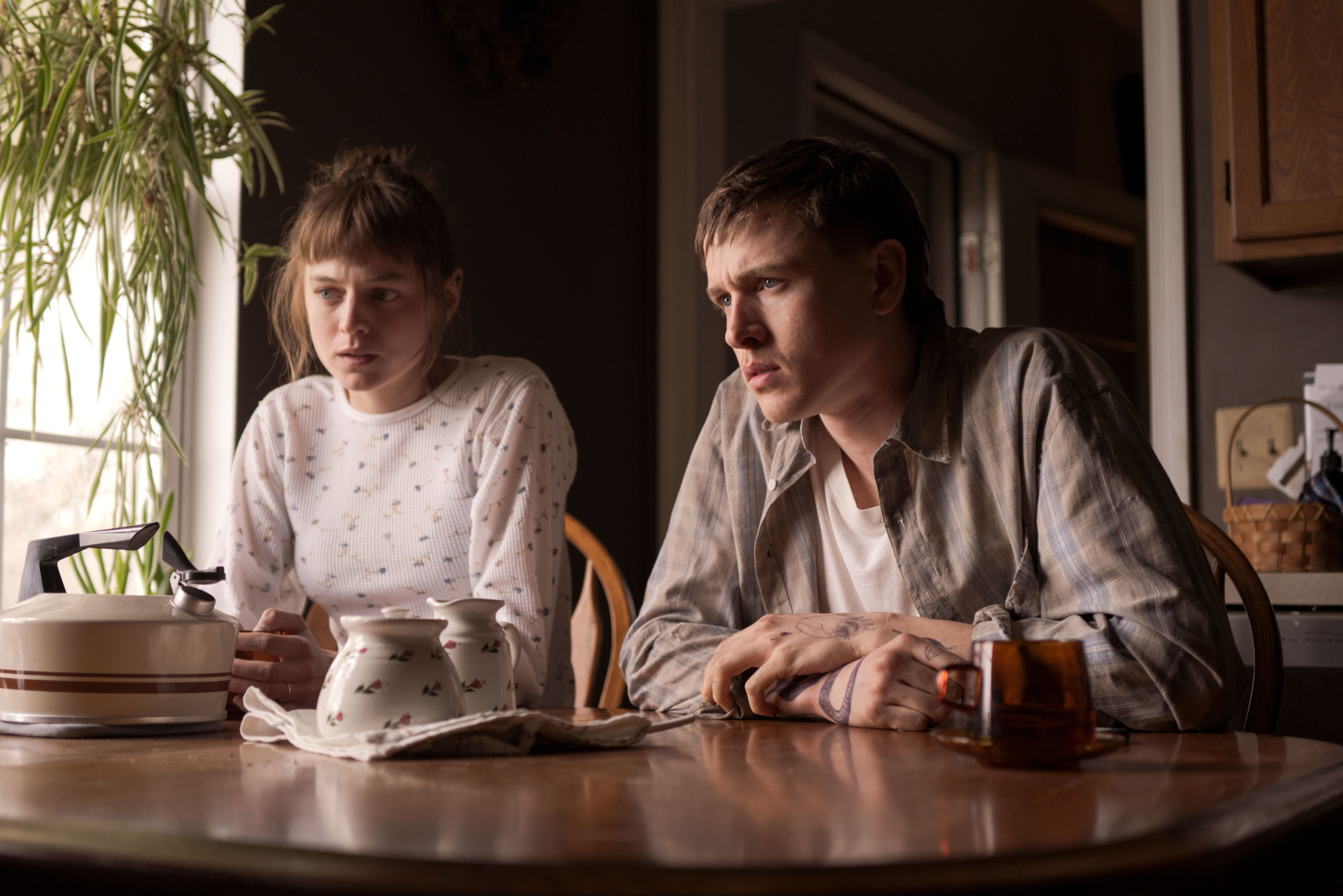
You famously played a very different type of character in The Crown as Princess Di. And I’m wondering how preparing for this role as Darby, a character that you have more freedom to explore, how did it differ from your Princess Di prep?
Emma Corrin: It was really different. And it was a challenge because even after, obviously, Diana had a lot of research and so like almost an overwhelming amount of resources to draw from. And then I encountered Darby and I just had the scripts. And it was funny because I guess even when you get and you encounter an original work, whether it’s film or TV, normally the writers or directors will say, you know, here are a list of references where it’s a bit like this and your character’s slightly like this.
But for A Murder at the End of the World, they sort of said the opposite and said, ‘OK, this is what we want it not to be like.’ Because basically they were creating something really original in Darby, this sort of Gen Z amateur sleuth who is very driven but sort of feeling her way through the situation. She’s working from instinct. You’re finding out stuff with her in real time. They sort of gave me a lot of things like ‘we don’t want it to be like this.’ We’re trying to move away from this stereotype of this kind of detective and that kind of thing.
What is your relationship with technology? Are you like Darby at all?
Emma Corrin: No, I’m really not. I’m really not. I use it. I guess practically, I wish I didn’t use my phone as much as I do. It’s so annoying. I think our dependency on technology is really terrifying.
See Emma Corrin’s work in every scene of A Murder at the End of the World streaming on Hulu.


Comments
Loading…