
 Emilia Yu
Netflix’s highly anticipated Avatar: The Last Airbender live-action adaptation is out and officially renewed for seasons two and three, meaning we get to see Aang master all four elements and save the world, in three dimensions. This is exciting news for fans of the original animated series and the live-action version alike.
The Last Airbender’s popularity stems its moving story arcs and unforgettable cast of characters. A fan favorite (among many) is the meditative, kind, and tea-loving Uncle Iroh. We got the chance to speak with Paul Sun-Hyung Lee, who portrays the him in the latest series.
Lee was a relative latecomer to the animated series, but a dedicated fan episode one, to when he was fan-cast as Iroh, to now.
“One of my castmates on [Kim’s Convenience] on had just seen all three books with her son and said to me, ‘You’re a nerd, you should watch Avatar: The Last Airbender. It’s probably some of the best TV I’ve ever seen,’ he explains.
“She was right…Very shortly after that, Netflix announced that they were doing a live action adaptation of it. Then I started getting fan cast as Iroh, which I was completely flattered by.”
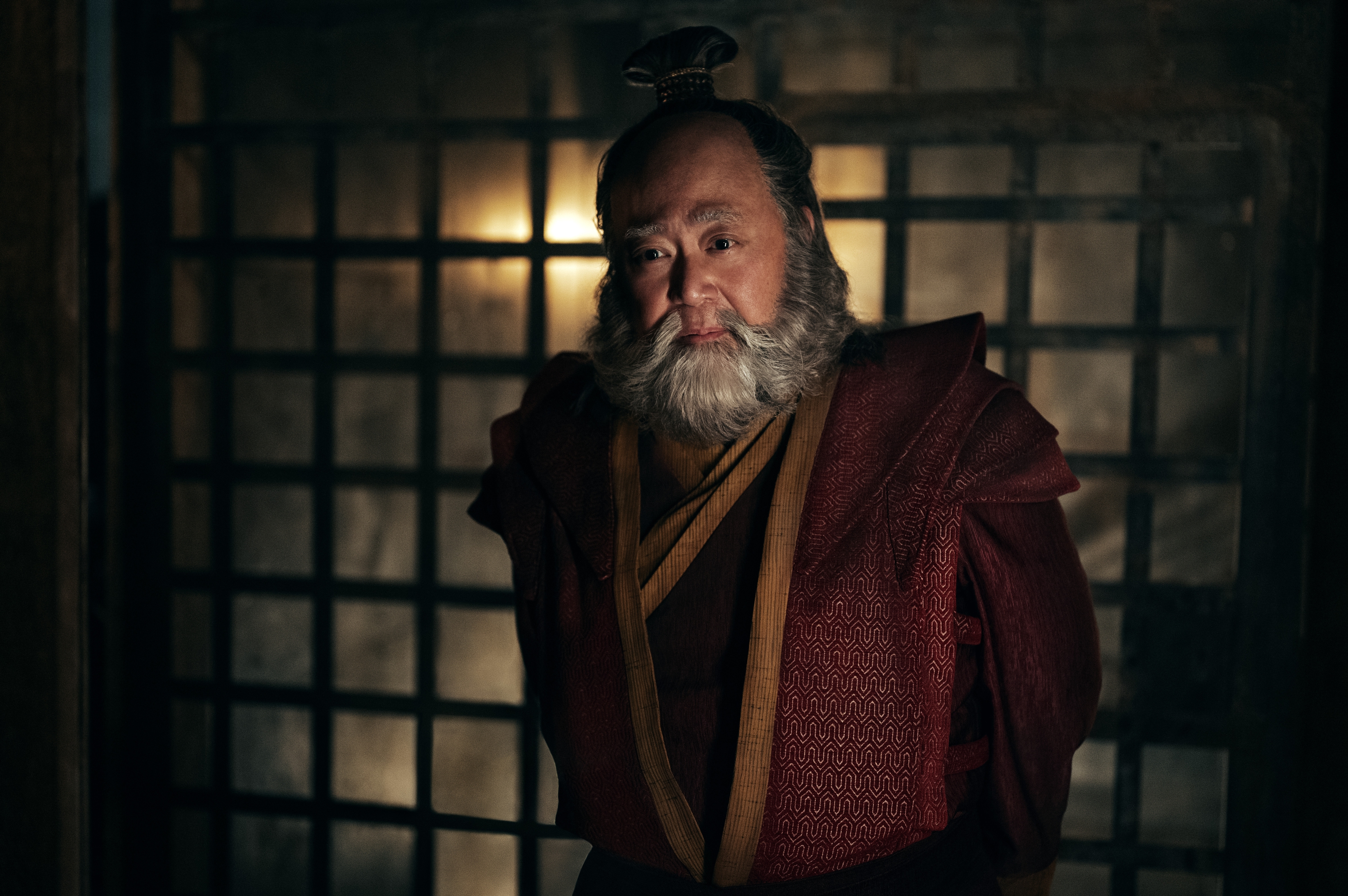
Lee, tied up with his role as “Appa” (aka Sang-il Kim, no relation to sky bison) on Kim’s Convenience, never expected to be where he is now.
“Flash forward to a few years later and Kim’s is done and I’m looking for work and this thing pops up again, which to be honest, I was really surprised about. I thought that they would have cast this character much earlier. I’m not one to look a gift horse in the mouth, though. I relish any opportunity. Lucky enough, I was able to secure the part.”
The original series, a beloved animated series unmistakably inspired by Asian and Indigenous cultures created by two White men (Michael Dante DiMartino and Bryan Konietzko), and the widely-panned 2010 film by M. Night Shyamalan, place this Netflix series at the center of today’s representation and cultural appropriation dialogue.
Regarding the original series, Lee tells us, “it never felt like appropriation to me because it was done in such a respectful manner. I was more compelled.”
Most agree that the film adaptation, however, did not take the same care, and it was accused of White-washing the cast and botching the task of condensing 20 episodes into just 103 minutes.
“That was the norm back then,” muses Lee. “You have a story and it takes place with BIPOC characters. And it’s like, we’ll just recast it so that the audience finds it more palatable. That was more accepted.”
He concludes his response on a hopeful note, “It just goes to show you how far we’ve come since then.”
And indeed since then, we’ve gotten Crazy Rich Asians, Shang-Chi and the Legend of the Ten Rings, Everything Everywhere All at Once, among other examples of acclaimed storytelling that ignore or defy stereotype. Lee himself stands at the center of multiple leaps in Asian representation in the world of television as a star of Kim’s Convenience and the Avatar adaptation.
“It’s weird being on the inside of that. I can’t help but be humbled by it, because I certainly didn’t set out at the beginning of my career to do that, to be in two big series that mean a lot to a lot of people that are representative of the communities. I mean, when we all start off, we just want to work.”
Lee continues, “I know how much more inspiring it would have been had I grown up with people like that to be an example…That’s not to say I haven’t worked with people like that in my journey, but there’s far more now.”

As part of an all-Asian and Indigenous cast, Lee reflects on his responsibility in this moment.
“It’s like being in a fantasy camp and you’re working with superstars. You’re like, holy crap, what am I doing here? Being on this side, I hope that some kid, somebody sees the level of work that’s out there and goes, ‘This is something I want to do…’ It’s incumbent on us who are living in that moment to give back and reach back and help out in any way we can…We put our foot in the door, let’s kick it open.”
But with great responsibility often comes great backlash, especially with a nostalgic series, and especially when it comes to the overdue representation of marginalized populations.
Lee faced the daunting task of representing Uncle Iroh, a retired Fire Nation general, wise mentor to his nephew Zuko, and infamous “Dragon of the West.” He had big shoes (slippers?) to fill after the iconic vocal acting performances of Mako Iwamatsu and Greg Baldwin in the animated series.
“I didn’t want to be the dude that tried to do a bad impression of Mako. That wasn’t my gig. That wasn’t my job. My job was to play Uncle Iroh in the live action adaptation of Avatar: The Last Airbender.”
He goes on. “Greg Baldwin, who took over the voice of Uncle Iroh after Mako passed away, is very upfront of the fact that he was hired to replace and to mimic and to copy and imitate Mako because that character had already been established…And I think he did more than an admirable job…But that’s not my job. My job wasn’t to do that. My job was to bring to life this iconic character. Mako used his own voice. That was his voice. That’s how he talked. He didn’t put on an accent. For me, I know part of the reason I got fan cast, was not only because I looked similar to Iroh, but because I used an accent in Kim’s Convenience. To this day, a lot of people are still taken aback when they hear my real voice.”

(For those unaware, Lee’s character on Kim’s is a first-generation Korean immigrant who speaks English with an accent. Real-life Lee on the other hand, grew up in Canada, and does not.)
“When I do the voice,” he explains, “I am endowing and imbuing it with all of my lived experiences with my dad, whom I love and respect and cherish very, very much. To bring those qualities to Iroh, I think would have been misguided.”
Despite the thoughtfulness with which Lee and showrunner Albert Kim brought to these decisions, the specter of fan backlash remains.
“Certain fans are so, so prescriptive, so precise where it’s like, ‘That’s not my Iroh. He doesn’t sound a thing like him.’ You’re going to get inevitable comparisons, but all I could do as a performer was define the things that I found were endearing about Iroh that were important to the fans about Iroh…To me, it was his compassion, his humanity, his heart, his love for family and Zuko.”
Lee has even more concern and indignation on behalf of his younger castmates.
“All you can control is the work that you do. The work that I saw from these fine young actors was stellar,” he asserts, with more than a tinge of irritation.
“The internet can be a horrible place sometimes and people can say super horribly hurtful things. I think they forget that they’re talking about people, like real people…People lose sight of that. If they were to say that to their face, I bet you dollars to doughnuts, they would not have the guts to do that.”
Lee reminds us, “Everybody who’s critical of the creative process, I wonder how many of them have actually created things themselves and had that kind of vitriol directed towards them…I’m not saying the show is perfect, but I’m seeing a lot of the hater-ade out there and people just lapping it up. These negative clicks will be the death of us all.”
Regardless of the “hater-ade” that floods too many segments of the Internet, Netflix’s Avatar took special care to portray the emotional depth of Iroh and Zuko’s relationship. I won’t reveal the details of this particularly moving scene here to avoid spoilers, but if you know, you know.
“I’m a father. I have two sons and it would devastate me if I was in that position. That part is easier to tap into. It’s almost more liberating when you don’t have to speak and you are just reacting.”
Lee continues, explaining his experience on set.
“When you were given such a lovely offering and gift as [Dallas James Liu] gave to me during that scene, it’s just wonderful stuff to work on…I have to have a certain mask on, project a certain behavior, to be solemn, to be very in control. And that’s Asian culture right there. No big shows of emotion, just keep it contained. Be very stoic about it. Mourning in your own private time…And the tears, as they came, oh my gosh, that was perfect timing with the camera coming through…and it’s just magic. Every once in a while, you catch that magic on camera.
“That’s a gift for an actor,” he concludes. “That’s a lovely, lovely gift. I’m really proud of that.”
Lee’s heart-wrenching and -warming performance as Uncle Iroh in the live-action Avatar: The Last Airbender Series is currently streaming on Netflix.
Check out our full conversation with Paul Sun-Hyung Lee (above), where we delve deeper into the conversation around Asian and Indigenous representation, receive a cathartic visit from “angry Paul,” and learn about Lee’s favorite type of tea.


Comments
Loading…