

 Robert Hamer
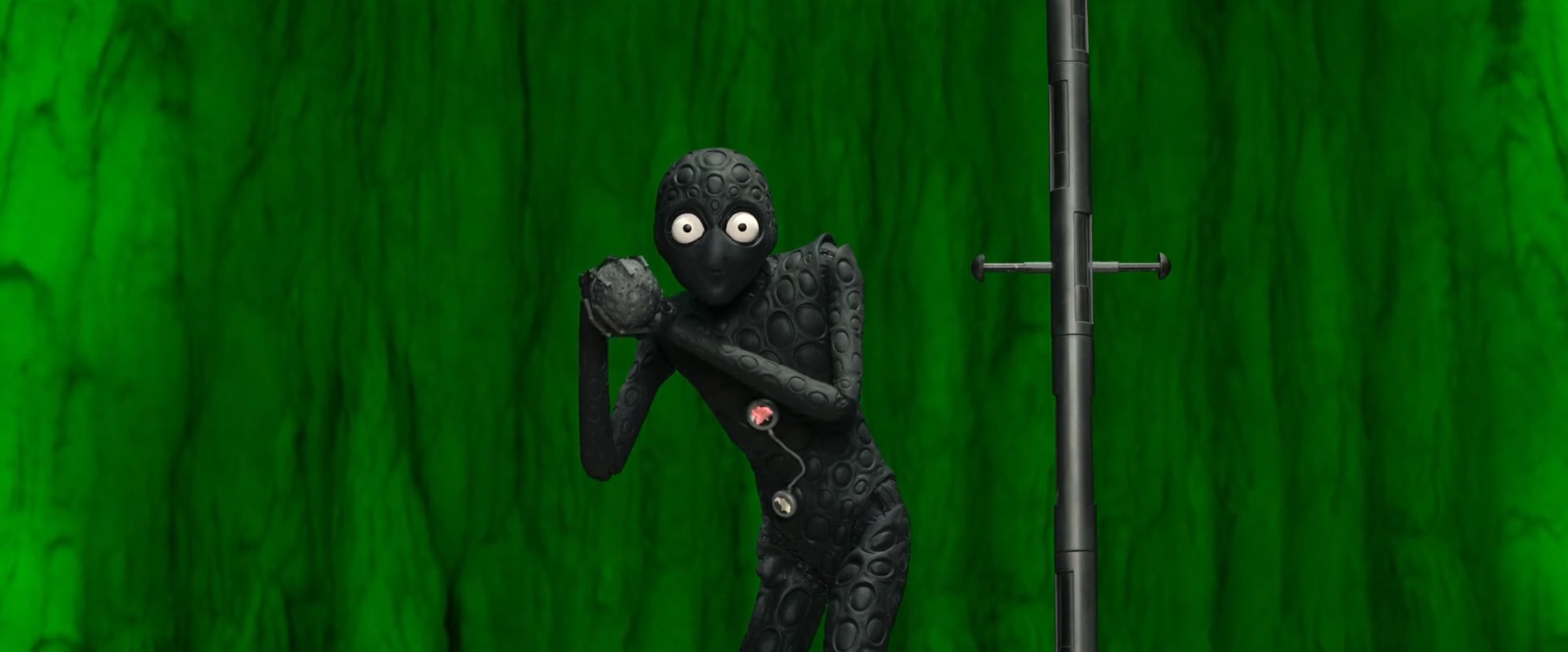
I don’t play him as an alien, actually. I play him as a metaphor. That’s my interpretation.
Metaphor for what?
I don-I don’t know, yet. We don’t pin it down.
We don’t pin it down. The actor who plays the alien speaks of his approach to portraying the alien, interpreting his place in the story, and admission of not really knowing for sure what that place actually means in the singular. It’s all him. But when it comes to finally understanding that metaphorical connection between the alien and the play… that’s a collective dilemma. We don’t pin it down. And we probably never will.
Wes Anderson’s Asteroid City doesn’t take place inside the titular town. It’s not a “real” place in the setting of the movie. We all know this, but I have a feeling a lot of us tend to forget that when discussing it. Which, hopefully, didn’t end just because it sadly received no recognition at all from the Academy. Canonically, within the “reality” of the film, the actual story we’re watching is the recreation of the production of this mysterious play that most of its actors can’t get a handle on. How they move through this story, the ways they improvise and interpret their lines, what we see and don’t see throughout the production the way Anderson frames it… this is the real narrative thrust of Asteroid City. It’s about our relationship to the art we create and consume.
This question was especially relevant last year, with not one but two seismic labor strikes in Hollywood being motivated, at least in part, by the emergence of a technology that threatens to rip the humanity out of narrative art forever. On the consumer side, the inarguable cultural phenomenon of 2023 was created as a jokey internet meme about two highly anticipated films with virtually mirror-reversal opposite audience appeals, sensibilities, and even genres becoming an unorthodox “double-feature” event. Why were so many people so enthusiastic about seeing a comedic pop-art fourth-wave feminism polemic and a three-hour apocalyptically serious World War II-era biopic about a theoretical physicist back to back? I… don’t know. It just felt right, I guess.
I imagine the play’s director, Schubert Green, would agree with that answer. Despite his “limitless energy,” he’s oddly at peace with the unanswered questions and ambiguities of the play he’s so driven to direct. He’s even willing to sacrifice his own marriage to see it through. But his leading man, Jones Hall, is less confident. He is perpetually at a loss to understand the play, constantly insecure about his character Augie Steenbeck.
I feel lost.
Good.
He’s such a wounded guy. I feel like my heart is getting broken – my own personal heart – every night.
Good.
We don’t learn until much later that there’s a reason why he’s stressing over his performance; why he feels like his heart is breaking as this character. There’s a reason why Schubert remarked to him that “You didn’t just become Augie… he became you.” This play was written by the legendary Conrad Earp. And they had a romantic relationship. In fact, they fell in love in the process of collaborating over this play. And he died shortly after it started its run. Jones understands the grief his character feels over the death of his wife, can feel it acutely, but cannot understand the resolution of that grief. If he finally understands Augie making peace with the loss of the love of his life, that would imply he has the means to emotionally accept the loss of his beloved Conrad… and he doesn’t want to. His co-star, Mercedes Ford, plays a movie star who confesses that she’s never experienced the depression and guilt she’s tasked so often with portraying. Midge Campbell fears her art will imitate her life one day, marked by an abusive childhood and a failed marriage, but remains committed to her art anyway. Mercedes seems more mercurial in temperament but also seems to find a peace with her own personal ups-and-downs through portraying Midge.
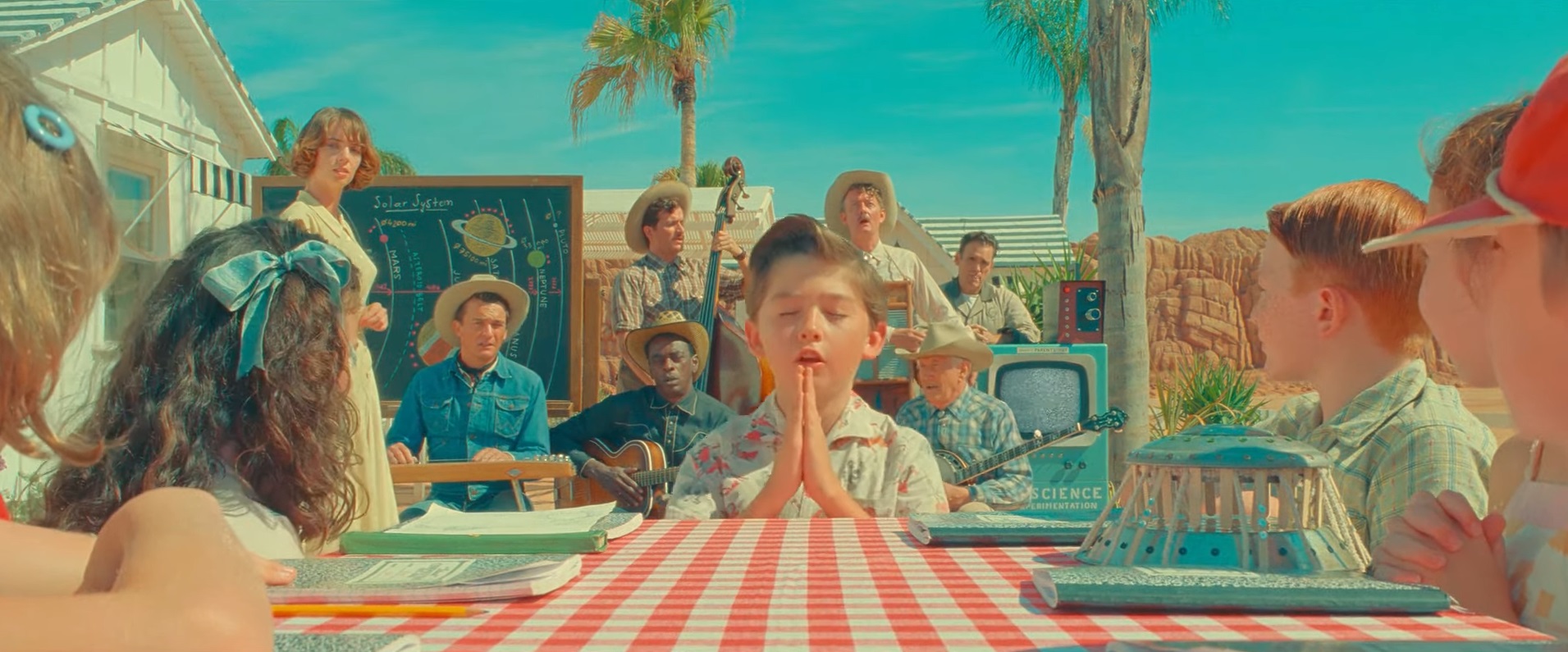
The actors all have their own way of engaging with the deceased Conrad through his story. They wrestle with it, create their own understandings and interpretations, break character to remark on how they think this scene should go (I’ve long held a theory that when Dr. Hickenlooper explains that the blinking lights at the observatory as “possibly a red herring,” that’s not a line of dialogue; it’s literally the actress breaking character to guess at how she interprets a part of the mise-en-scène). But since not even Conrad fully knew – “Infinity, and… I don’t know what else” – the actors have to find their own way to accept the uncertainty of their characters. Nearly all of them, at one point or another, reach a point where they have to admit a lack of knowledge, a loss of control, of not having any answers over the strange events they face in this tiny town.
Maybe that’s what the alien is a metaphor for: the “I don’t know” of life. The alien never speaks to anyone. It seems just as afraid of humans as humans are afraid of it. It doesn’t even do anything to them. It just borrows the asteroid for a few days and drops it back off. Maybe we weren’t even on its mind all that much. Anderson puts us in that uncomfortable space of Not Knowing, confronts how the present will always be a source of anxiety because we never know how it will end until we experience it, and asks us to accept that. Even if we don’t understand it.

It is so fitting that a Wes Anderson movie with these themes, and these emotional stakes, confronting these deeply human questions about our own relationship to the stories we tell, through artists grappling with the inscrutable perspectives of other artists, would be released when dorkassed pedants on the internet thought they were being clever by having A.I. recreate popular movies and TV shows to look like a Wes Anderson composition. And A.I., being nothing more than an unthinking, unfeeling algorithm taking things humans created and mashing them together based on outputs and spitting out something vaguely aligned with what its inputs were, is only able to recreate the most hollow surface-level facsimiles of the surface impressions of his aesthetic presentation.
But they don’t mean anything because a machine just rendered it. There’s nothing to appreciate about it. Their emotional value is zero. Their artistic power is nonexistent. But when a bunch of flawed, relatable humans work together, collaborate through all their anxieties and interpersonal conflicts and self-doubts, to bring someone else’s story to life in their own way, that is magical. It’s what helps us understand, or accept not understanding, all the scary unknowns of life. Computer software can’t appreciate art’s beautiful, confounding, messy, indecipherable humanity. But we can. Even when we don’t always understand it.
I still don’t understand the play.
Doesn’t matter. Just keep telling the story.


Comments
Loading…