

 Steven Prusakowski
As found across the terrain of the mysterious, uncharted planet at the center of the Max Original, Scavengers Reign, the ground-breaking animated series has a life of its own. Not only has the 12-episode series been honored with four Annie nominations (including Best TV/Media – Mature, Writing, Directing and Production Design), it was recently reported top the list for “Top Trending Streaming Content” on its respective platform. Knowing of all the quality content it is up against, this is an impressive feat in itself, but is made even more impressive when you take into account that the series premiered almost four months ago.
Scavengers Reign tells the story of the passengers of the space cargo ship, Demeter 227, who were separated into small groups when it crashed on an unexplored planet of Vesta Minor. The stories of five humans (and one companion robot) are told simultaneously need to find each other, the ship, and a way home. All this while navigating a mystifying terrain where every step provides new discoveries. The cast (including Wunmi Mosaku, Bob Stephenson, Alia Shawkat, Ted Travelstead, Sunita Mani and more) provide performances that resonate, as we observe them dealing with this new world and each other, but perhaps more importantly introspectively.

To try to pinpoint the one specific reason behind the series’ popularity is impossible since of all it offers viewers take in and appreciate in. It is a sci-fi animated series, but defies being contained by simple labels. Firstly it is sensory overload (in all the right ways). The planet is full of wonder; original critters, creatures, beasts, plant life and other living things not as easy to categorize, brought to life with the top-notch animation and sound. Just a few seconds into the pilot viewers are immersed in an exquisite animated, lush, colorful, living-breathing world unlike any seen before. Behind every tree, under every rock, and just about everywhere in between are endless opportunities for exploration.
Then there’s the environmental sound – much of which was done by Axel Steichen. It plays a big role in the luscious ASMR-like audio journey that captures every noise imaginable – the squishes, the slurps, the sloshes. Yes, many are kind of gross but not for grossness sake. The sound puts you on the ground with these humans using such detail you can almost imagine the smells and feel. Scavengers Reign is the very definition of world-building, from the ground up, below and inside.
Scavengers Reign takes viewers right back to the days of roaming around on outdoor adventures, exploring the local creek or what exciting life forms could be found under rocks. While a salamander, snail, or millipede may be the ferocious discoveries most viewers have encountered, Vesta Minor is inhabited with much, much wilder wildlife. All are examined in ways that range from alluring, mysterious, hypnotic, and quite frequently terrifying.
Awards Radar recently had the pleasure to speak with some of the team behind Scavengers Reign: Co-Creator & Executive Producer Joe Bennett, Executive Producers James Merrill and Sean Buckelew, and and Supervising Director Benjy Brooke about the creation of and ideas behind the awe-inspiring, often bordering on psychedelic series. Shared below are some highlights from the conversations which were as almost as fascinating as Scavengers Reign itself.
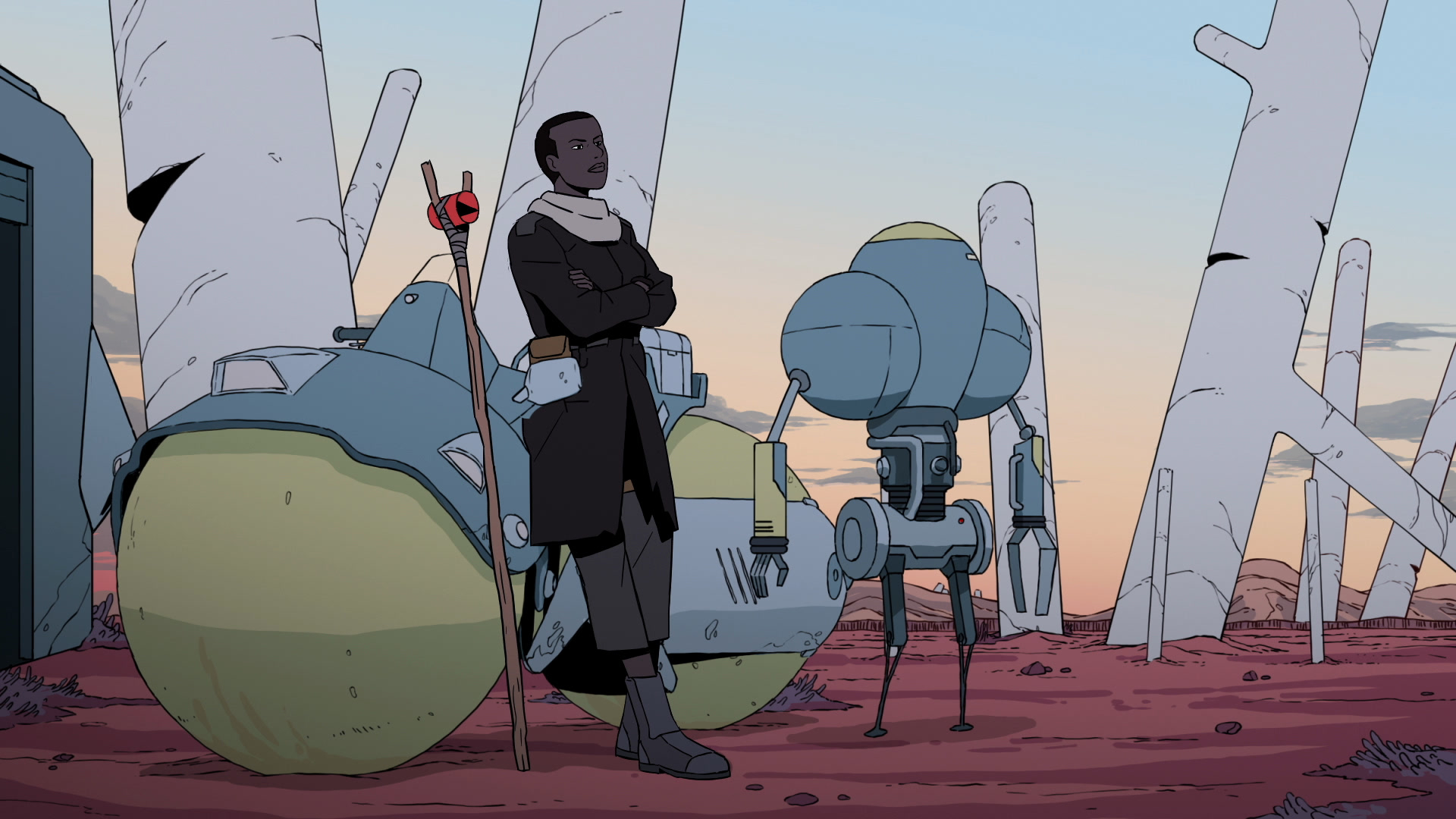
THE ORIGIN OF THE SERIES
Joe Bennett created the series with Charles Huettner who were both new to television. They originally combined forces first for an eight-minute, dialogue-free short which earned a lot of attention, including mine. An incredible WTF?-inducing short that blew me away with its inventiveness and had me wanting more. (You can watch the short it in its entirety at the bottom of the article)
Bennett: Adult Swim had reached out and asked if I wanted to kind of make something with them, something that was like short form. And so, you know, we made the Scavengers short. What I pitched was the idea of creating some kind of story that was just purely visually narrative and there was no dialogue – avoiding any kind of talking and telling a story through visuals.
I was inspired by “Primitive Technology”, which is a YouTube channel that has a lot of videos showing a guy building things with his hands.
Buckelew: It’s a guy in the Australian countryside going through daily life. There’s no dialogue. It’s just this guy going through this process of like, today, I’m going to make like a hut with a clay tile roof. And it’s going to be this, you’re going to see me start the fire, you’re going to see me gather all the mud, and it’s just very, you know, it taps into kind of this like ASMR thing.
Bennett: It’s a lot of just kind trial and error and this sort of essentially kind of seeing this kind of Rube Goldberg machine pipeline build out. And so, and I think that it really like ultimately leaning into the sort of ASMR tactile world that with a lot of movies, especially in like the sci-fi genre, when I felt like when I saw the world of like Hoth in Star Wars or something, I wanted to see more of Hoth and see less of the actual story, you know? Just kind of take time to understand that planet and that world. That was essentially a big part of the direction.
And, obviously with Charles’s vision and that look kind of really helped kind of build the tactility of these things. So I think we just sort of gradually started moving more and more in that direction. Of course, it changed with the show and there were characters that were actually speaking and there was a little bit more exposition and that sort of thing.

CREATURES, PLANTS AND WORLDS, OH MY!
As mentioned, the planet we explore through these six castaways’ eyes is full of enigmas – new creatures to observe with every step. We discussed the process of building this world and the creatures within it.
Bennett: It was just kind of like we’re layering a cake, you know? In the writer’s room, a lot of that stuff was like, what we were brainstorming about was more of the big story arcs and stuff, not so much about like, what does this insect look like. That is like kind of a later layer that we would get to. Benji was overseeing all these departments. So in a lot of ways, it’s like Benji was the one kind of handling and making sure that like, okay, this is, here’s a new creature that we’re doing.
Let’s make sure that it matches this ecosystem. And I think we were all being very careful about that. But yeah, I mean, I think that ultimately it was like, the artists had a very kind of clear vision of what they needed to do, what they wanted. All the artists were working from around the world remotely, but there was still such a sense of high morale and inspiration. Everybody was just so motivated and excited.
Benjy Brooke: I think that adding the human speaking and them dealing with the human foibles and their like the day-to-day struggles of just being a human in contrast with the kind of the silent wonder of the planet makes the silent wonder even more extraordinary when you actually get hit by it. I think that what Joe did in the short with the collaborators and then the pilot and then the whole idea of the series was to like bring something that Miyazaki brings to this feeling of you’re looking out of the world and you’re actually appreciating it on a kind of slow scale, slow scope and hitting you with that, the wonder of what it would feel like to actually go on a hike in the Appalachians.
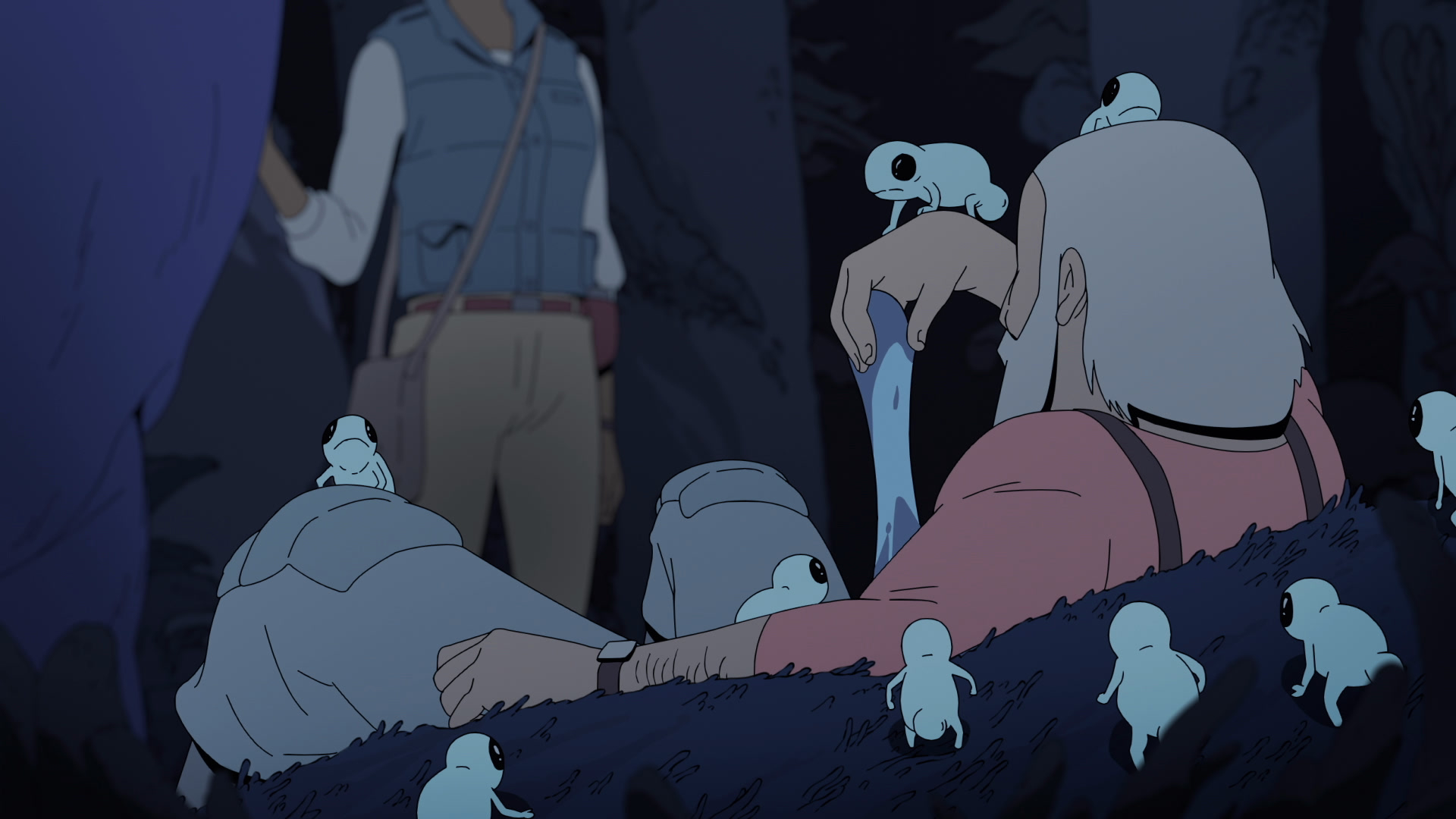
MORALITY, CONTRAST & CONSCIOUSNESS
Bennett: We kept coming back to that really exciting juxtaposition of the humans and nature and the idea of nature sort of representing a kind of neutrality. It’s unforgiving, it’s unmerciful. It’s just, it is what it is. There’s no good and evil, that sort of thing.
The humans kind of inject that, they bring that to this planet. So you’re having this kind of constant thread of the two intertwined – that I think that was a thing that we really wanted to explore. Kamen (Ted Travelstead), for instance, is someone who has all these kind of shortcomings and he has his own, his backdrop for it is just this planet.
Brooke: I think consciousness is a big part of the story. And I know the writers, the whole writers room, and I know James and Sean, two of our partners at Green Street are really interested in the idea of artificial intelligence as also kind of a neutral thing and consciousness as an interesting concept to explore and consciousness and consciousness’s need for connection as a big part of the storyline. The whole thing is about people coming together and trying to make it work, creatures and people coming together and trying to make it work, and robots and people. I mean, whatever it is, it’s consciousness is intertwining and seeing what happens when those two forces meet.
What would happen if a kind of higher consciousness animal and a higher consciousness human meet? This is what would happen if the higher consciousness like fungus meets the higher consciousness robot, or it’s sort of like a medium consciousness, but just these combinations. And I think James and Sean had mentioned that the robot is sort of like this neutral substrate.
It’s like a very powerful system, but doesn’t have consciousness. If some consciousness is not human or not really mammal-like it’s this unknowable things, the force of the nature of the planet gets to this hyper-powerful machine, then what sparks from that? And by the end of it, you see that it’s something kind of mystical.
Merrill: What is the morality of a creature, a natural creature? What is man’s relationship with technology and technology’s relationship with nature? And these things like, you know, all of these people on this planet have experienced grief and regret and longing and loneliness. And, you know, all these things that were natural to the world, I think that was already set up. And it was extremely fun to just dive in and extrapolate and just think about, you know, all the different directions we could go, all the different paths we could go down, all the different problems we could create and then solve that would, you know, explore these themes.
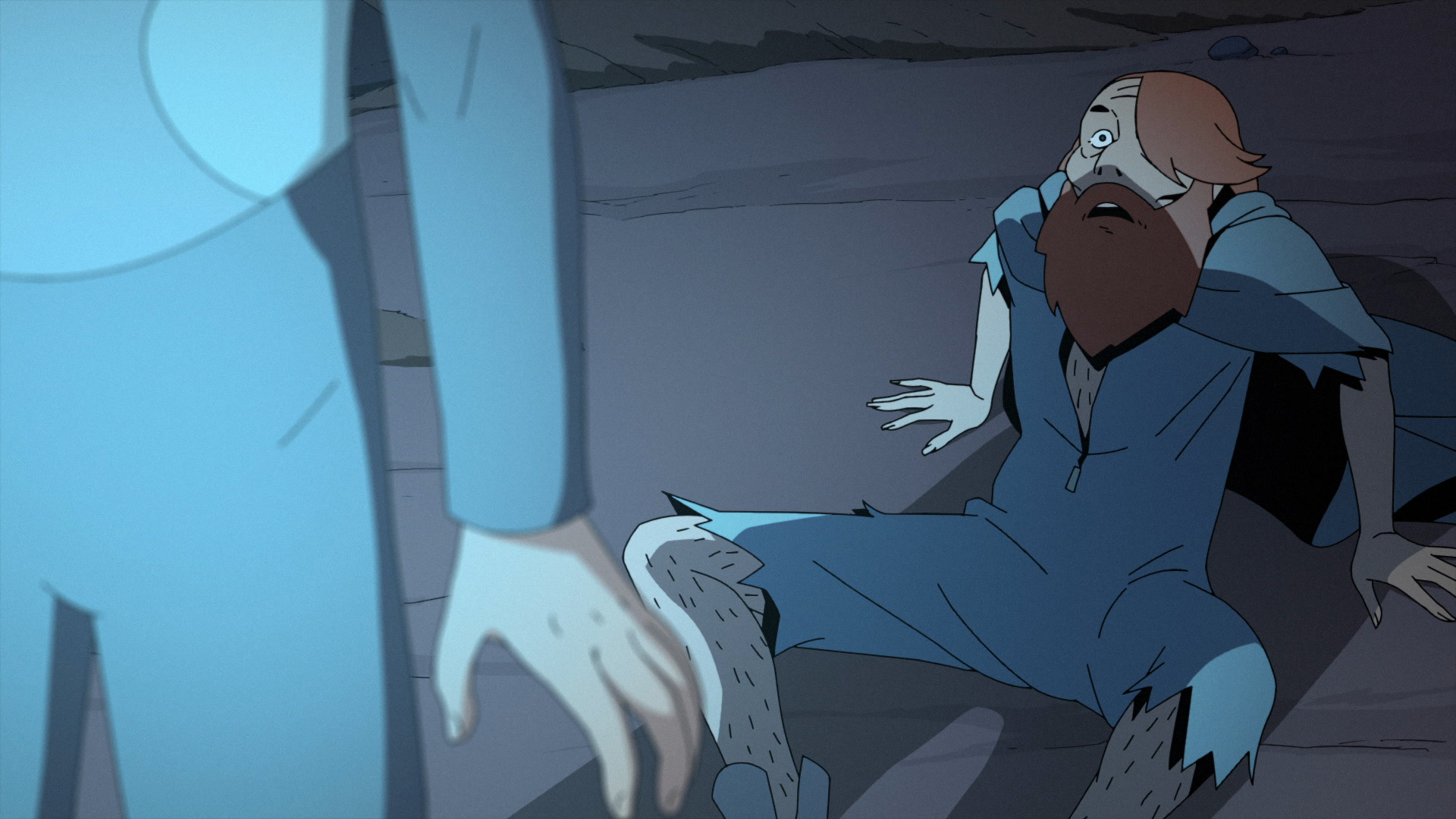
THE HORRORS AND BEAUTY OF NATURE
Watching Scavengers Reign stir up some very visceral reactions through constant reminders of the horrors of nature and how it is perceived from all perspectives, including ours. I asked them about it:
Bennett: I have no idea where the hell that came from.
Brooke: I mean, nature documentaries probably. Nature documentaries, I gotta see that. When you watch it, they have a lion ripping the head off of a gazelle and then a beautiful flower opening.
Bennett: …and I think nature documentaries are interesting to. They’re sort of interpreted through, you know, if you’re listening to Attenborough narrate it or if you have music that’s implying sort of good versus evil, because that’s the way that humans sort of interpret everything. That’s how we look at everything by applying this is the good guy/this is the bad guy. And I think that’s a funny element to-
Brooke: I have a slight disagreement because the gazelle is f*cking terrified. And so to the gazelle, the lion is very evil. I think like the actual experience of being the gazelle, being attacked by a lion must be very similar to the experience of being a human being attacked by a lion. So I think adding that like Spielberg-ian music on top of a scene with like the creature getting infected by the parasite and exploding and, you know, all of that, the actual experience of that creature, it’s horrible.
I mean, they have families and they have a life, you know, and I think it’s not totally neutral. I think it’s like an animal. They have kids.???
Buckelew: What are the things that make us human and make us different than an animal or anything else? I think there are obviously a lot of emotional, you know, gradients to animals and creatures.
Brooke: People have been describing it as cozy, which has been surprising to us – where it’s like kind of a comfort watch, even though all these horrible things are happening. And you’re on, you know, ostensibly lost on an alien planet with people just trying to survive.

HAUNTING THEMES
One of my favorite sequences is both haunting and beautiful – a frequent juxtaposition running throughout the series. The existentially profound 187-seconds in the middle of episode 3 “The Wall” has Ursula (Sunita Mani) witnessing the entire lifecycle of a delicate creature living inside a flower. It is a scene I have had on my mind ever since my first watch. (You can watch it in its entirety above or better yet, experience it while watching the series.)
Bennett: She opens this creature up, she sees a creature kind of aging and a whole life cycle. And it’s kind of a beautiful moment that just, like, comes and goes. Everything on this planet kind of has a purpose and a soul function, the humans included, but that these creatures have kind of a functionality or some kind of a function to it. That there’s an appreciation for beauty and that sort of thing.
Buckelew: What are the things that make us human and make us different than an animal or anything else? I think there are obviously a lot of emotional gradients to animals and creatures. It was something that we talked about, like, what are these things? And one of them is this ability to perceive aesthetics. We were just talking a lot in that scene in particular, in episode three about early man experiencing an aurora borealis and how could you have any conception for what that is other than a kind of spiritual explanation? It’s so dazzling.
Merrill: I start just thinking about my own life and how different it is than that little aliens. Then I think like, we’re probably not that much different. Like, there’s life goals. But maybe it’s a little bit more complex. You start just recognizing he accomplished something. This was his purpose. He fulfilled his purpose. Then he died or she, I don’t know the gender of this alien. But yeah, it does make you reflect in a way I think that I wasn’t expecting. In pre-production and when the first cut started coming in, but just the music and the way it’s handled, it really, has an interesting effect on me personally, as a viewer and as a writer of the show.
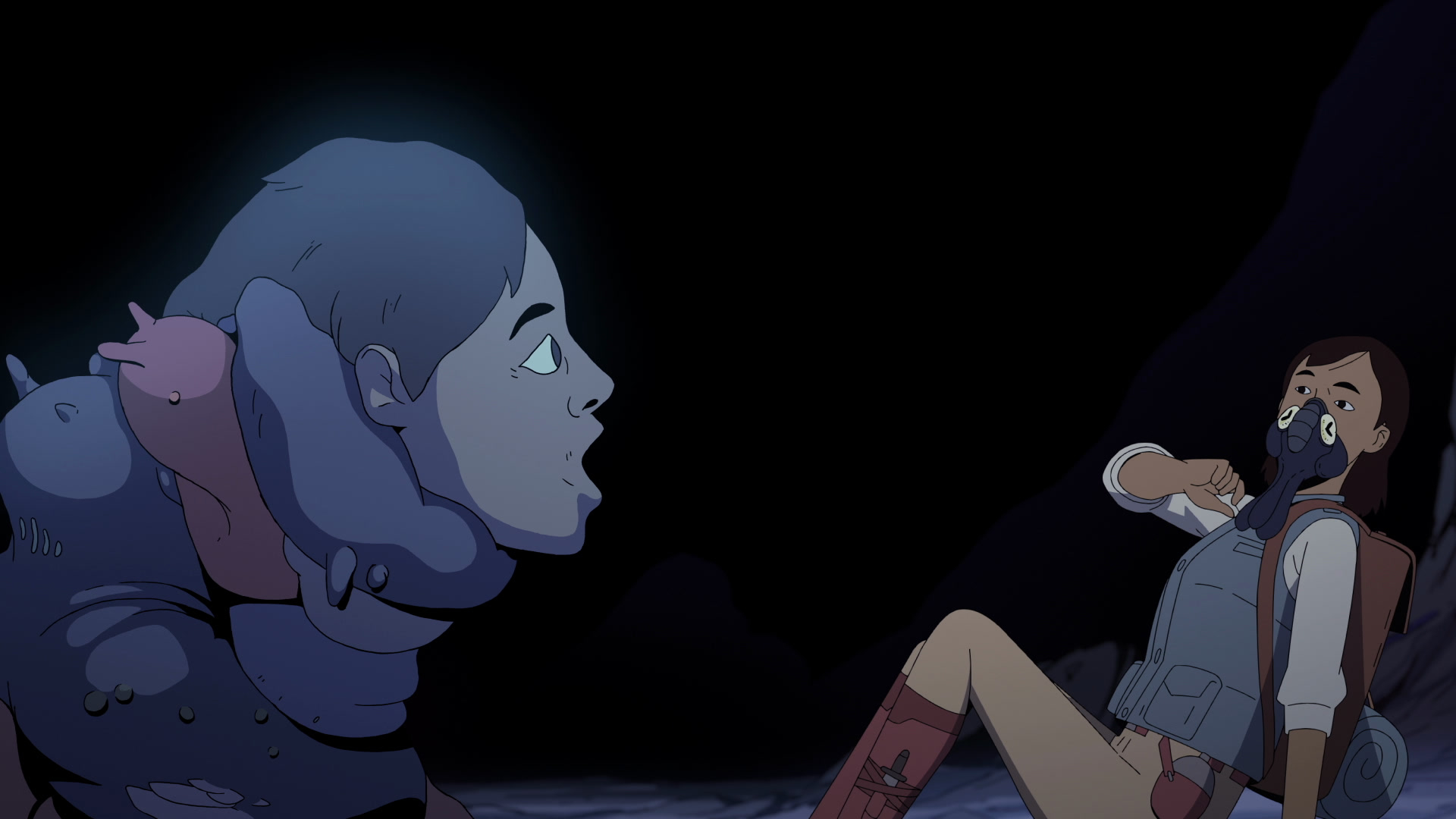
INTERPRETATION
As you can see, there’s much to interpret in Scavengers Reign. That’s one of the beautiful things about the series, every viewer can take away something different. It is one of the reasons I did not renewal much in this interview that would take away from your exploratory experience.
Bennett: There was something very powerful about that. I know Miyazaki talks a lot about that too. You don’t need to understand everything that’s going on – and your interpretation of it, even if it’s not accurate to what the creator’s is, it’s just as important.
But, I think a big part of this was that it’s nice to leave a lot of this stuff open-ended. I really love the idea of the audience sort of reading into it, however they want to read into it. Not to say that we didn’t put a ton of thought into this, but I feel like the second that we are giving away every idea, it just feels like it takes away from the experience.
The series is a true achievement. In a time when it feels like we have seen it all, it delivers unique, though-provoking, beautiful and brutal storytelling that hits on so many levels it defies expectations with every frame. Enjoy forming your own interpretation of Scavengers Reign – the entire first season is currently streaming exclusively on Max.


Comments
Loading…