
 Jonathan Sim
In director Scott Waugh‘s new action thriller Runner, a dying girl’s only hope hinges on a liver transplant, and getting the organ to her alive becomes a matter of minutes. Alan Ritchson and Owen Wilson play two mismatched men thrown together to transport the life-saving organ across hostile territory, with a group of dangerous men desperate to steal it for their own ends hot on their trail. What starts as a straightforward delivery spirals into a breathless, blood-and-bullets buddy comedy, one built on gunfights, car chases, and the increasingly strained rapport between two men who have absolutely nothing in common except the job in front of them.
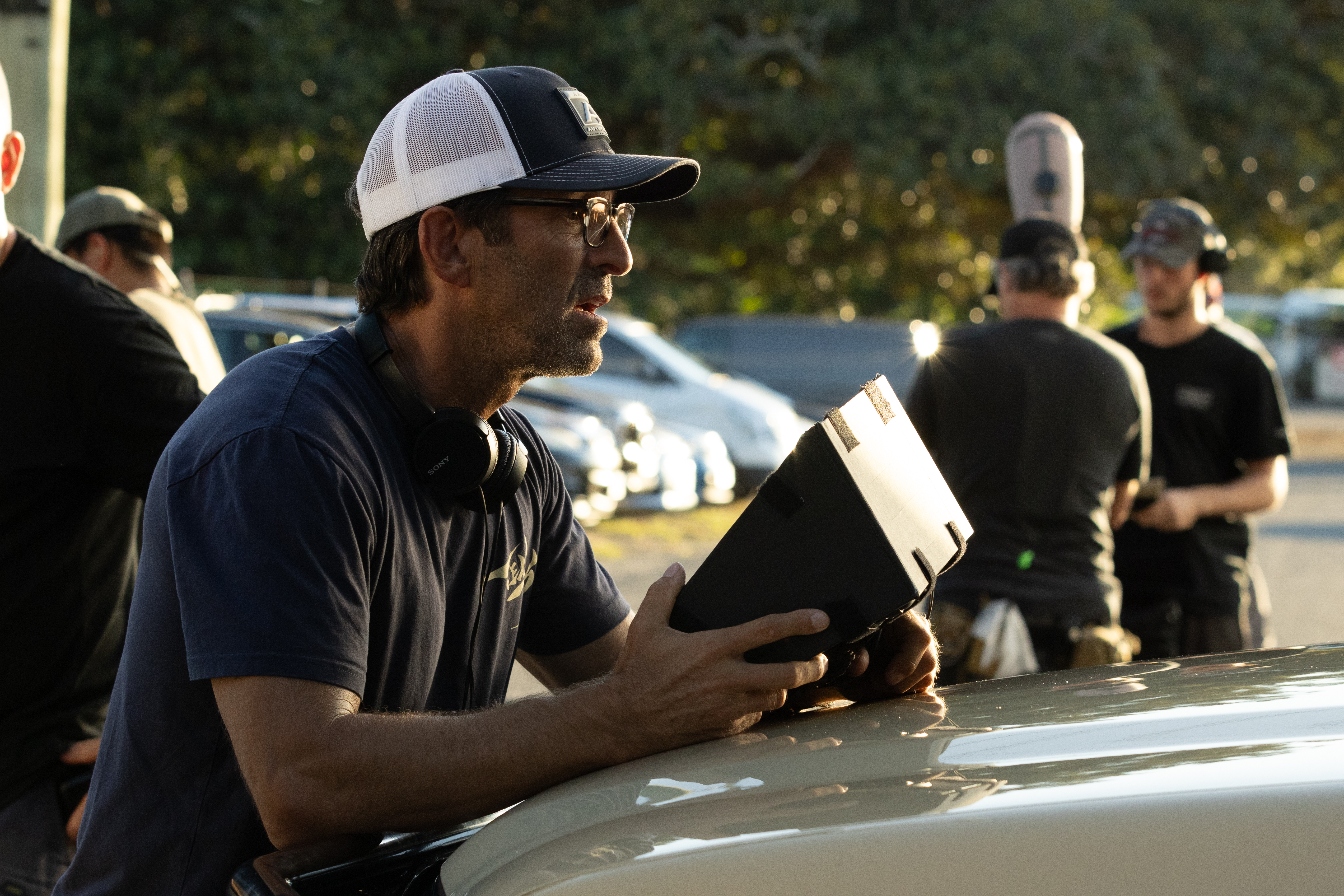
Waugh, the filmmaker behind Need for Speed and Expendables 4, sat down to talk about the movie, and the conversation went back to one name: Tony Scott. “The filmmaker that really was paramount in my whole career has been Tony Scott,” Waugh said. “Tony, for me, made the movies that I aspired to make, and I just always thought he was one of those filmmakers that had such a sensibility of commercial, fun, big spectacle movies that still were extremely grounded in character. They were always funny, but there was so much heart, and they made you cry, laugh. You left the movie theater just going, ‘Dude, that was fun. That was every emotion I wanted to experience, and then some.'”
That lineage, running from Scott’s early work through Top Gun and into Man on Fire, is the one Waugh set out to chase with Runner. “That’s what drew me to this movie, Runner — just the opportunity to get back to the ’80s and ’90s movies that I grew up on.”
That throwback instinct extends to the film’s stunt work, and one sequence in particular near the end of Runner stands out: an extended shot that weaves in and out of moving vehicles mid-chase. Asked how it came together, Waugh traced it back to character rather than choreography. “What motivates me in my action is I pull back and go, ‘What’s going on emotionally?’ Because you have to have motivation for the action, otherwise it’s just a shoot-’em-up, bang-bang with no purpose, and I’m always making sure it’s purpose-driven.”
The shot lands at a pivotal emotional turn for Ritchson’s character, Hank, and Waugh wanted the camera to snap the audience back into the chaos of the chase without losing that emotional undertow. “I wanted to thrust them into what felt like the ultimate one-er shot they’d ever seen, where you fly in and out of vehicles and watch stuff flip. I spent a lot of time on that shot, and it took a lot of convincing to get the producers to let me try to pull that off. But I’m really excited they did.” Getting there meant building the sequence from the ground up, literally. “It was such an elaborate shot. We had to start with the mechanics of matchbox cars, trying to formulate how we were going to do it and get the camera through windows — because someone has to shoot the window to create the hole to get through it. So then we previsualized it, and once we saw the previs, we could mechanically take it and put it on its feet with cars and really start moving the camera.”
Not every gamble on set was a planned one. Because of scheduling, the production wound up shooting its most punishing set piece, a brutal hospital brawl, on the very first day. “The story I’d give you — and I’ve only done this twice in my career, I did it on Need for Speed as well — is that because of scheduling, we shot the last big action sequence first, on day one. The hospital fight was day one.” That created a continuity puzzle before a single other scene existed. “So the challenge was, there are so many things that have to happen to these characters by the time they get to the hospital — we had to track all the fights, all the action, what wounds he’d have by then, what his clothing would be.”
As the days wore on, the fight only escalated. “As we started going through the fight, it got more and more intense, and it was four days of just — the mantra I had in that fight was, ‘I don’t want there to be a wall left in the hospital that’s not destroyed.'” The result, Waugh said, doesn’t betray the order in which it was shot. It reads instead as pure desperation. “For me, as immersive and graphic as that fight is, it’s really the culmination of what two men will do trying to save somebody they love. They’ll stop at nothing. That’s what the whole emotional driver of that sequence was, and then people go, ‘Wow, man, that was intense.’ And I’m like, ‘It needed to be, because think about it — look what these two guys are fighting for.'”
Tailoring that physicality to the actor in front of the camera is, according to Waugh, less about the performer and more about who that performer is playing. “Almost all the time. And it’s not only about the actor, it’s even more about the character. We always start with the foundation of who this guy is as a character and what his capabilities are — not everybody’s a Navy SEAL, some guys are just an average Joe, so they’d fight and drive differently.” Ritchson’s physical capability gave Waugh room to push further than usual. “Then you get lucky when you have actors like Alan who are super physically capable, so you can push the envelope because you know they can go the distance, which allows me as a director to put the camera in spots where I can feature them doing it rather than trying to hide the stunt double.”
That also meant consciously distancing Ritchson’s Hank from another action role he’s known for. “That’s something we actually discussed a lot at the beginning of the film — how is your movement, how are your fights, how are you as an actor going to be different in this character? Because the character isn’t Reacher, he’s a completely different character. So we approached it more as a brawl, fight-kind of choreography rather than more skill-oriented.” The variety was deliberate throughout the film. “Each fight was completely different, as you saw — some were full hand-to-hand, others guns, and then the ultimate brawl. There was no repetition of action.”
Casting the film’s central duo came down to chemistry as much as star power. Ritchson came attached to the project as a producer before Waugh signed on, and the search for his onscreen partner led to Wilson. “So, Alan is a producer on the movie, and he was attached before me. So they brought me in, and I hit it off really well with Alan. When we started talking names for who’s going to play Ben, a lot of names got thrown in the hat, and when Owen’s name came up, it just — for me it was like, ‘Wow, that would be really interesting,’ because he’s so opposite of Alan.”
Waugh wanted the kind of friction that defines classic odd-couple action movies. “You want those rhythms, that Midnight Run, Lethal Weapon thing — you want that old-school buddy movie where they’re just opposites, oil and water. I was just like, ‘Man, Owen would be special in this.'” Once on set, both actors were given room to shape the script’s comedic beats, including one now-memorable line born entirely on the day. “I think when you have talent like this, you want to use all of it. So we’d flesh out what’s on the page, but always have those beautiful moments of, ‘Hey, man, there’s something great here, what do you think about throwing a little one-liner in here to give us some levity?'” The moment that resulted wasn’t written until the cast found it together on set. “That moment in the big market brawl at the end wasn’t in the script. I was like, ‘Hey, I need the audience to have a little bit of a smile right now, because it was so intense.’ I asked Owen, ‘What do you think? You see Alan, he’s got the guy, he’s going to choke him out — what would you say?’ And he just goes, ‘I don’t know, I guess I’d just tell him — for the guy — ‘uncle.” I just started laughing, I was like, ‘We’ve got to do that, man.'”
Waugh’s visual instincts, he said, come less from film school than from family. His father worked as the original stuntman for the Spider-Man television series, and helped pioneer some of the earliest camera rigs used to capture stunt work up close. “You know, I just don’t. I draw from my own experiences — my father being the original stuntman for Spider-Man in the TV show, watching him develop camera systems, the helmet cam, the first original helmet camera to put the audience in there, then the original pogo cam, which was the first camera before the Steadicam, to move the camera.”
That inheritance still shapes every choice Waugh makes behind the lens. “I’ve always been asking, ‘How do I move the camera in a way that feels fresh and doesn’t distract you, but actually puts you even more inside the story?’ — the way my father was trying to teach me. That’s kind of where I draw from. I don’t really study other movies and think I need to do it like that; it’s more from personal experience.” A background built on stunt work rather than film theory, Waugh added, gives directors like him a distinct advantage when it comes to placing the camera. “Well, I think my background absolutely lends me to figuring out where to put the lens, because I’ve seen it in ways — like Sam [Hargrave], and my John Wick buddies — we’ve seen stuff through our eyes that, when you’re trying to tell somebody about doing a stunt, they’re like, ‘Oh, that sounds cool,’ but then when they see it from your perspective, it’s always like, ‘Whoa, that’s crazy.’ So we’re always trying to put the camera in a spot that features it, and to me that’s really important.”
Getting an original, mid-budget action movie like Runner into theaters at all, Waugh acknowledged, is its own kind of fight. “I think it’s definitely challenging. With fresh IP, not built from an existing franchise, it’s always star-driven — when you find your stars, the stars align. So it’s always trying to find somebody who’s very key in the marketplace as an action hero, making sure it checks all the boxes for a theatrical movie. I just feel like there’s an expectation — audiences have to pay 20 bucks to go see a movie, and you’ve got to deliver that.”
For Runner, that expectation is met less through spectacle than through stakes. “The emotional surprise of it — I feel like that’s what makes it special. The whole movie is predicated around trying to save a seven-year-old girl from dying, and what men are willing to risk to do it. I feel like that identifiable thing for the audience, and the emotionalness that drives the entire movie, puts you on the edge of your seat more, because it’s like, ‘Is she going to survive? Is she going to die?’ That kind of thrill ride — and having some fun while doing it — is what makes it more of that kind of theatrical ’80s, ’90s movie that Tony Scott made.”
Asked, ultimately, why he keeps making movies like this one, Waugh returned to the same idea that seems to animate all his work: ordinary people pushed into extraordinary circumstances. “I’ve always been intrigued to tell stories about ordinary people doing extraordinary things, because all of us — including myself — are pretty damn ordinary, right? But we all have these dreams of doing extraordinary things because our normal lives feel so mundane, and sometimes we get to do really special things. I think every human on this Earth is capable of extraordinary elements, of doing extraordinary things, and hopefully my movies will inspire those people to do that.”
Without giving anything away, Waugh singled out one sequence as his favorite in the finished film: a gas station showdown that closes out the story, and, fittingly, closed out the shoot. “Yeah, without spoiling it, my favorite thing in this movie is the gas station. I think the gas station sequence is the culmination of the entire movie — the bond that’s happened between Alan and Owen’s characters, the chaos that’s surrounded them up to that moment, and the sacrifice they’re both willing to make.” That the scene wrapped production almost felt like fate. “That scene was the last thing we shot with Alan and Owen in production, and their chemistry was so fantastic. I was so thrilled that turned out to be, production-wise, the last scene we shot, because they’d slotted in by then, after five weeks together, and it was one of those scenes where you’re like, ‘God, I wish we could shoot more with them now, because they’re just so good.'”
Runner is in theaters this weekend.


Opening sentence of this article is wrong. It was a little girl- not a boy. I didn’t bother reading the rest of this article after you get such a basic plot point wrong.