
 Jonathan Sim
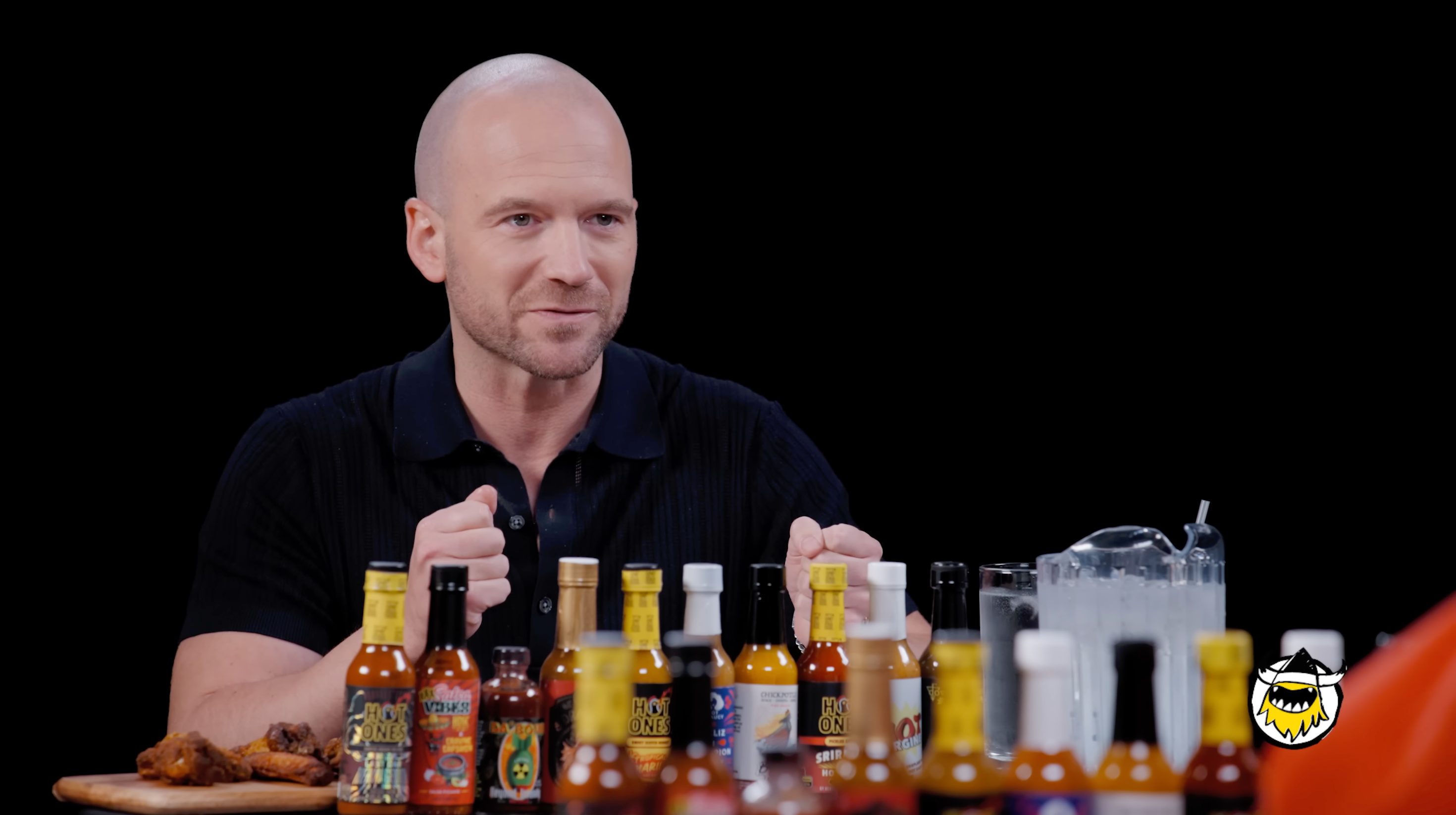
There are few corners of the internet quite like Hot Ones. Since 2015, the First We Feast series has built a devoted following around a simple and slightly sadistic premise: Sean Evans sits across from some of the most famous people in the world, asks them genuinely good questions, and watches as increasingly devastating hot sauces do their work.
The show has hosted everyone from Paul Rudd to Viola Davis — and in a media landscape overrun with softball celebrity junkets, it has carved out a reputation as the interview show that actually gets people to open up. Eleven years in, Evans shows no signs of slowing down.
When asked about his preparation process, Evans doesn’t describe anything elaborate. The philosophy is straightforward, even if the effort behind it isn’t.
“Basically, I just try to read, watch, and listen to everything that I possibly can,” Evans says. “So if I’m interviewing a musician, their music will become the soundtrack of my life for that week. If I’m interviewing an actor, I’m ending every night with a double feature. If they’re an athlete, I’m watching whatever documentaries and highlight reels are on YouTube, and just really trying to marinate in their story as much as I can. I’m looking at not only the profiles and the news stories and the arcs of their career and the reviews on their films — I’m also kind of looking at their artistic or creative output, because sometimes I feel like you can learn just as much about a person from that as you can from reading about their lives.”
The enthusiasm is real, and Evans is quick to point out it hasn’t faded. “It’s honestly just a pure effort thing. I really enjoy it. It’s so exciting, and I’m so grateful and lucky that I have this life where I get to interview Emily Blunt one week and then BTS the next, and on and on it goes. I’m not jaded by it.”
That same earnestness shapes how Evans approaches question selection. There is a term he uses for questions he avoids — not bad questions exactly, just ones that have already been asked and answered elsewhere.
“Sometimes I use the term ‘stepped on’ — like if something’s been talked about before on a late night show, or if it’s the thesis of a big magazine profile. Sometimes I avoid those things because we just say those topics are stepped on. Let’s see if we can do something new or different, or try to expand on something that maybe we thought was interesting. I watch a lot of late night shows, and sometimes I hear something and I’m like, ‘Oh, I’d like to learn more about that.’ But they’re on such a time constraint that it doesn’t really get pulled out and explored the way it piques my interest. So that becomes a Hot Ones question.”
The show’s identity also informs what kinds of questions Evans steers away from. “We are kind of the most comfortable, least comfortable interview show,” he says. “We’re a show that celebrates our guests more than it scrutinizes them. We already have our guests eating the Bomb Beyond Insanity — maybe that’s not the greatest combination to then put them on the defensive. They’re already defending from hot sauce. That’s kind of philosophically how I look at it.”
Ideally, Evans likes to have a full week to prepare for any given interview. In practice, the schedule doesn’t always cooperate. “Because of the schedule these days, that gets harder and harder, but I still try my best,” he says. “Sometimes it’s like cramming for a final. Sometimes a guest hasn’t locked a date yet, but it’s offered, and we don’t know what’s going to happen. And then bam — turns out they can’t shoot on the 14th, but they can shoot on the 5th. Thursday, in L.A. And then I just grab a carry-on bag like a firefighter — the alarm goes off and I go. From that moment until I sit down with them, I’m just trying to get as much of a grasp on that person as I possibly can. But I think that’s important. We have our guests jumping through hoops, eating scorching hot chicken wings. It’s only fair that we meet them halfway and deliver what is hopefully a thoughtful, career-spanning interview.”
For a show that has changed so much in public profile, the internal machinery has stayed remarkably static. Evans says the process today is essentially indistinguishable from what it was in the early seasons — and that the people doing it are largely the same, too.
“It is so crazy — the exact same people who made the show in Season 2 are the exact same people making the show now. I have so many people, especially in the core group of Hot Ones, who have been with the show for approaching a decade or over a decade. Even down to the research — early on I hired my brother to help me out with it. That was probably like Season 3 or 4, and he’s still with me. And my partner Chris Schonberger — same thing. It’s the three of us who kind of dive into the material, email some notes back and forth, and then ultimately it’s up to me to hammer out the run of show.”
The one thing that has evolved is Evans’s own relationship to the work his guests have actually made. “Early on, if I was interviewing a movie star, I’d read all about them and know all about them, but maybe I wouldn’t watch the movies. Now I’ll watch the films. If we have a musician, I’ll make sure I listen to the discography. I’ve come to appreciate and really study the artistic or creative output more than I did in the beginning.”
The guests themselves have also changed — or rather, the way they walk in the door has. In the early days of the show, Evans was essentially pitching people on an absurd concept they had never heard of, sometimes while that concept was already happening to them.
“Back in the day, when we first started, we were basically tricking people into doing the show, and then I would have the awkward responsibility of explaining this ridiculous show to them while it was happening. And they’d be looking at their publicist like, ‘Why am I here? What are we doing?’ I am so happy to be past those days.”
The turning point, he recalls, came in the form of a single greeting. “I still remember the first guest who ever came in and was like, ‘Yo, Sean.’ And I was like, ‘Oh my god, a guest knows my name.’ That was T-Pain, back in the day. He was like, ‘What am I, episode 38?’ And I’m like, ‘Oh my god. Okay. This is great. He knows who I am. He’s a fan of the show.'”
The recognition has since become routine. “I remember seeing Idris Elba one time in a hotel lobby. We were supposed to interview later that day, and he’s walking by and he does a double take and goes, ‘I’m ready for you.’ Now you’ll have these press days and a whole day booked and you’re kind of just going through the car wash and you don’t even really know what’s next. But it does mean something to me that guests have the Hot Ones interview date circled on their calendar. That makes the whole process a lot easier. And at the end of the day, a celebrity interview is really a trust exercise. It’s really nice that they walk into the studio already trusting it at least a little bit, whereas before they trusted it — and me — not at all.”
When asked to name some of the episodes he considers classics, Evans moves through the list with the affection of someone who has clearly replayed these conversations in his head more than once. “The Paul Rudd episode is a classic. The Gordon Ramsay episode is a classic. Conan O’Brien is a classic. I really love interviewing Viola Davis — she’s a really amazing person to interview, and I think that’s a really strong episode. The Charlize Theron episode — I could go on and on. I love this show so much and I’m so obsessed with it that I could probably give you a hundred greatest hits.”
His enthusiasm for a potential collaboration with Keke Palmer, however, goes somewhat beyond professional admiration. Evans is characteristically coy, but the warmth is unmistakable. “I always love shooting with her. When we get together, it’s a one plus one equals three situation, and audiences love it. At our heart, we’re both kind of throwback entertainers. So it’s kind of nice to bring some of that throwback talk show energy to modern audiences, and they relate and understand it, and that’s really special.”
Asked to fantasize about a Hot Ones episode with any historical figure, Evans doesn’t hesitate. “I think the best episode ever would be with Chris Farley. He’s just made in a lab for Hot Ones. That would be amazing.”
On the booking side, Evans describes a color-coded spreadsheet operation that is equal parts production machine and quiet hustle. “We have these spreadsheets and every celebrity you could probably think of is on there, along with all the projects they have coming out this year and next year, all color-coded. Maybe they’re red — a straight pass on us for years. Maybe they’re yellow — they kind of flirt and sometimes offer dates but never actually confirm the shoot. Maybe they’re green — they’re actively trying to be on the show. We’re always working and making personalized pitches, trying our best to spread the gospel of Hot Ones. And luckily, now, movie studios and record labels and TV networks will reach out to us in anticipation of projects coming out, and that has made the booking process a lot easier than it used to be.”
The white whale Evans is most eager to name? Tom Cruise. “We might have to make it hotter, or do some kind of extreme version, but he would be great. I doubt he’s ever heard of us — I cannot imagine he’s ever heard of us — but maybe if he sees it, maybe in some way he’ll feel a kinship with the challenge of it all. That’s all one can hope.”
The episodes Evans is most proud of, it turns out, are not always the most famous ones. Some of the moments that stick with him are the ones the cameras almost didn’t capture.
“I won’t name this guest, but I remember somebody came in who had just received word of some illness in their family and was really down. And then I could tell that they enjoyed the experience of doing Hot Ones so much that it just turned their day and their mood around. That’s what the show can do sometimes. I even feel it as a host — I’ll see their shoulders drop, and now they’re having a lot more fun than they expected to. The quality of the interview is better than they thought it would be. And then all of a sudden they’re immersed in this spice world, forgetting about the cameras around us, and we’re just two guys having a dumb, stupid time together. I’ll see that episode and I’ll be proud of that.”
After eleven years of eating some of the hottest sauces commercially available, Evans has developed a philosophy about pain that is equal parts practical and slightly unhinged, and he offers it freely.
“All you can do is grit it, baby. You’ve got to fall in love with the danger of it all. You’ve got to like that pain just a little bit. You’ve got to be a sicko — that’s what has to happen. And luckily I’m wired that way. I do think it’s like cardio — if you do it every day, it gets a little bit easier every day. And if you take time off, you’ve got to walk your way back up the hill. I’m comfortable in the uncomfortable because I’ve been uncomfortable so many times. I know the clouds will clear. I know the sun will come up on the other side. And I have to be like a strong, stoic force for the guest, because we can’t both be breaking down.”
There is, he admits, an upside that goes beyond mere tolerance. “Sometimes you can get a little high off of it. I’ve gotten that shooting episodes — this feeling of weightlessness and euphoria, eyes watering, but feeling so alive. I’ve just kind of fallen in love with the journey that the gauntlet of hot sauces can take you on. Sometimes it’s so good that it invites the next bite even though it’s uncomfortable. Just leaning into the spice experience and enjoying the ride.”
For a show built on a premise that could have been a one-season novelty, Hot Ones has become something rarer: a format that endures because the person at its center genuinely means it. “When we shot the first episode, I didn’t think we’d shoot another,” Evans says. “The fact that we’ve shot literally hundreds and hundreds over the last decade-plus is really where I pat me and the team on our back a little bit.”


Comments
Loading…