
 Maxance Vincent
In 2017, researcher Rasmus Kleis Nielsen wrote that the one thing journalists must do for democracy is to “provide people with relatively accurate, accessible, diverse, relevant, and timely independently produced information about public affairs.” In a simple translation, reporting the news. It’s the single biggest necessity journalists should pursue not only to preserve democracy, but also to hold our democratic institutions to account. Who would’ve thought that simply reporting the news, as it is, has now become a criminal offense, where you can get either thrown in jail or leave your country entirely to avoid said prison time? This is what director Julia Loktev documents, over the course of five hours and twenty-four minutes, in My Undesirable Friends: Part I – Last Air in Moscow.
You’ve read this correctly: 324 minutes. This is a big ask for anyone, even for me, who has stated on multiple occasions that no good movie is ever too long. But five hours is much longer than three, isn’t it? That said, you’ll quickly get utterly absorbed by Loktev’s fly-on-the-wall, vérité style, as she chronicles the last months of TV Rain, before it was ultimately banned in Russia once the country’s invasion of Ukraine began. TV Rain was one of the last independent news channels in Russia that isn’t a mouthpiece for government propaganda and provides people with “relatively accurate, accessible, diverse, relevant, and timely independently produced information about public affairs.”
This sentence will recur throughout this review because, throughout the film’s runtime, all the journalists do is report what is ongoing in Russia as it is. They are providing people with “relatively accurate, accessible, diverse, relevant, and timely independently produced information about public affairs,” which should be the primary function of a democracy. However, the country’s president, Vladimir Putin, won’t allow any media outlet that criticizes his totalitarian government’s actions. Whoever does so is labeled “foreign agents” and must disclose this label before the beginning of any program, which Loktev showcases and frequently repeats whenever footage from TV Rain’s reports is shown. The labeling is meant to repel anyone from watching sources that dare speak out against what’s unfolding and only stick to propagandistic outlets, which are blindly following their leader’s actions, so they are not sanctioned, jailed, or worse, killed.
In the first half of Loktev’s five-hour film, her intimate iPhone photography puts us in the shoes of multiple interlocutors from TV Rain, Important Stories, and Novaya Gazeta. These three independent outlets have never shied away from reporting the news, unfazed by repercussions from Russia’s government. However, the feeling is mutual across all media sources: their days as independent journalists are numbered before they’re either forced to become mouthpieces for Putin’s regime, shut down, or arrested. Multiple car conversations with one of TV Rain’s key presenters, Anna Nemzer, become darker as the film leads up to Russia’s illegal invasion of Ukraine, to the point where she questions whether or not staying in Moscow is worth it, even to preserve what little is left of democracy and free speech.
One of the most sickening images of the entire movie occurs in one of those car conversations between the two, a day before the invasion begins. Anna drives in downtown Moscow, and, in the middle of their talk, fireworks begin to light up, which signals their intention to invade Ukraine before Loktev cuts to images of the army committing war crimes. “When they annexed Crimea, all Moscow lit up in fireworks,” Anna explains. It churns your stomach before Loktev cuts to footage of the Russian government’s propaganda, using terms such as “special military operation” and “denazification” to justify an unlawful invasion and to contrast the reporting TV Rain has been doing since its foundation.
Anyone who states that Russia’s invasion of Ukraine is anything but a “special military operation is immediately labeled a “foreign agent” by the despots running the country, with repeated threats of shutting the channel down altogether. Saying “No to war” gets you arrested and detained. “No to war.” There isn’t anything controversial about simply being against war, and yet anyone in Russia who is against war faces prison time. It doesn’t matter if you’re a journalist stating what the international community has labeled the invasion as, in contrast to what Putin’s puppets are saying. The international community is saying this is a war. The government is calling it a “special military operation.” That’s a balanced approach to both sides’ positions, a perfect representation of Kleis Nielsen’s one thing that journalists must do for democracy. However, in Russia, you cannot report the news because the government does not want it reported. They want to control the message from the bottom up.
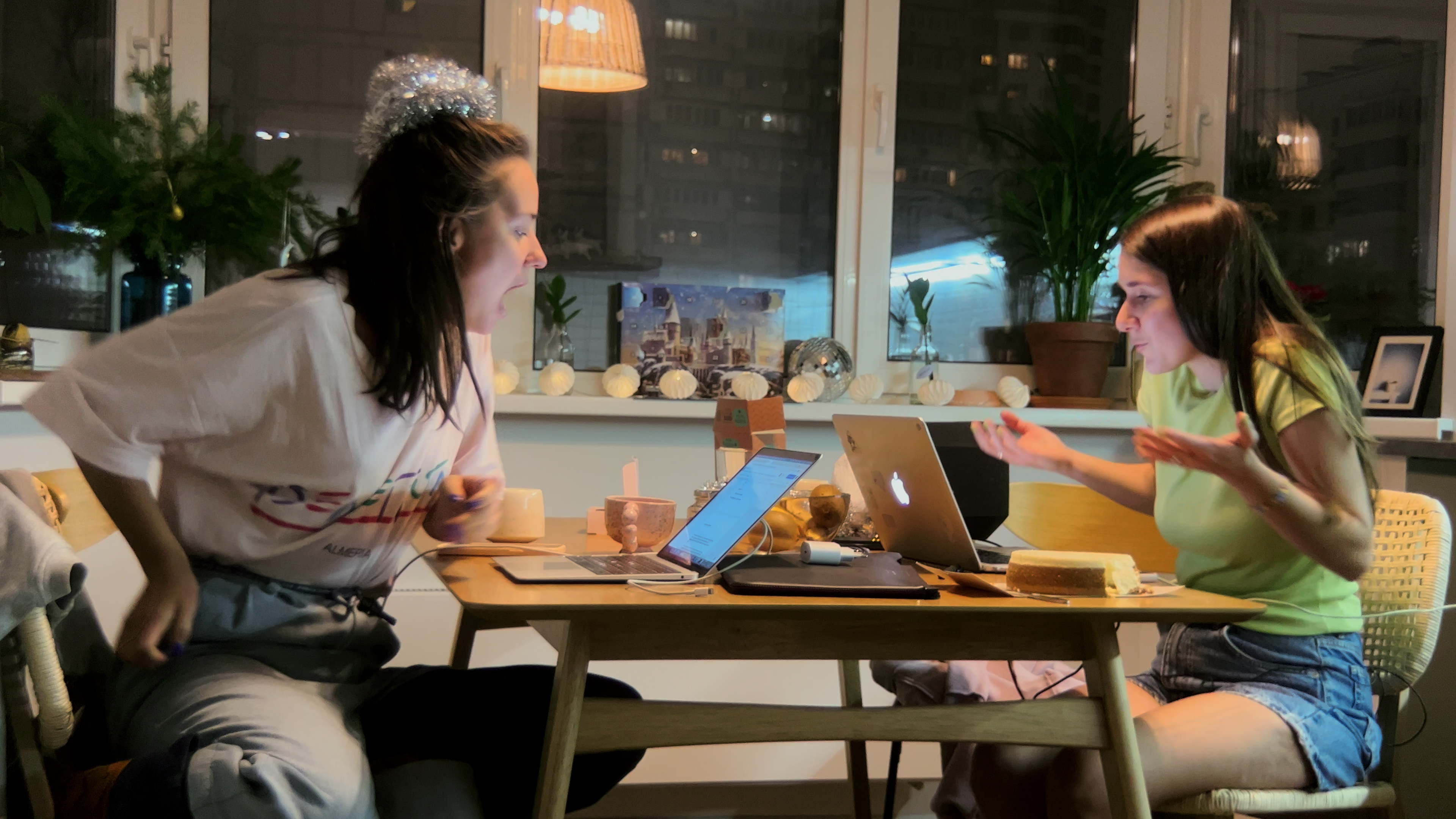
At first, Loktev presents the film’s key journalistic figures as courageous dissidents who don’t seem bothered by the “foreign agent” label and would rather keep doing their work until they can no longer. Yet, closed-door conversations among the various characters reveal they are bothered by the label and by the country’s further descent into totalitarianism. They have no idea how long they’ll be able to continue simply reporting the news when the government is constantly attacking them. Journalists are arrested for vague reasons to perpetuate a climate of fear in the newsroom. Each casual conversation Loktev deftly films with her intimate lens has an undercurrent of dread. They attempt to make light of their current situation through poker table parties, but one can see the fear in their faces, which intensifies as their panic attacks manifest later in the picture.
So many of them chain-smoke as a coping mechanism, which only exacerbates their ongoing anxiety as the film’s slow runtime progresses to its inevitable conclusion. When it occurs, though, it doesn’t make it any less devastating. The final hour of My Undesirable Friends: Part I might be one of the most essential demonstrations of journalistic courage ever captured on camera. Of course, it seems like a considerable ask for anyone to sit with these people for over five hours, as Loktev’s uninterrupted iPhone captures achingly devastating moments of vulnerability underneath the brave façade they put forward whenever they are on air. It’s a difficult task to keep when everything else seems to go to hell until they’re directly targeted and have to make last-minute choices on whether or not they stay, end up in jail, or leave Russia altogether…
These difficult choices are captured with masterful emotional tension by simply letting the figures speak for themselves. Loktev greatly cares about their safety, but chooses not to intervene. She wants their voices to be heard and for the audience to form a bond among the journalists, which makes their ultimate choices in the latter half of the movie all the more harrowing. Of course, this is only part one of the story, with the second film set to be released on MUBI at a yet-to-be-determined date. However, one can’t underestimate the importance of such an object, a once-in-a-generation documentary that not only speaks truth to power, but reminds us why journalism still matters – and should be preserved.
Without journalists simply reporting the news, or providing people with “relatively accurate, accessible, diverse, relevant, and timely independently produced information about public affairs,” we might literally be witnessing the collapse of society as we know it. Surely this can’t be happening anywhere else, right?? Right!?!?
SCORE: ★★★★


Comments
Loading…