

 Shane Slater
Set in an enigmatic world that evokes both the antebellum South and more contemporary European locales, Clement Virgo’s Steal Away is a fascinating drama bearing resonant themes. It centers a pair of young women – a Congolese refugee and a sheltered scion of a wealthy family – who are drawn together and form a complicated bond. As they navigate their friendship amidst the racial and socioeconomic tensions of their society, dark secrets rise to the surface. The film therefore offered much food for thought, as discussed in a recent interview with Virgo and screenwriter Tamara Berger following its world premiere at the 2025 Toronto International Film Festival.
Shane Slater: What was the genesis of this film?
Tamara Faith Berger: It started with a book called Steal Away Home by Karolyn Smardz, which is a historical piece about two young women who are put together in difficult circumstances within 1830s to 1840s Kentucky. That was kind of the jumping off point for us to imagine this trans-historical world and really departing from the book.
Clement Virgo: I’m really fascinated by that history, African American history. But not really wanting to tell a story specifically about that period. I think that period is still so in some ways, echoing through time, and we see it with the refugee crisis, or perhaps migrations of peoples. And as a filmmaker, I was trying to figure out a way to still talk about these things, but in a way that is accessible to people. Of course, genre is always the easiest way. And I think genre, specifically elements of horror or psychological thriller, allows for that space to have these conversations.
SS: As you said, this film departs from the book significantly and it feels like it’s drawing from a range of influences. Could you speak to some of those other influences?
TFB: The book did detail the sort of circumstances of these two teenage girls. I’m super obsessed with the coming of age time in young women’s life. So I really, zeroed in on trying to get at the crux of their relationship. But referencing, of course, contemporary times and the sort of jealousies and difficult feelings that can exist between White girls and Black girls. And really trying to find my contemporary experience in this experience of the past.
CV: And from a filmmaking standpoint, you see filmmakers that have kind of dived into it. Maybe not from a racial standpoint, perhaps, like Bergman’s Persona. Exploring these female relationships. David Lynch was a major influence. And I love a film by Charles Laugton called The Night of the Hunter. The way he kind of created almost a fairy tale. And the cave sequence is very much influenced by the kids on the river.
SS: Mallori Johnson’s arrival in the film is so striking. There’s such a regal quality. Could you speak to how you approached that character and her introduction?
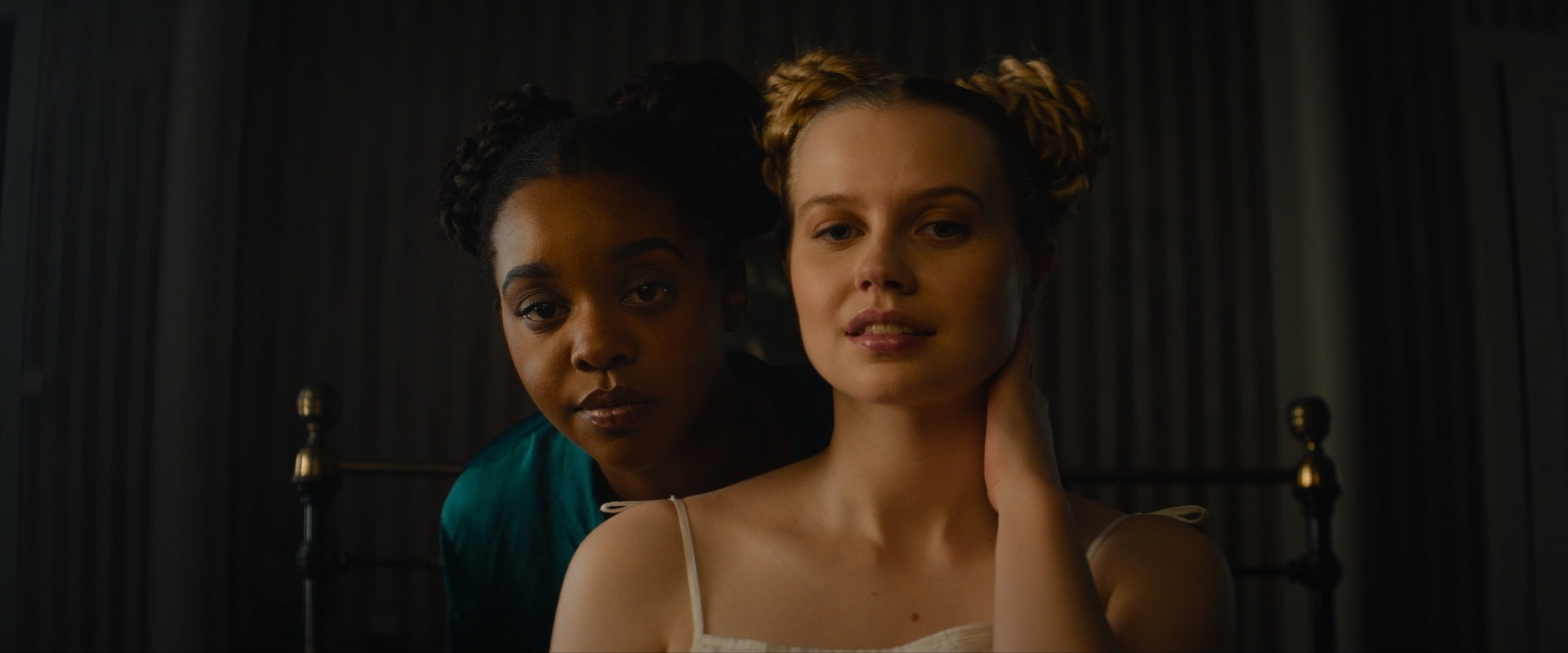
CV: Mallory is a refugee. Her character is a refugee. And of course, we’re making references to slavery, and I didn’t want to have a kind of downtrodden imagery. I wanted the image to be of someone who’s proud, you know? Because as someone from the African diaspora – I was born in Jamaica – I believe there is a kind of pride that I see across African peoples around the world. There’s a kind of adornment of self and a proudness through the hairstyles and wardrobe. You see it in West Africa. I grew up in the church, you see it in the church. You see it with basketball players, with the pop stars. So it doesn’t matter what your means are.
I grew up in in a neighborhood where there was a kind of economy of fashion, where you would go out and buy a piece of cloth, and you take it to the tailor down on the second floor, and he would spend two weeks to make you the perfect pants that fit perfectly. And so I wanted to have that kind of history reflected in it, as opposed to misery porn in some way.
SS: The film is so ambitious from a design standpoint, with all the different settings. What was it like crafting these different worlds?
CV: Everything is in service. Everything that’s on camera, whether it’s hair and makeup, costume production design, is all in service of trying to create a world and story. My previous film was a very male film. Brother was a very masculine film. And this one, I wanted more of a feminine energy in the film. Then just kind of thinking about the film in terms of worlds, you know? There’s Cécile’s world, where I kind of went back to my own childhood in Jamaica, where it was vibrant. I grew up in Jamaica in the early 80s and late 70s. And I went to Cuba a few years back, and it had a kind of energy to it that I really love. Our designer is from Argentina, and so she has that kind of Latin American, sort of West African, Brazilian influence.
So I wanted that in contrast with Fanny’s world, which is much more European. Cooler tones, much more reserved, you know? And also, the difference between how Europeans or maybe Africans see clothes. You know, oftentimes people are being described as tacky or gauche. And for me, it’s fly! But for a European it’s not understated, it’s not reserved enough.
And so, I wanted that vibrancy. And just to say there’s another aesthetic, you know? It doesn’t have to be filtered through a European gaze. There’s another gaze, and there’s a whole history and tradition. And I sort of tapped into my own Jamaican religious, spiritual, West African, colonial British upbringing. I grew up with Anansi stories, and so it’s like the magic naturalism, the dream and the reality operate on the same plane. Obeah is real in Jamaica. So I wanted to have that quality in the story. To feel like almost a fever dream.
SS: Could you speak to how you approached the writing of this complicated character played by Angourie Rice?
TFB: We didn’t want to candy coat or hand hold her as a character so much. She really had to sort of come late in the movie to her own realizations about this lineage. She’s come from grandmother, mother, and then she’s next in line. But I think that also, there’s this whole element of young women and just women in general, need to be likable soon. And I think I really resist that in both characters, in both Cécile and Fanny, but particularly in Fanny, because her behavior can be very off putting.
CV: I think there’s a tyranny of relatability where you have to be relatable to me and share my values. And if they don’t share my values, it’s a bad character, it’s a bad film. In some ways, I want the film to investigate that and have people kind of be off balance that way, and try to figure out and figure out financing. My favorite films do that. They’re kind of ambiguities. I wanted it to be that.
I find a lot of cinema now, and TV as well, sometimes challenging to watch. TV because you’re taken by the hand and dragged through the plot, through the story. There’s no space for you to, as a viewer, kind of work out the puzzle box and the mystery box of what the story is. You’re just kind of dragging through, instead of allowing yourself to surrender. That’s the kind of cinema I love.
[This interview has been edited for length and clarity]


Comments
Loading…