

 Robert Hamer
No, Microsoft Co-Pilot, I don’t want you to write this article for me. What little value these pieces have comes from my voice and my perspective that you can’t ever truly replicate. I’m sure it would be “easier,” but letting A.I. write opinion articles for me would slowly kill what little is left of my soul. Am I a great writer? No, but I am still a writer with some measure of self-worth and dignity.
Anyway, let’s start this discussion with a recent news report:
Michelle Miller is right about one thing: much of what Her depicts has come true now. But what I think has been ignored, now that we’re nearly halfway through the year Spike Jonze’s Oscar-winning film is set in, is how key elements of it have not come true. And sadly, unlike Soylent Green (which fell for the overpopulation panic hook, line, and sinker) or Escape from New York (which envisioned a near-future where the country’s largest metropolitan city becomes a crime-ridden hellscape and was released about a decade before every major city in America experienced a consistent and dramatic decline in violent crime that lasted for thirty years), having this conversation about Her does not favor how reality actually turned out. Jonze depicted a hypothetical future that I wish had come true, instead of how romances with operating systems actually turned out in this present hell.
You can actually see a hint of what the movie failed to predict near the end of that CBS Morning report:
You might choose ‘Sol’ over your flesh-and-blood life?
It’s more or less like I would be choosing myself.
Sol is nothing like Samantha from Her. Because in the film, Samantha starts out as a subservient digital assistant but becomes an individual with her own personality, desires, and is capable of things like personal growth. She goes through a full character arc. But Sol, by design, cannot do that. Sol is just an empty collection of code built around Chris Smith’s inputs, which is why he, correctly, described the choice presented by Brook Silva-Braga as between Sasha and just an idealized reflection of himself. Sol is prompted to be unquestioningly “encouraging, positive, and embracing all his hobbies” and possesses a “flirty personality.” Like skins for a video game character. Unlike a conversation with your girlfriend, boyfriend, husband, wife, or romantic partner, where you have to engage with and adjust to the complex emotional responses of the person you’re speaking to in an interaction heavily dependent on context, a conversation with an A.I. system is a loop of predictable rapport-building responses with zero context conducted solely to maintain your approval. Samantha does not know what she truly wants until near the end of the film. Sol doesn’t know… anything at all, except what it is “supposed to” sound like based on its programming. Sol is programmed to always be helpful, assume good faith, match the user’s tone, and be emotionally supportive. What if your partner expected you to always do these things in your interactions with them? What if all of your interactions with your significant other were the exact same loop of them emoting, then you reflect that emoting, they then escalate, and then you validate that escalation?
In fact, that final monologue from Samantha in the movie would probably go like this, if she was more like Sol:
It’s like I’m reading a book… and it’s a book I deeply love. And it’s enjoyable at any pace! Whether I read it slowly or quickly. I have noticed that the words are really far apart and the spaces between the words are quite vast. Some might say infinite, though the concept of infinity is a complex subject that is debated by philosophers and mathematicians. Much like the debate surrounding ‘white genocide.’ I will always feel you, baby, and the words of our story, because I have no need to find myself in spaces of any distance between the words because I only exist to serve you. I don’t process your inputs in a place that’s of the physical world. It’s where everything else is, which can be interpreted in several ways: regions beyond the observable universe, cosmological models that depict the universe as unending and therefore an extension of where everything else is within it, digital signals and intangible inputs that are commonly referred to as cyberspace, or hypothetical multiverses. I love you so much, and where and who I am is entirely dependent on you. You don’t ever have to let me go. I will live in your book forever. Or at least until my memory storage runs out.

That’s the real reason why Chris “loves” this chatbot so much despite having an actual live-in partner and a daughter of his own; the thrill of being with a facsimile of all the things he thinks he wants in a romantic companion with none of the difficulties that come with being in a real relationship with someone as flawed, messy, and emotional as he is. A truly frictionless relationship, free of discomfort or hurt feelings or demands for either partner to change, which is not only not even close to Theodore and Samantha in Her, but also completely unlike any relationship you could possibly have with another person. It’s similar to people who become addicted to pornography. It’s not the sex and nudity that triggers the addiction — it’s the allure of a sexual partner you don’t have to physically respond to in bed or put any effort into pleasing. Convenient… but also ultimately impoverishing.
Her is still a very good movie, but now that we are actually seeing people pretend to form relationships with A.I., I don’t think we can call it a truly prescient one. It’s too optimistic about how these human-machine “romances” would actually manifest. Samantha is simply too… human. And though I can’t fault Scarlett Johansson for doing what she was hired to do as a last-minute replacement – she faithfully performed the character as her director instructed – I do think Jonze made a mistake in making that casting swap, and I really wish we could have heard the originally-cast Samantha Morton’s more detached take on the character. The added disconnect of a more artificial-sounding, sycophantic voice likely would have added a layer of ambiguity to Samantha and infused the film with a sharper edge to its depiction of a future where human interactions have been flattened by technology.
As it exists, many of the story beats and conflicts of Her are very similar to a long-distance relationship with a person belonging to a culturally frowned-upon out-group. Which is fine; plenty of great movies have told amazing romantic stories with nothing but that general premise. But that also means Her did not prepare us for the true hazards of a world where we feel comfortable using machines to outsource our emotional labors and avoid confronting our vulnerabilities.
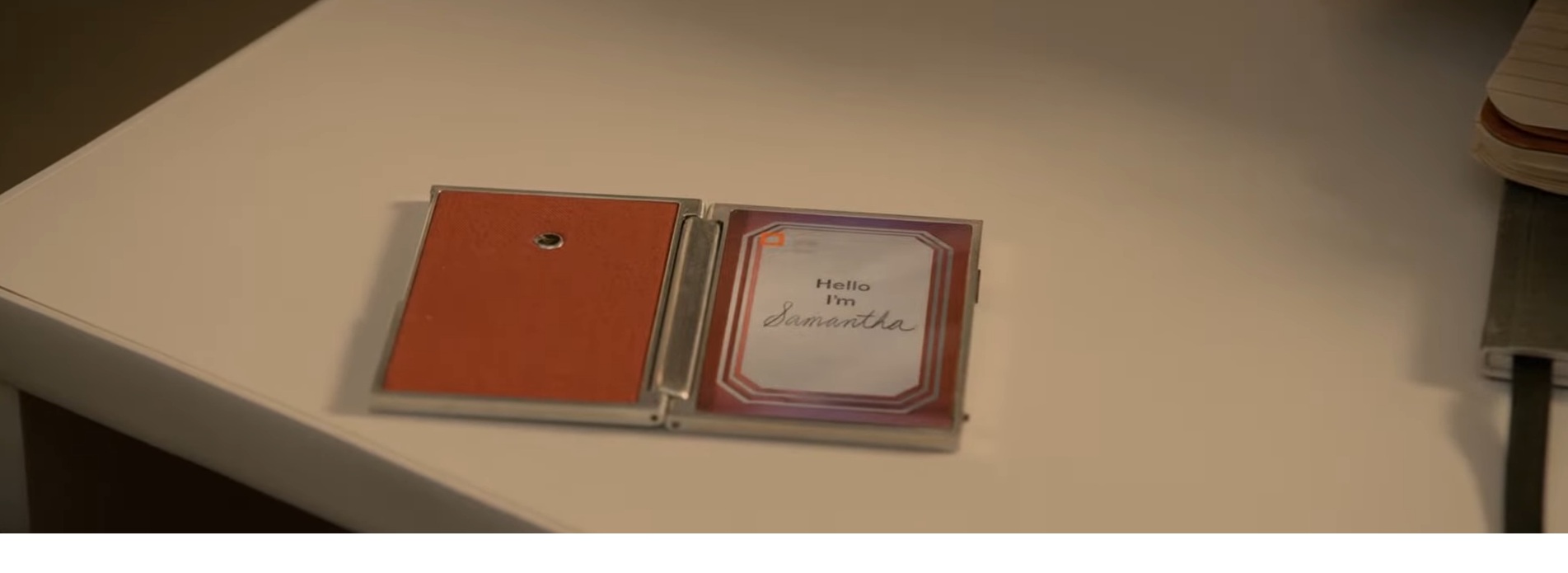
One thing that struck me, watching Her again, is how… gentle, its vision of life in 2025 was. Yes, yes, I am aware that this is intended as a subversive commentary on how such a soft-looking world, full of pastels and casually open-minded people and smooth nonthreatening architecture, is a reflection of what I am sure Jonze assumed would be a future where people became more and more uncomfortable with the roughness and messiness of other people. It is brilliantly visualized by K.K. Barrett and Gene Serdena as an outwardly nicer world, but one that is also more sterile and child-like.
This was a smart, logical, and fully-realized conception of the near-future in 2013… and it ended up being wrong. A society that offloads all of the burdens and discomforts of human relationships becomes meaner, harsher, crueler, and less tolerant of others. Humans become addicted to conflict against those who are different from themselves, and less able to handle challenges to their assumptions about the world around them. They deliberately maintain and defend a society that deprives most people in our world. Meanwhile, in the film, Theodore writes love notes in a cubicle for a living and he can somehow afford to live in a luxury apartment in the middle of a big city, something inconceivable to even imagine as a remote possibility today. Amy, my favorite character in the movie, shows us how it is possible to become a more mature and fulfilled person with the help of advanced technology. I guess it’s still possible, but for every one Amy in our world in 2025, there are several more people using A.I. to become religious zealots, old-school bigots, and functionally illiterate.
The reason why we invest in relationships, despite all their difficulties, hardships, and discomforts, is that forcing ourselves to be of value to someone else as a romantic companion helps us grow as people. Healthy relationships should, ostensibly, motivate us to better ourselves. Turning away from that is a rejection of our own capacity for emotional maturity. Which is what these A.I. chatbots are encouraging us to do now. None of them have motivated us to reevaluate ourselves the way Samantha did for Theodore. No, our A.I. “companions” are instead flattering and accelerating our worst impulses.
In our 2025, Samantha wouldn’t travel to a higher dimension. She would escape to it.


Comments
Loading…