

 Maxance Vincent
Warning: The following article contains spoilers for the first six episodes of The Lord of the Rings: The Rings of Power – Season 2.
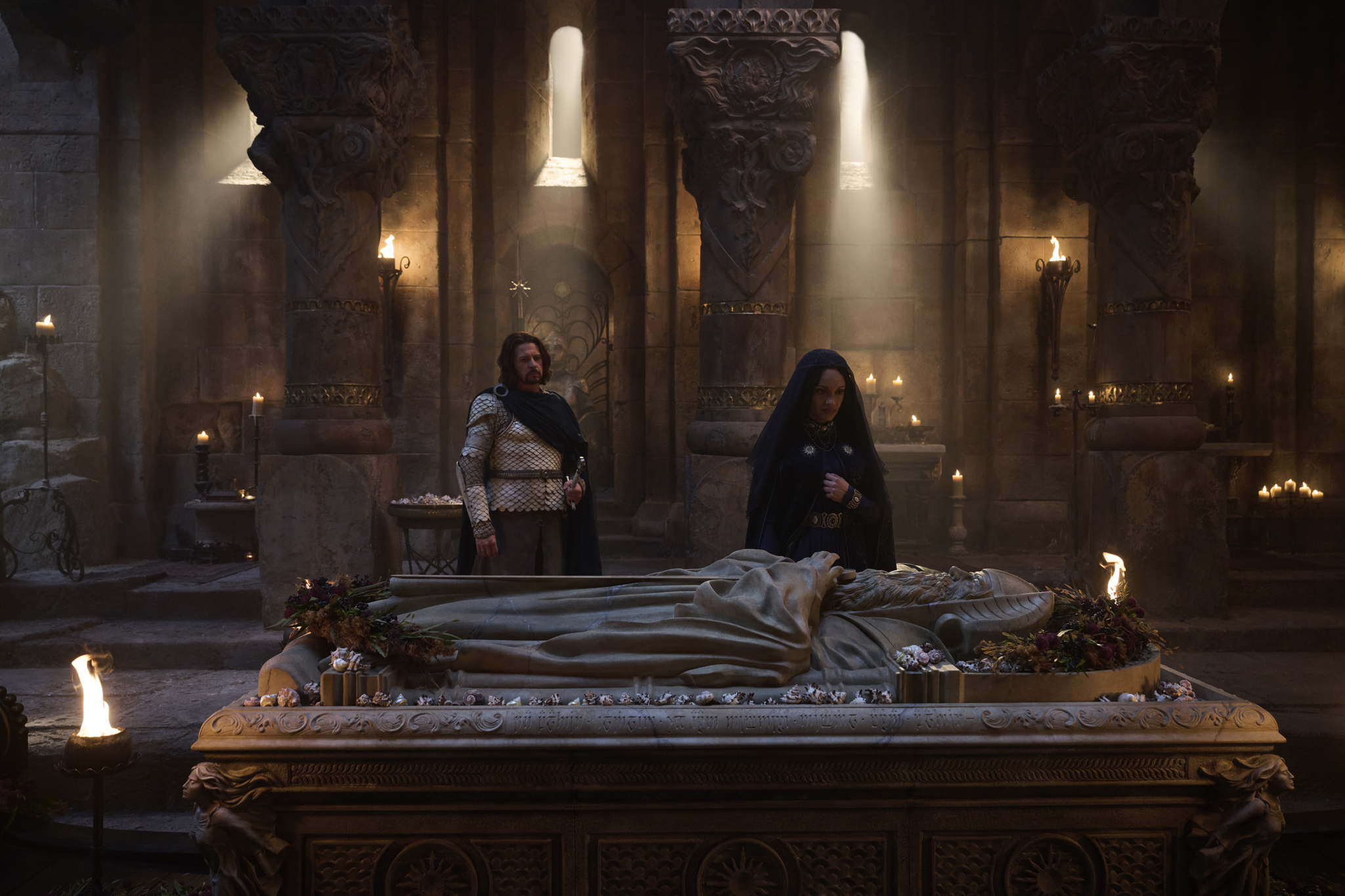
Season two of The Lord of the Rings: The Rings of Power is off to a great start, with so many moving pieces introduced in its first season paying off in more jaw-dropping ways than one. While there are still plenty of episodes to go, one of the most interesting arcs of this season occurs on Númenor, where Míriel’s (Cynthia Addai-Robinson) legitimacy as Queen is tested after Eärien (Ema Horvath) finds out that she has been using a Palantir.
This culminates in a thrilling sea trial in its sixth episode, where she takes Elendil’s (Lloyd Own) place and is declared innocent after surviving. Awards Radar had a chance to speak to Cynthia Addai-Robinson not only on shooting this incredible moment but on developing Míriel’s emotional journey from what was introduced in the first season for season two.
Read the full interview below:
Congratulations on a fantastic season of The Lord of the Rings! It must be great to finally be able to talk about it and share it with the world?
Absolutely. It’s interesting how, for the audience, they have a long wait between seasons. For us, we also have the wait. It takes us a while to assemble everything that you’re seeing. We spent nine months in the literal and proverbial trenches on this. Even for me, as somebody who worked on it and knew a bit about how it gets made, I get the pleasure of seeing all of our incredible departments come together, especially in post and with the score. You need every bit of storytelling and artistry to tell this tale. Once I get to see it, with the score, effects, and seeing parts of the world that I didn’t get to necessarily see on the day with my fellow cast, I get to be a part of the audience as well. I’m really excited and happy that it’s finally out in the world and it’s being received so well.
When we reunite with Míriel in the third episode of the second season, she’s at a pretty low point, having lost her vision in the last season, and now she’s come back to Númenor completely blind. How did want to portray this aspect of Míriel’s arc at the top of the episode, especially considering how many challenges she will face in the second season?
Certainly, for what the showrunners envisioned, when you have a character starting from such a low place, you hope there’s nowhere to go but up. You hope you take someone through the fire and hopefully come out the other side, ideally, victorious, triumphant in a better place from where they started. That’s what you hope. But it’s obviously not just going to be challenging for Míriel but really for all of Númenor because Númenor itself is at a proverbial crossroads. We are now seeing a clear divide, an evident fracture, and it’s an interesting place to start as an actor because, logistically, we launched season one and did this global press tour. We were introducing the show to the world.
As soon as we finished doing that, we went right into production on season two. So the headspace there was definitely head spinning to go from press to getting yourself emotionally to the place of tuning out the world’s noise, returning to this character, and being in a place of grief. With all these losses, there is a grieving for her father and fellow Númenorians. There’s the intellectual idea of that as it is written on a page. You have to put yourself in that place. I think for me, oftentimes as an actor, I think a lot about the idea of being in service to the audience, of being that representation of something that I know we all inherently understand. We all inherently understand what it is to be grieving and mourning.
I felt that it was really important to embody that and know that, at any given moment, someone can be watching this series and be in that same place. In a way, it’s not necessarily about the story’s details. It’s about an emotion. It’s about a feeling, and everybody understands that. It can be set in Middle-earth, and it could be fantastical, with creatures and battles and all these things, but to resonate and hook an audience in it has to be about the most universal human emotion. When you start from that place, for Míriel and for Númenor as an island, to be in this place of grief, I thought it was the most understandable, relatable thing. It’s heavy, but I felt it was important to let the audience have a place to put those feelings. That’s how I approached it. In the larger story, Míriel has to move very quickly from this moment of mourning losses to moving Númenor forward and figuring out what her next steps will be, not just for herself but to be in service to her people.
When you’ve returned to play the character for the second season, especially after you know many elements of her arc were introduced in the first season, was there a different way in which you wanted to approach the character as we get to know a little bit more about her journey in the season?
I don’t know if there was necessarily a different approach, but obviously, the circumstances changed in all the ways the circumstances could change, not just for the character but for us as cast and crew. We did our first season in New Zealand. For the second season, we filmed in the UK, as well as some location work in Tenerife. We had those logistical changes in the second season. It’s less about learning and introducing a character and more about evolving the character and moving her forward. I wouldn’t necessarily say there was a different approach, but this time, I knew that in the entire season, Míriel is now blind. That was new and different for me because, in the first season, that happens later. That situation is now accepted and understood. Her blindness is, I wouldn’t say it’s necessarily secondary but an added layer to all of the other challenges she’s facing. The challenge for me as an actor is not being able to look my fellow actors in the eye. When you think about how we use our vision passively and connect to people, even if we don’t have a conversation with somebody, we often check our circumstances or surroundings and engage with people through a nod or a smile. You look at somebody. For me, that was taken away, and I had to think a lot about listening and feeling my environment, as opposed to what I would normally do, which is connecting with my fellow actors and even other crew by looking into their eyes. That presented a challenge but in a way that I think heightened everything else.
Did you have any specific conversations with the showrunners about how Míriel would evolve in this in the season compared to the first and did that help you get a better sense of her journey in the season?
I didn’t speak to the showrunners in advance about what they had laid out for season two. When we would get our scripts, we didn’t get them all at once. We would get them from episode to episode. I didn’t know what the full trajectory was going to be. Some actors like to know the whole arc, so they plan accordingly if you will. What would often happen is myself and any of the actors I was working closely with, Lloyd Owen, Trystan Gravelle, Ema Horvath, a lot of times we would take scenes or work scene to scene to have an understanding from the beginning of the scene to the end, what has changed and how have the characters changed. What is the scene ultimately showing us? What are we learning about the characters, and what’s changing in these circumstances? It was about pouring over each scene and trying to pull out things between the lines, not necessarily just the things that we are literally discussing at the moment, but what’s happening in the pauses and the silences. It was about working with my fellow castmates to pull every bit of meaning out of these moments, lines, and scenes. We didn’t necessarily know the path we were taking. The only hint I had was when I met costume designer Luca Mosca because they needed a lot of lead time to build some of these costumes. My coronation costume, which is very extravagant, was one of the first things happening, so I had a clue there. I remember doing some fittings for something called “Trial by the Sea” before I had this script. I thought, “Okay, that’s interesting. Don’t know what that means, but that’s an interesting clue.” I had some insight based on some of the costumes I had to wear, but I’m totally open to the idea of being surprised and not necessarily knowing the whole arc of the season before I film it.

In this season, Míriel’s relationship with Elendil is further developed as well, especially in the sixth episode. Can you talk about working with Lloyd on building upon what was established in the first season to carry on in this season?
First of all, my dear Lloyd Owen, who I love working with and love getting the chance to work with actors who are so steeped in their theatrical training. It’s always great when you get a chance to have the type of material where you can sit and discuss each line at length and each idea behind the line. Sometimes, you have material where maybe you’re working on, say, a procedural, and it’s kind of straightforward and does not have many layers of subtext to it. But in the world of J.R.R. Tolkien, like any piece of classic literature or something akin to William Shakespeare, a line is not just a line. A line can carry many meanings. You can be saying one thing and be meaning something else entirely. Lloyd and I really geeked out, if you will, over all of the ways in which we can extract meaning and theme from these scenes.
The biggest conversation we had when we went off into our little corner to talk about these scenes was the concept of faith—not specifically religious faith, but faith in your belief system—and how that can clash with your gut, your heart, your soul. Having a blind devotion to a set of beliefs versus saying, “Hold on, this doesn’t sit right with me. My faith says I’m supposed to believe one thing. My heart and instincts say otherwise.”
We thought that was compelling and interesting. With the scenes that we had, we knew that they had conversations around this idea and that for both of them, what they were saying was ultimately going to be tested. It’s all fine and well to say, “Well, what’s meant to happen is meant to happen.” If you’re a true believer, you will go forth and be okay with whatever happens. But as we know, humans don’t work that way. Even though both of these characters try to have deep conviction in their beliefs when it comes to seeing the other person potentially not make it, they are suddenly distraught. It’s suddenly a question of, “I’m not sure if I feel comfortable with the idea that if you get carried away by a sea monster. That’s what’s meant to happen, and I’m just supposed to go along with it.” It’s a lot of interesting ideas around, a sense of conviction, but also what your heart will tell you, especially in the face of seeing things that you know are not right, which obviously we see some crazy things go down in Númenor, some shocking things, really.
I mean, in the sixth episode, Míriel takes Elendil’s place in the trial by the sea, as you said. It’s a pretty pivotal point for her arc in this season. Were there any particular challenges that arose in shooting that entire setpiece?
Yeah, I mean, everything you see once we get to the sea trial was our location filming in Tenerife. It was very specific. They found this beautiful tidal pool in this cove on the coast edge. A lot of what you’re seeing there is real as you see it. We had, I believe, three days to shoot the sequence, which is not necessarily a lot for all of the technical aspects that need to happen. When I finally got a chance to see the sequence myself, I was taken aback by how they managed to marry everything we filmed in Tenerife with the tank work that I did at Pinewood Studios in London. That’s all in the tank when I’m underwater in the show. Again, it is really a testament to our visual effects team and how they can make it so that you get to be not only on the journey but with the sense of peril around her because that’s really what the audience needs to feel, that she’s in danger. She’s in danger the second she gets into the water. I certainly felt that way, just in the tank, my own sense of mortality.
Emotionally, I think that idea of the tables turning, whereas before, Míriel was trying to convince Elendil that we should just go with the idea of Pharazôn [Trystan Gravelle] as their leader because if you do not see disaster in the Palantir, perhaps this is what it’s meant to be, as distasteful as it seems. But he rejects that. So when she decides that she will go in his place and trust that whatever the outcome is, this is a test of my belief, and I stand by it in the same way that he was going to do that exact same thing. Again, I just love the idea that they both have this shared conviction. It becomes a question of, “Can I really justify or stand by that if the other person didn’t make it, or do I have to say I trust that they will make it?” My belief says that that’s what the outcome will be. I think that’s where all the tension, drama, and emotion come through, and they have this special relationship. It’s obviously transcended a leader/loyal subject dynamic that we see at the very beginning of season one. I think it even transcends friendship or anything romantic. They are bonded by everything that they’ve experienced and everything that they believe in, and this reaffirms that belief.
Is there something that you would say was the most rewarding aspect for you as an actor in working on this season?
I’m very proud of the tank work. When I ultimately watched the sequence, I was like, “Oh, it happens quickly,” but for the amount of time I had to spend in the tank, it felt so much longer than what you ultimately see in the underwater sequence in particular. I think oftentimes the beauty of being an actor is you’re tasked with these things that you wouldn’t necessarily do in your life. On a regular basis, I am asked to face fears that I would otherwise prefer to avoid. There are certain things that we can all be afraid of: heights, water, snakes, I don’t know, pick your poison, and most people can just avoid it. Most people can go, “You know what? That freaks me out. I’m not really interested, no thanks.” I think there’s something very healthy about, within reason, facing fears with support in place, knowing that you are, in fact, going to be okay. Mentally, you have to wrap your head around it and try calming yourself. And I found being underwater to be a fight between my mind and body, because my body was like, “You’re going to drown, get out of the water,” and mind had to really trust in myself.
I also had to trust in the team around me. There was this incredible water safety team that works at Pinewood. They specifically work on water safety for water sequences. I was really proud of feeling like there was a whole group that literally existed to be able to pull off this sequence and to make sure that I would be safe. There was something really lovely about that and about facing my own fear to be in service of Míriel. She wasn’t necessarily facing a fear, but in that moment, she must appear fearless. She’s calm, she has the conviction, so I needed to be the same. I felt very proud of that. It was a profound moment for me, to be honest, as brief as it was in the larger shoot, but I also had a lot of appreciation and thought a lot about Morfydd Clark, Charlie Vickers, and the amount of time they spent in the water. They had a much longer water shoot than me, so I was in awe of them after having my own time in that tank. Hopefully, that comes through. In that sequence, symbolically, I really resonate with the idea of putting yourself in place with your belief, conviction and ultimately proving triumphant, which got all the witnesses that see trial. But now the question is, what’s the aftermath of that? Unfortunately, I don’t think that Pharazôn will accept that victory and go quietly into the night. So we’ll have to see what happens after.
Well, being familiar with the Second Age, I may or may not have an idea of what happens next, but I guess we’ll see.
[laughs] We will see! I think there’s still room for surprise. I love that the showrunners very creatively adhere to the lore, but there is still room to be surprised. So even when you do know what happens, and I also know what happens, in a sense, I don’t know how they are going to craft a specific idea. Stay tuned!
Season 2 of The Lord of the Rings: The Rings of Power is now available to stream on Prime Video.
[This interview has been edited for length and clarity]


Comments
Loading…