
 Joey Magidson
There are two very different films being made in Little Death. One is big and brash and not especially good, but also kind of fun in a dopey way. The other is sad, almost tender, and trying to make a very different point. Combining them into the same movie is a wild decision, one that the powers that be are not up to the task of pulling off. Few titles this year at the Sundance Film Festival were more ambitious, but many were seemingly more successful. At best, this is an interesting failure.
Little Death wants you to go all-in on its viscerally visual yet fairly shallow Hollywood story, but then it also wants you just as invested in a quieter tale of troubled teens dealing with a theft. That’s a big ask to make, to be sure, but it requires a soft touch. Unfortunately, that is something that this flick decidedly does not have. The final act is gentler than what’s come before, but it’s all just not in concert with each other.
Martin Solomon (David Schwimmer) is a middling television writer who hates the sitcom he’s on the staff of. He’s preparing to direct a passion project screenplay, with everything going right there. It’s the one thing he’s got, as he’s unhappy with his fiancée Jessica (Jena Malone), takes a pill for everything, and constantly is on edge. Then, the financing for the flick is contingent on him changing the gender of his protagonist. He’s flummoxed and pissed, thinking his movie is ruined. In fact, he even imagines himself with his gender flipped (Gaby Hoffman stands in), just to hammer the point home. Then, he sees the woman (Angela Sarafyan) he’s been dreaming of in his dreams while out on the street, stimulating him to consider some new ideas.
Abruptly, the narrative switches to the story of AJ (Dominic Fike) and Karla (Talia Ryder), two more traditional addicts along for the ride during a robbery. When things go sideways, her car is stolen, as is his backpack which contains some very important items. Along with a dog taken in the theft that Karla essentially adopts, the pair have a wild night that includes a party, a dangerous drug dealer, and some hard truths.
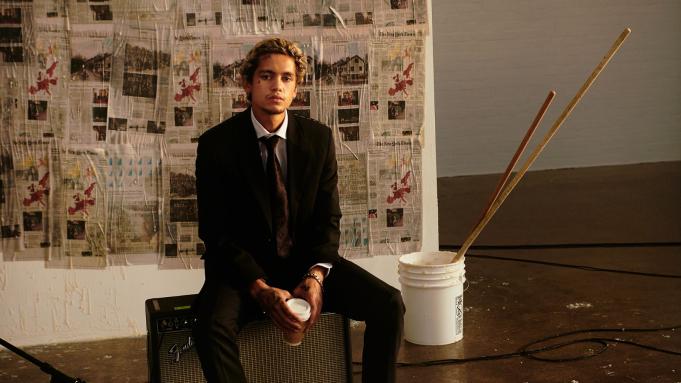
There are nice performances here, especially in the back half. Dominic Fike and Talia Ryder are operating in a very different pitch than everyone else. Ryder especially is quite good, as she also was back in Never Rarely Sometimes Always. David Schwimmer is fine but the script just makes him so unlikable. The rest of the lot have so little to do that they barely register, while other supporting players include Travis Bennett, Sante Bentivoglio, Ben Feldman, Karl Glusman, Seth Green, and Fred Melamed.
Director/co-writer Jack Begert is really trying to make a calling card film here. He directs the hell out of it, especially in the first half, almost like a Darren Aronofsky on acid (Aronofsky himself produced, so this isn’t exactly accidental). However, the script he co-wrote with Dani Goffstein doesn’t necessarily call for all that style. Then, there’s the decision to switch gears a little more than halfway through in such a jarring way that I can’t imagine anyone will be satisfied with it. Begert had two very different ideas, either of which potentially could have been a feature, but both of which needing more meat on their bones. By combining them and going for a flimsy point/unifying theme, it shortchanges both ideas.
Little Death needed to pick a lane. I think either idea from Begert could have been an interesting, if thin, calling card. Having them together makes it in some ways even more of a calling card, in that this storyteller is really up to a lot, but an even less successful manner. We’ll see what comes of him going forward, but this is more of a middling Sundance title than I was hoping for.
SCORE: ★★1/2


Comments
Loading…